5 Steps Homebuyers Should Use to Compare APR and Interest Rate
2026-09-03
The interest rate is what a lender charges you to borrow the principal, full stop. APR takes that rate and adds the required lender fees, then expresses the whole cost as one annual percentage. Use APR when you’re comparing total loan cost across lenders with matching terms. Use the interest rate when your real question is “what’s my monthly payment?” The one big exception: on credit cards, APR and interest rate are almost always the same number.
TL;DR:
- APR includes lender fees like origination costs and points, making it more comprehensive than the interest rate for full loan cost comparison over the full term.
- Fees such as discount points and closing costs can significantly raise the APR, especially if the loan is held long enough for those costs to pay off.
- For short-term mortgages or plans to refinance, the interest rate and break-even analysis on points are more relevant than the APR.
- Credit card APR and interest rate usually match because upfront fees aren’t typically folded into the APR calculation.
- Comparing multiple offers requires matching loan terms and fee structures, requesting full disclosures, and calculating break-even points for discount points to avoid overpaying.
Table of Contents
- What an Interest Rate Actually Covers
- What APR Is and Which Fees It Bundles In
- How Fees Turn a Low Rate Into a Higher APR
- Mortgages, ARMs, and Credit Cards Need Different Rules
- A Short Checklist for Comparing Two Loan Offers
- Where Fiatmap Fits Into This Comparison
- The Real Lesson Buried in APR Math
- Compare Real Mortgage Costs With Fiatmap’s Free Tools
- Sources
What an Interest Rate Actually Covers
Your interest rate is the percentage a lender charges on the money you borrow, and it’s the number that determines your monthly principal and interest payment. Lenders build amortization schedules straight off this figure, so a small difference in rate compounds into real money over a 15 or 30-year mortgage.
Rates come in two flavors:
- Fixed rates stay locked for the life of the loan, so your payment never moves.
- Variable rates adjust on a schedule tied to an index, which means your payment can rise or fall.
Central bank policy pushes rates up or down across the whole economy, which is why mortgage rates swing when the Federal Reserve changes its benchmark. If you only plan to hold a loan for a couple of years, the interest rate, not the APR, tends to be the more relevant number, since you’ll refinance or sell before fees fully play out.
What APR Is and Which Fees It Bundles In
APR takes your interest rate and layers on the mandatory fees a lender requires to originate the loan, then spreads that cost across the term as a single annualized percentage. That’s why APR almost always lands higher than the stated interest rate on a mortgage or personal loan.
Typical costs folded into APR include:
- Origination fees
- Discount points
- Certain closing costs
- Mortgage insurance premiums, where required
Regulators require this disclosure. The Truth in Lending Act) obligates lenders to disclose APR under Regulation Z, and mortgage lenders must provide that disclosure within three days of your application. That timing matters: you get the real number early enough to shop around before committing.
One exception worth flagging now: on credit cards, APR and interest rate usually match, because card issuers typically don’t fold upfront fees into the calculation the way mortgage lenders do.
How Fees Turn a Low Rate Into a Higher APR
The math behind APR isn’t complicated once you see it worked out. A lender takes any upfront fee, spreads its cost across the loan term, and folds that annualized slice on top of the interest rate.
Here’s a simple version:
- Start with a $10,000 loan at a 6% interest rate over five-year.
- Add a 5% origination fee, or $500, deducted before you receive the funds.
- Spread that $500 across the five-year term and annualize it.
- The resulting APR lands meaningfully above 6%, even though the interest rate itself never changed.
Pro Tip: Always ask whether the fee is deducted from your loan proceeds or paid separately at closing. A financed fee changes how much cash actually lands in your account, even when the APR calculation treats it the same way.
The catch: APR assumes you hold the loan for the full term at a fixed schedule. It doesn’t account for future rate adjustments on a variable loan, and it can vary depending on how a lender treats compounding frequency.
Mortgages, ARMs, and Credit Cards Need Different Rules
Which number matters more depends entirely on the loan type and how long you plan to keep it.
- If you’re keeping a mortgage for the full term, APR gives you the cleaner apples-to-apples comparison, since it captures the fees that a bare interest rate hides.
- If you expect to refinance or sell within a few years, upfront costs hit differently. Calculate the break-even point on any discount points by dividing their cost by your monthly savings.
- Adjustable rate mortgages complicate APR further, since it can’t forecast where the index lands after the initial fixed period ends.
- Credit cards are the simple case: APR and interest rate are effectively interchangeable there.
| Loan type | Prioritize | Why |
|---|---|---|
| Fixed mortgage, long hold | APR | Captures fees over full term |
| Mortgage, short hold or planned refinance | Interest rate + break-even math | Fees may not pay off before you move on |
| ARM | Both, cautiously | APR can’t predict future rate resets |
| Credit card | Either | The two numbers usually match |
Fiatmap’s mortgage rate glossary entry walks through how lenders set these rates if you want the mechanics behind the number.
A Short Checklist for Comparing Two Loan Offers
Before you sign anything, run through this:
- Confirm both offers cover the same loan term and rate type. Comparing a 30-year fixed APR against a 5-year ARM APR tells you nothing useful.
- Ask each lender whether fees are financed into the loan or paid upfront, since that changes your actual cash outlay.
- Request the Truth in Lending disclosure and a full amortization schedule from every lender you’re considering.
- If either offer includes discount points, calculate the break-even month and compare it against how long you plan to keep the loan.
- Check the compounding frequency on both offers. Two loans with identical APRs can still cost different amounts if one compounds more often.
Where Fiatmap Fits Into This Comparison
Once you know which number to prioritize, the harder part is finding reliable rate data to compare against. Fiatmap’s mortgage rate glossary explains the concept in plain terms, and the mortgage rates ranking shows how borrowing costs stack up across 128 countries using official statistics rather than lender marketing copy.
If you’re weighing a move abroad or just curious how your rate compares internationally, the country mortgage rankings put that context in front of you fast, backed by sourced data rather than guesswork.
The Real Lesson Buried in APR Math
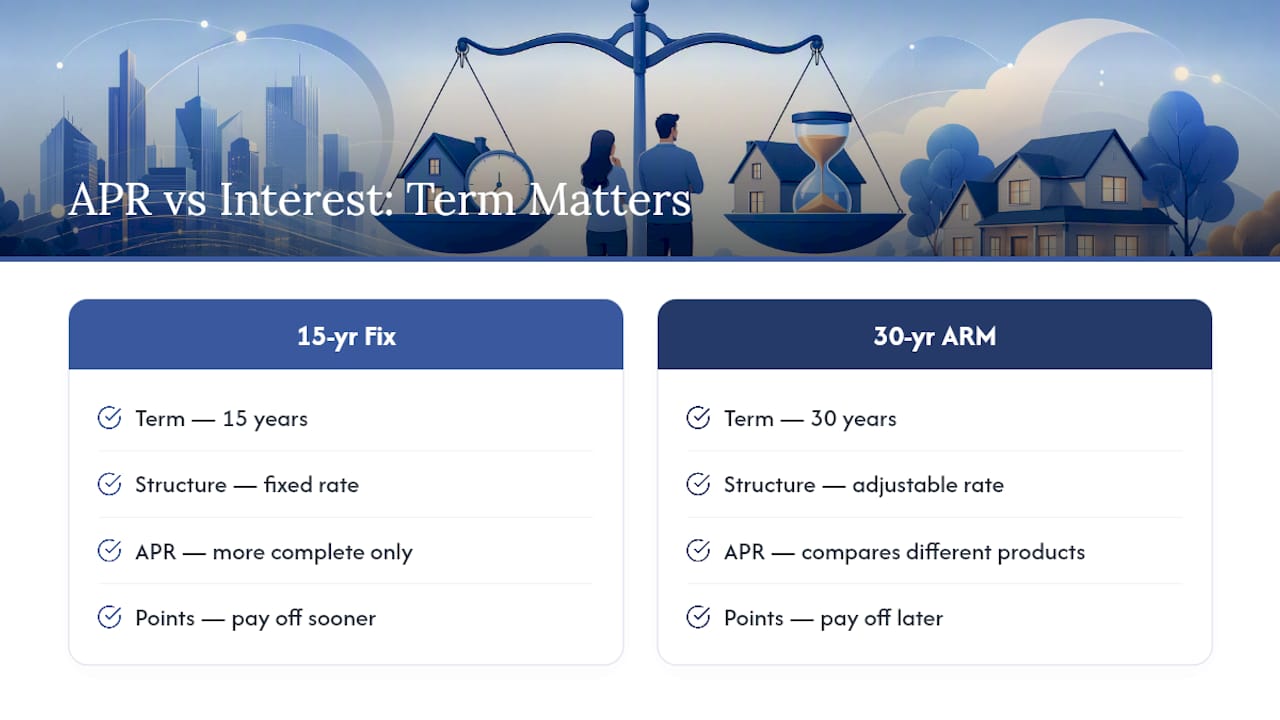
Most advice on this topic stops at “APR is more accurate, always use it.” That’s lazy. APR is more complete, not more accurate, and completeness only helps when the loans you’re comparing actually share the same term and structure. Compare a 15-year fixed APR against a 30 year ARM APR and you’ve compared two different products wearing the same label.
The bigger blind spot is the break-even calculation on points. Borrowers fixate on the lowest advertised rate and skip the arithmetic on whether they’ll actually hold the loan long enough for a point-buydown to pay off. A loan you refinance in three years makes upfront fees far more expensive per year than the APR implies, because APR assumes you ride out the entire term.
Prioritize this order: figure out your realistic holding period first, then pick APR or the interest rate based on that answer, then run the break-even math on any points. Skipping straight to “just compare APRs” is how borrowers overpay for a low headline rate loaded with fees they’ll never earn back.
— Torstein
Compare Real Mortgage Costs With Fiatmap’s Free Tools
Once you understand the difference between APR and the interest rate, the next question is how your offer stacks up against actual market data instead of a single lender’s pitch. Mortgage rates are pulled from official statistics across many countries, so you’re comparing your quote against real benchmarks rather than a sales script.
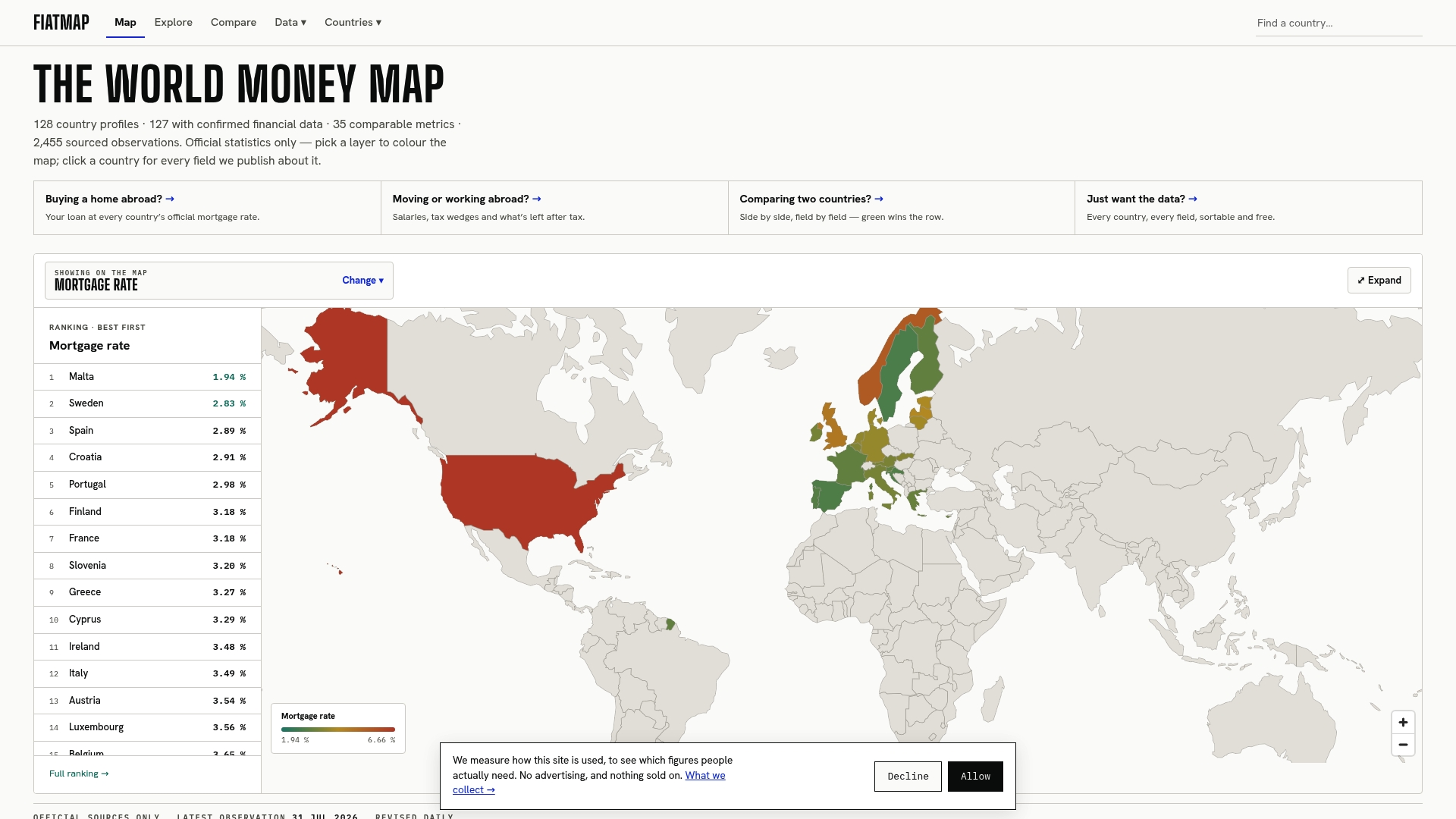
Run your numbers through the mortgage calculator abroad to test how different fee and points scenarios shift your total cost, or check the mortgage rates ranking to see where your offer sits against national averages. Every dataset is downloadable in CSV or JSON if you want to build your own comparison model. Start with the free Fiatmap dataset and see what your loan actually looks like next to the rest of the market.
This article is general information, not a substitute for advice from a qualified financial advisor. Consult a qualified financial professional about your own circumstances before acting on anything here.
Sources
- What is the difference between a loan interest rate and the APR? | Consumer Financial Protection Bureau
- APR vs. interest rate: What’s the difference? | Fidelity
Recommended
The figures on this site are collected from official statistics and each carries its own source and date — see /sources and the dataset. Where this article states a number, the country and ranking pages are what it should agree with.