Practice Balance of Payments with Data from 128 Countries for Students
2026-09-04
The balance of payments is the official record of every economic transaction between a country’s residents and the rest of the world over a set period. Its core logic is an accounting identity: the current account plus the capital and financial account equals zero, once you account for a statistical discrepancy. A country running a current account deficit is, by definition, a net borrower from the rest of the world; a surplus makes it a net lender.
TL;DR:
- A current account deficit indicates a country is a net borrower from the rest of the world, financed mainly through foreign investment or borrowing.
- The financial account includes foreign direct investment, portfolio investment, and reserve assets, which are the main sources to finance persistent current account deficits.
- Data discrepancies, informal trade, and valuation issues cause the balance of payments to rarely sum to zero, with statistical discrepancies accounting for the gaps.
- Countries with high savings and export-oriented policies tend to run surpluses, while those relying on borrowing and consumption usually have deficits.
- The accuracy of BOP data is limited by challenges in tracking digital, informal, and transfer pricing activities, making estimates approximate rather than precise.
Table of Contents
- Balance of Payments Explained: The Three-Account Structure
- What Are the Components of the Current Account?
- How Do Capital and Financial Accounts Finance the Current Account?
- Why Doesn’t the Balance of Payments Actually Sum to Zero?
- What Does a Current Account Surplus or Deficit Actually Mean?
- Try It Yourself: Reading Real BOP Data
- How Did the Balance of Payments Framework Develop?
- Why Does the Balance of Payments Matter for Economic Policy?
- How Does the Balance of Payments Connect to Exchange Rates?
- What Causes Persistent Balance of Payments Imbalances?
- What Limits the Accuracy of Balance of Payments Data?
- A Teaching Note on Studying the Balance of Payments
- Where to Learn More About the Balance of Payments
- Sources
Balance of Payments Explained: The Three-Account Structure
Every cross-border transaction lands in one of three buckets, and the whole system is designed so those buckets offset each other. Understanding balance of payments starts with knowing what belongs where.
- Current account: trade in goods and services, primary income (like investment returns), and secondary income (like remittances).
- Capital account: capital transfers and the sale or purchase of non-produced, non-financial assets (patents, land rights sold to a foreign buyer).
- Financial account: cross-border ownership changes in assets: direct investment, portfolio investment, other investment, and reserve assets.
The current and capital account balances together determine whether a country is a net lender or borrower internationally. Here’s a simplified example: imagine a country exports significantly more in goods and services than it imports, leaving a current account deficit that must be financed somehow, so the financial account shows a net inflow, perhaps foreign investors buying government bonds or a foreign company opening a factory. The two numbers cancel out. That’s the identity working exactly as designed.
What Are the Components of the Current Account?
The current account is usually the headline number, and it breaks into three distinct pieces that often get confused on exams.
- Trade balance (goods and services): Exports of cars, wheat, or software minus imports of oil, electronics, or consulting services. Tourism counts here too. A German visiting Thailand and paying for a hotel room generates a services import for Germany and a services export for Thailand.
- Primary income: Returns on cross-border investment, wages earned by nonresident workers, and dividends paid to foreign shareholders. If a French pension fund holds American stocks, the dividends it receives are American primary income outflows.
- Secondary income: Money that moves without a matching good, service, or asset changing hands, mainly worker remittances and foreign aid.
A quick worked example: suppose a country posts a trade surplus, primary income indicating it pays out more investment income than it receives, and secondary income from workers abroad sending money home. Add those together to get a current account balance that reflects the combined effect of these components. That $30 billion has to show up somewhere else in the accounts, and it does, as a net outflow in the capital and financial account.
How Do Capital and Financial Accounts Finance the Current Account?
The capital account is the smaller, less discussed cousin here. It captures capital transfers, things like debt forgiveness between governments, and transactions in non-produced, non-financial assets such as trademarks or licenses sold across borders. Most of the heavy lifting happens in the financial account.
The financial account breaks into four categories:
- Foreign direct investment (FDI): A company buying or building a lasting stake in a foreign business, like a factory or a controlling equity share.
- Portfolio investment: Cross-border purchases of stocks and bonds that don’t come with management control.
- Other investment: Bank loans, trade credit, and currency deposits held across borders.
- Reserve assets: Foreign currency, gold, and other reserves held by a central bank.
When a country runs a current account deficit, it has to pay for those extra imports somehow. That happens through the financial account, either by selling assets to foreigners, borrowing from abroad, or drawing down reserves. A current account deficit simply means the country is importing more than it exports and financing the gap with capital from elsewhere. One tricky wrinkle worth flagging: a single decision can touch multiple accounts at different times. Buying a foreign bond shows up in the financial account the moment the purchase happens, but the coupon payments that bond generates later land in the current account as primary income.
Why Doesn’t the Balance of Payments Actually Sum to Zero?
The whole system runs on double-entry bookkeeping, the same logic used in corporate accounting. Every transaction gets recorded twice, once as a credit and once as a debit, so the books should balance perfectly in theory. In practice, they almost never do.
- Different data sources report the same transaction at different values or times.
- Small transactions, especially in cash or informal trade, get missed entirely.
- Currency conversions and timing mismatches between exporting and importing countries introduce rounding errors.
Statistical agencies plug this gap with a line called net errors and omissions, sometimes labeled the statistical discrepancy. It’s not a sign of fraud or bad math. It’s an admission that measuring every dollar, euro, and yen crossing every border in a given quarter is genuinely hard.
Pro Tip: *If you see “net errors and omissions” on a country’s BOP table, don’t ignore it, read it as a signal of how reliable that country’s underlying data collection is.
Most central banks and statistical offices publish BOP data on a quarterly and annual basis, which gives analysts a fairly current read on capital flows without waiting a full year for revisions.
What Does a Current Account Surplus or Deficit Actually Mean?
A surplus makes a country a net lender to the rest of the world; a deficit makes it a net borrower. Neither is automatically good or bad, but the label tells you where money is flowing.
- Net lender (surplus): the country exports more than it imports and is accumulating foreign assets or paying down foreign liabilities.
- Net borrower (deficit): the country imports more than it exports and covers the difference through inflows recorded in the financial account.
The financing side is where the real story lives. A deficit funded by foreign direct investment building new factories looks very different from one funded by short-term borrowing to pay for consumer goods. The first tends to expand future productive capacity; the second can leave a country exposed if lenders get nervous and pull out. Economists watching a country’s external position pay close attention to what’s financing the gap, not just the size of the gap itself.
Pro Tip: When comparing two countries with similar deficit sizes, check the composition of the financing side. A deficit backed mostly by FDI is generally more stable than one backed mostly by short-term portfolio inflows, which can reverse quickly during a crisis.
Try It Yourself: Reading Real BOP Data
Fiatmap’s Global Money Dataset pulls current account and reserve data from official statistics across 128 countries, which makes it a solid place to practice reading these numbers firsthand rather than just memorizing definitions.
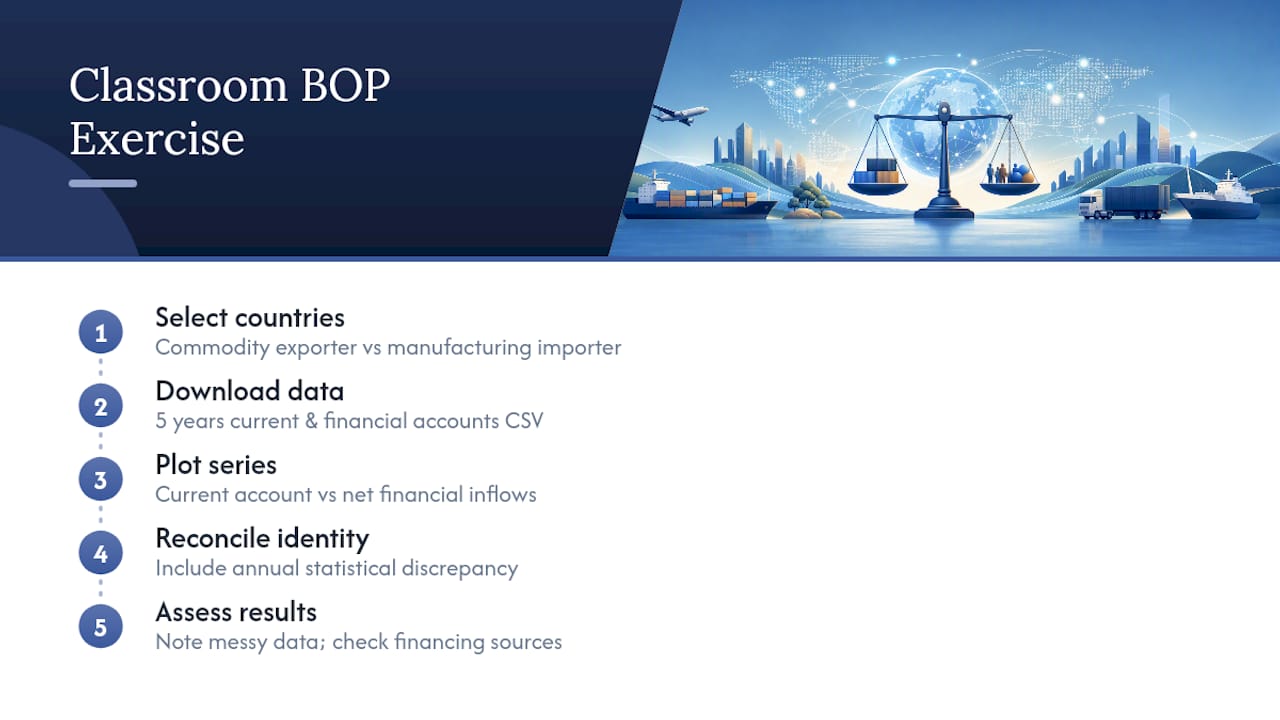
A simple classroom exercise: pick two countries with contrasting profiles, say one commodity exporter and one manufacturing importer. Download five years of current account and financial account data as CSV. Plot the current account balance against net financial inflows for each year and check whether the identity roughly holds once you account for the statistical discrepancy. You’ll notice real-world data is messier than textbook examples, and that’s the point. It builds the habit of checking financing sources rather than just headline deficit numbers.
How Did the Balance of Payments Framework Develop?
The modern BOP framework grew out of the Bretton Woods era, when countries needed a standardized way to track currency flows under fixed exchange rate agreements. Before that, nations kept ad hoc trade ledgers with little consistency between them, which made comparing one country’s external position to another’s close to meaningless.
The International Monetary Fund formalized the system with its Balance of Payments Manual, now in its sixth edition, known as BPM6. This manual sets the classification rules that statistical agencies worldwide now follow, which is why a current account deficit in Brazil and a current account deficit in Japan mean the same thing on paper and can be compared directly.
The framework has been revised repeatedly, most significantly after the collapse of Bretton Woods in the early 1970s, when floating exchange rates changed how reserve assets and financial flows needed to be tracked. Globalization in the 1990s and 2000s forced another round of updates, since portfolio investment and short-term capital flows exploded in volume and needed finer categories than the original postwar framework allowed. What started as a simple trade ledger is now a detailed system tracking everything from cryptocurrency-adjacent transactions to complex derivative positions, and the IMF continues to update its guidance as financial instruments evolve.
Why Does the Balance of Payments Matter for Economic Policy?
Governments and central banks treat the BOP as one of the core dashboards for judging economic health, right alongside GDP and inflation. It tells policymakers whether the country is living within its means internationally or piling up external debt that eventually needs repaying.
A persistent, large current account deficit can signal that a country is consuming more than it produces, a pattern that historically precedes currency crises when foreign lenders lose confidence and pull their capital out fast. The Reserve Bank of Australia treats the balance of payments as a central indicator precisely because it captures whether an open economy is a net lender or borrower to the rest of the world, which shapes everything from interest rate decisions to currency intervention.
On the flip side, a large and persistent surplus isn’t automatically a triumph either. It can mean a country is under-consuming relative to its productive capacity, or that its currency is undervalued in ways that create friction with trading partners. Policymakers watching a swelling reserve account sometimes face pressure to let the currency appreciate rather than keep accumulating foreign assets indefinitely.
Central banks also use BOP data to calibrate foreign exchange reserves, decide when to intervene in currency markets, and assess whether a country’s external debt load is sustainable. A country with mounting external liabilities and shrinking reserves is in a fundamentally different policy position than one with the opposite profile, even if their GDP growth rates look identical on paper.
How Does the Balance of Payments Connect to Exchange Rates?
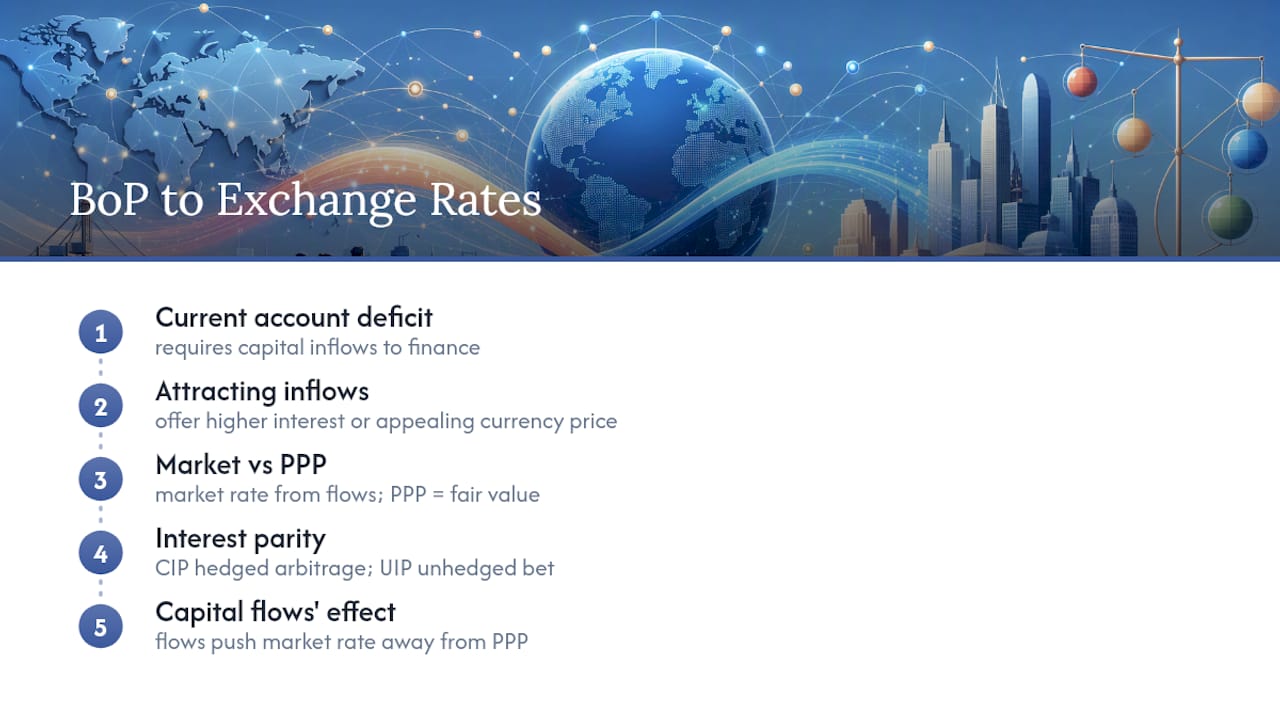
The two are tied together through the financial account, and the relationship runs in both directions. A country running a current account deficit needs capital inflows to finance it, and those inflows typically require offering investors an attractive return, which often means higher interest rates or a currency priced to make purchases of local assets appealing.
This is where the difference between market exchange rate and purchasing power parity becomes relevant. The market exchange rate reflects what currencies are actually trading for based on capital flows, trade balances, and speculation. Purchasing power parity, or PPP, estimates what the exchange rate would need to be for identical goods to cost the same in both countries. The gap between PPP and the market rate often widens when a country runs persistent current account imbalances, since capital flows can push a currency away from its “fair value” for extended periods.
Interest rate differentials matter here too. The distinction between covered and uncovered interest parity, often shortened to CIP versus UIP, explains why investors move capital across borders even when currency risk is involved. Under covered interest parity, investors hedge the currency risk using forward contracts, and arbitrage keeps returns roughly equal across countries after accounting for the hedge. Uncovered interest parity assumes no hedge, so investors are betting that exchange rate movements won’t wipe out the interest rate advantage. When UIP breaks down, and it frequently does in the short run, capital tends to chase whichever country offers the better unhedged return, which shows up directly in that country’s financial account.
What Causes Persistent Balance of Payments Imbalances?
Chronic surpluses and deficits rarely happen by accident. They usually trace back to structural features of an economy rather than short-term shocks.
Countries with high domestic savings rates and export-oriented industrial policy, historically Germany, Japan, and more recently several East Asian economies, tend to run persistent surpluses. Their populations save more than they invest domestically, and the excess gets channeled abroad through the financial account, buying foreign bonds, building factories overseas, or accumulating reserves.
Persistent deficit countries often share the opposite traits: high consumption relative to income, reliance on foreign capital to fund government or corporate borrowing, and sometimes currencies that serve as global reserve assets, which paradoxically makes running deficits easier since foreign demand for that currency stays strong regardless of the trade picture. The United States is the clearest example of this last pattern, running current account deficits for decades while the dollar’s reserve status keeps foreign appetite for American assets high.
The implications of letting an imbalance run for years without adjustment vary by case. A surplus country can face pressure from trading partners over currency manipulation accusations or slower domestic consumption growth. A deficit country risks a sudden stop, a term economists use for when foreign capital inflows abruptly reverse, often triggering a currency crisis, as happened across several countries during the Asian financial crisis in the late 1990s. Persistent imbalances aren’t inherently dangerous, but they do concentrate risk that eventually has to unwind somehow.
What Limits the Accuracy of Balance of Payments Data?
Collecting accurate BOP data across an entire economy is a genuinely difficult statistical problem, and several structural issues make it harder every year. Cross-border e-commerce and digital services have exploded in volume, but they’re notoriously hard to track through traditional customs and banking channels, since a subscription payment to a foreign software company doesn’t generate the same paper trail as a container ship full of goods.
Informal and undocumented labor flows create another blind spot, particularly for remittance data. Money sent home through informal channels, cash carried across borders by hand, or unregulated transfer services, never shows up in official secondary income figures, which means remittance-dependent economies often have less reliable current account numbers than their trade-dependent counterparts.
Valuation methods introduce further uncertainty, especially for portfolio investment and reserve assets, since market prices fluctuate constantly and different agencies may use different reporting dates within the same quarter. Multinational companies complicate things even further: profit shifting and transfer pricing between subsidiaries can distort primary income figures in ways that don’t reflect genuine economic activity, making the reported current account balance somewhat divorced from real trade and investment patterns in a handful of countries with heavy multinational presence.
A Teaching Note on Studying the Balance of Payments
If there’s one thing worth memorizing cold for an exam, it’s this: accounts, identity, financing, discrepancy. Know the three accounts, know that they sum to zero in theory, know how deficits get financed, and know why real data never balances perfectly.
For essay answers, always write out the identity first, then walk through one numeric example, then explain the financing mechanism in a sentence or two. That structure covers what graders actually look for.
Beyond the textbook, practice with real country data. Numbers from an actual government debt ranking or current account dataset teach you more about how these concepts behave in practice than another page of definitions ever will.
— Torstein
Where to Learn More About the Balance of Payments
- IMF’s BPM6 manual: the official international classification standard.
- Eurostat’s beginner guide: plain definitions of each account.
- St. Louis Fed explainer: the double-entry logic in accessible terms.
- RBA explainer: policy relevance and financing mechanics.
- ECB Data Portal: official account methodology and datasets.
Sources
- What Is the Balance of Payments? — Federal Reserve Bank of St. Louis
- Beginners: Balance of payments — Eurostat
- The balance of payments — Reserve Bank of Australia
- What Is the Balance of Payments (BOP)? — Investopedia
Recommended
The figures on this site are collected from official statistics and each carries its own source and date — see /sources and the dataset. Where this article states a number, the country and ranking pages are what it should agree with.