0–20% + 3.8% NIIT: Estimate 2026 Capital Gains on U.S. Property
2026-10-07

Selling a property usually triggers capital gains tax on the profit, calculated as the amount realized minus your adjusted basis. The two rules that matter most to check immediately are the Section 121 home-sale exclusion of up to $250,000 ($500,000 if married filing jointly), and depreciation recapture on any rental or business use, which can create taxable income even when part of your gain is excludable. Gains on property held more than one year get long-term rates of 0%, 15%, or 20%, plus a possible 3.8% surtax; a year or less and you pay ordinary income rates instead.
TL;DR:
- Section 121 excludes up to $250,000 for single filers or $500,000 for joint filers, but requires 24 months of ownership and residence within five years.
- Depreciation claimed or claimable after May 6, 1997, stays taxable despite the home sale exclusion; mixed use requires separate allocation of rental and residential gain.
- Gains on property held over one year qualify for 0%, 15%, or 20% long term rates; higher income sellers may also owe the 3.8% Net Investment Income Tax.
- A 1031 exchange applies only to investment real estate; identify replacement property within 45 days of closing and complete the purchase within 180 days.
- Inherited property generally receives a basis equal to its fair market value at death; an appraisal or estate record can support that value when you sell.
Table of Contents
- How to calculate your taxable capital gain on property
- Primary residence exclusion: eligibility and how rental use affects it
- Capital gains tax rates for 2026 and the Net Investment Income Tax
- Special rules for rental and business property
- Ways to reduce or defer capital gains tax on property
- Reporting the sale: forms, schedules, and timing
- Worked example and quick worksheet walkthrough
- Impact of state and local capital gains taxes on property
- Treatment of capital gains tax for inherited property basis and step-up rules
- Special considerations for non-resident aliens owning U.S. property
- Capital gains implications of mixed-use property sales
- A note on getting ready before you list
- Fiatmap: planning net proceeds and timing around your sale
- FAQ
- Sources
How to calculate your taxable capital gain on property
The math starts with two numbers: amount realized and adjusted basis. Amount realized is your sale price minus selling costs like agent commissions, transfer taxes, and title fees. Adjusted basis is what you paid for the property, plus the cost of capital improvements and certain closing costs from the purchase, minus any depreciation you claimed or could have claimed on rental or business use.
- Find your amount realized: sale price minus selling expenses.
- Find your adjusted basis: original purchase price plus capital improvements and eligible closing costs, minus depreciation taken.
- Subtract adjusted basis from amount realized to get your total gain.
- Apply any available exclusion (Section 121) or deferral (like a 1031 exchange) to find your taxable gain.
Before you start, gather your closing disclosure from the purchase and the sale, receipts for every capital improvement (a new roof counts, a paint job usually does not), any depreciation schedules from past tax returns if the property was ever rented, and Form 1099-S if the closing agent issued one. Publication 523 includes worksheets that walk through this exact sequence for a primary home.
Primary residence exclusion: eligibility and how rental use affects it
Section 121 lets you exclude up to $250,000 of gain if you are single, or $500,000 if you are married filing jointly, as long as you meet the ownership and use tests. You need to have owned and lived in the home as your main residence for a total of about 2 years during the 5 years ending on the sale date, and those 24 months do not need to be continuous.
- The $250,000 single exclusion and $500,000 joint exclusion require passing the ownership and use test within that 5-year lookback.
- A partial exclusion may apply if you sell early because of a job change, a health issue, or another unforeseen circumstance.
- You generally cannot claim the exclusion again if you used it on another home sale within the past 2 years.
- Depreciation claimed on the home for rental or business use after May 6, 1997, cannot be excluded and gets taxed separately as recapture, even on an otherwise qualifying sale.
Publication 523 covers the allocation math when a home served both as your residence and as a rental, which matters more than most sellers expect.
Capital gains tax rates for 2026 and the Net Investment Income Tax
For tax year 2026, long-term capital gains (property held more than one year) fall into three brackets based on your taxable income.
- 0% rate applies to lower-income filers, generally those with taxable income near or below the lower thresholds set for 2026.
- 15% rate covers the broad middle range of taxable income and catches most sellers with moderate profit.
- 20% rate applies once taxable income crosses the top threshold for the year.
- Short-term gains, from property held one year or less, are taxed as ordinary income, with a top marginal rate of 37% for high earners in 2026.
The 3.8% Net Investment Income Tax can apply on top of these rates when your modified adjusted gross income exceeds set thresholds, adding a real cost for higher-income sellers with large gains. Exact dollar thresholds for each bracket and for NIIT are published annually; the IRS 2026 inflation adjustments announcement has the precise figures for returns filed in 2027.
Special rules for rental and business property
Depreciation is both a tax benefit while you own a rental and a liability when you sell it. Every year you claim depreciation, your adjusted basis drops, which increases your taxable gain at sale. The portion of gain attributable to depreciation gets taxed through recapture rules under sections 1250 and 1245, reported on Form 4797 rather than the standard capital gains forms.
- Depreciation lowers your adjusted basis, which raises your taxable gain dollar for dollar.
- Recapture on real property is generally taxed as ordinary income up to a capped rate, separate from your regular long-term capital gains rate.
- The IRS applies “allowed or allowable” depreciation, meaning you owe recapture on depreciation you were entitled to take even if you never claimed it on your returns.
- When part of a property was personal use and part was rental or business use, you allocate basis, improvements, and depreciation between the two uses before calculating gain on each portion.
Pro Tip: Pull your full depreciation schedule before you list a rental property; the “allowed or allowable” rule means skipping depreciation on past returns does not protect you from recapture at sale.
Publication 527 covers rental property depreciation mechanics in detail, and Publication 544 explains how recapture interacts with the sale of business assets more broadly. Investors who treat depreciation as a one-way benefit often underestimate the bill that comes due when they sell.
Ways to reduce or defer capital gains tax on property
Several legal strategies can lower or postpone the tax bill, though each comes with strict rules.
- Convert a rental to your primary residence and live there long enough to meet the ownership and use test, which can open up a prorated version of the Section 121 exclusion.
- Use a 1031 like-kind exchange for investment real estate: identify a replacement property within 45 days of closing and complete the purchase within 180 days. This option does not apply to personal residences.
- Invest gains in a Qualified Opportunity Fund, which can temporarily defer the original gain and, if held under the required holding period rules, permanently exclude post-investment appreciation; eligible investments are tracked on Form 8997.
- Spread the gain with an installment sale, taking payments over multiple years to smooth out the tax hit.
- Tax-loss harvesting from other investments can offset property gains in the same tax year.
- Each strategy has deadlines, eligibility rules, and paperwork that make a tax professional worth consulting before you commit.
Reporting the sale: forms, schedules, and timing
Most property sales get reported on Form 8949 and carried to Schedule D, where you separate short-term and long-term transactions. If any part of the gain involves depreciation recapture on rental or business property, that portion moves to Form 4797 instead, which calculates the ordinary-income piece before the remainder flows back to Schedule D.
- Use Form 8949 and Schedule D for the straightforward capital gain or loss on a sale.
- Use Form 4797 when depreciation recapture applies, even on a sale that otherwise qualifies for the home-sale exclusion.
- Use Form 6252 if you structured the sale as an installment sale and are reporting payments over multiple years.
- Report Form 8960 if the Net Investment Income Tax applies to your situation.
A common filing mistake is skipping the report entirely when a sale qualifies for the full Section 121 exclusion. If the closing agent issued Form 1099-S, the IRS already has a record of the transaction, so leaving it off your return tends to generate a notice later even when no tax is owed.
Worked example and quick worksheet walkthrough
Example A, primary residence: Say you bought a home for $350,000 and spent $40,000 on a kitchen remodel and a new roof, bringing your basis to $390,000. You sell for $700,000 and pay $42,000 in selling costs, so your amount realized is $658,000. Your gain is $268,000. As a single filer who meets the ownership and use test, your $250,000 exclusion wipes out most of it, leaving $18,000 taxable.
Example B, rental property: Say you bought a rental for $300,000, claimed $60,000 in depreciation, and sell for $450,000 with $25,000 in selling costs. Your adjusted basis drops to $240,000, your amount realized is $425,000, and your total gain is $185,000. The $60,000 tied to depreciation gets taxed as recapture; the remaining $125,000 is taxed at your long-term capital gains rate.
- List sale price and selling costs.
- List purchase price, improvements, and depreciation.
- Subtract basis from amount realized.
- Separate any recapture portion before applying exclusions.
Impact of state and local capital gains taxes on property
Federal rules are only half the picture. Most states that collect income tax also tax capital gains, usually by folding the gain into your state taxable income and applying the state’s regular income tax rates rather than a separate capital gains schedule. A handful of states have no personal income tax at all, which means no state-level tax on the sale, while others apply the same marginal rates to a six-figure property gain that they apply to wages.
Local and county transfer taxes are a separate cost that often gets confused with capital gains tax. These are typically a percentage of the sale price, charged regardless of whether you made a profit, and they reduce your amount realized rather than counting as income tax.
Because state treatment varies so widely, the same $150,000 gain can produce a very different total tax bill depending on where the property sits. Sellers moving a large rental portfolio or a high-value primary residence across state lines sometimes time a sale around a change in residency, though state tax agencies scrutinize these moves closely and residency rules are not simple to game. Checking your specific state revenue department’s guidance, or working with a tax professional licensed in that state, is the only reliable way to know the add-on cost before you list the property.

Treatment of capital gains tax for inherited property basis and step-up rules
Inherited property gets different basis treatment than property you buy yourself. Instead of carrying over what the original owner paid, an inherited property generally receives a stepped-up basis equal to its fair market value on the date of the decedent’s death. This step-up is one of the more favorable rules in the tax code for heirs, because it can erase decades of appreciation that would otherwise be taxable.
If you inherit a home worth $500,000 at the time of death and sell it shortly after for close to that amount, your taxable gain may be minimal or zero, even if the original owner bought it decades earlier for a fraction of that price. The catch is documentation: you need a credible appraisal or other record of fair market value at the date of death to substantiate the stepped-up basis, and that record needs to come from the estate or a qualified appraiser rather than a guess.
Selling soon after inheriting tends to produce a smaller gain than waiting years, since the clock on appreciation resets at the step-up date. If the property was a rental before or after inheritance, ordinary depreciation and recapture rules still apply going forward from the new basis. Heirs working through probate, liens, or a property that needs significant repair work before sale sometimes look at direct cash buyers; resources on inherited house taxes walk through the basis and documentation steps specific to that situation in more detail.
Special considerations for non-resident aliens owning U.S. property
Non-resident aliens who sell U.S. real property are subject to a separate withholding regime under the Foreign Investment in Real Property Tax Act, commonly shortened to FIRPTA. Under this framework, the buyer or closing agent is generally required to withhold a percentage of the sale price at closing and remit it to the IRS, regardless of whether the seller actually owes that much tax once the return is filed.
This withholding is not the final tax bill. It is a prepayment against whatever capital gains tax the non-resident alien actually owes, calculated the same way as for U.S. residents: amount realized minus adjusted basis, subject to the same long-term and short-term rate structure. A non-resident seller who overpaid through withholding can file a U.S. tax return to claim a refund of the difference.
Non-resident aliens do not qualify for the Section 121 home-sale exclusion unless they meet the same ownership, use, and residency tests that apply to any other taxpayer, which is rare for someone who does not live in the U.S. Given the withholding mechanics and the filing requirements involved, this is one area where getting a qualified cross-border tax professional involved before closing tends to save more money than it costs.
Capital gains implications of mixed-use property sales
A property that served as both your home and a rental, or that mixed personal and business use, requires splitting the sale into two calculations rather than one. The portion used as your primary residence may qualify for the Section 121 exclusion, while the portion used as a rental does not, and carries its own depreciation recapture exposure.
Publication 523 lays out the allocation approach: you divide the sale price, the adjusted basis, and the selling costs between the residential and rental portions, typically based on square footage or a similar reasonable method, then run the gain calculation separately for each. The exclusion applies only to the residential share, and any depreciation claimed on the rental share gets recaptured regardless of how the rest of the sale is treated.
A classic example is a duplex where you lived in one unit and rented the other. If you sell the whole building, you cannot apply the $250,000 exclusion to the entire gain, only to the unit you occupied, and the rental unit’s depreciation history follows it into the recapture calculation. Getting this allocation wrong is one of the more common and costly mistakes sellers make, since it can mean either overpaying by excluding too little or underreporting by excluding too much.

A note on getting ready before you list
The biggest lever most sellers control is documentation, not strategy. Gather every closing statement, every improvement receipt, and every depreciation schedule before you talk numbers with anyone. A rough worksheet built from those documents, run a few months before listing, gives you time to decide whether a 1031 exchange, an installment sale, or simply waiting out the ownership test is worth pursuing.
- Collect your original and current closing disclosures.
- Compile receipts for capital improvements going back to purchase.
- Pull depreciation schedules from every year the property was rented.
- Run a provisional estimate using the steps above before you set a list price.
- Bring that estimate to a tax professional rather than starting the conversation from scratch.
— Torstein
Fiatmap: planning net proceeds and timing around your sale
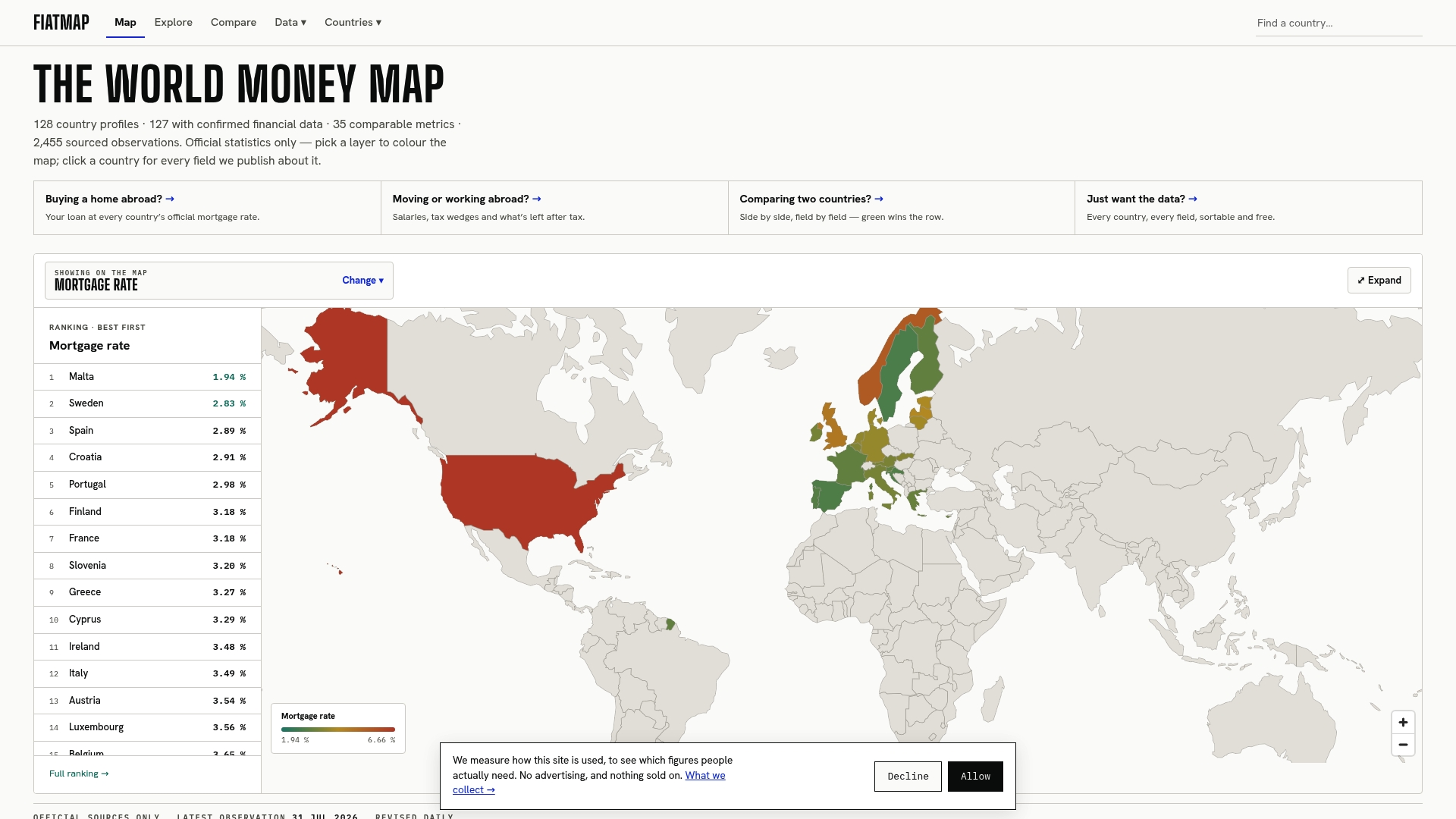
Once you have a rough tax estimate, the next question is usually what the proceeds are actually worth once you account for financing conditions and where that money might go next. We built Fiatmap as a data atlas covering mortgage rates, inflation, and dozens of other economic metrics across 128 countries, sourced exclusively from official statistics.
- Our mortgage calculator helps you compare financing costs if sale proceeds are funding a new purchase.
- Downloadable datasets allow modeling carrying costs and macro conditions in your own spreadsheet.
- Country comparison tools can show how inflation and rates differ if you are weighing where to reinvest.
None of this replaces a tax professional, but if you want to see how your net proceeds stack up against financing conditions elsewhere, explore our mortgage and inflation data before you decide on next steps.
This article is general information, not a substitute for advice from a qualified financial advisor. Consult a qualified financial professional about your own circumstances before acting on anything here.
FAQ
How do I calculate my capital gains on a property sale?
Subtract your adjusted basis (purchase price plus capital improvements minus depreciation) from your amount realized (sale price minus selling costs) to get your total gain. From there, apply any available exclusion, like the Section 121 home-sale exclusion, or deferral to find the taxable portion.
What are the capital gains tax brackets for 2026?
Long-term gains for property held over a year fall into 0%, 15%, or 20% brackets depending on taxable income, while short-term gains are taxed at ordinary income rates. Higher earners may also owe an additional 3.8% Net Investment Income Tax on top of these rates.
How do I avoid paying taxes on rental income?
There is no way to make rental income itself tax-free, but you can reduce taxable rental profit through depreciation and deductible expenses while you own the property. At sale, converting the property to a primary residence long enough to meet the ownership and use test, or using a 1031 exchange, are the main lawful ways to defer the capital gains tax on the eventual sale.
How do I calculate the capital gains tax on the sale of a property?
First find your taxable gain by subtracting adjusted basis from amount realized, then apply any exclusion or recapture adjustment. Multiply the remaining long-term gain by your applicable 0%, 15%, or 20% rate, and add any depreciation recapture taxed separately through Form 4797.
Does inherited property get a stepped-up basis?
Yes, inherited property generally receives a basis equal to its fair market value on the date of the decedent’s death, which can significantly reduce taxable gain if sold soon after. Heirs should secure an appraisal or estate documentation establishing that value before filing a sale.
Recommended
The figures on this site are collected from official statistics and each carries its own source and date — see /sources and the dataset. Where this article states a number, the country and ranking pages are what it should agree with.