10% Currency Depreciation Adds ~3pp to Inflation: Check Country Data
2026-09-24

Currency depreciation tends to push domestic inflation higher, but the effect is partial, not automatic. A weaker currency raises the cost of imports, and some of that gets passed to consumer prices through what economists call exchange-rate pass-through. The typical estimate: a 10% depreciation adds roughly 3 percentage points to inflation within a year in many developing economies, though credible monetary policy can cut that impact sharply. The sections below cover the mechanics, the evidence, the timing, and what it means for your own finances.
TL;DR:
- A 10% currency depreciation generally adds about 3 percentage points to inflation within a year in developing economies, though this varies widely by country and policy credibility.
- Countries with high import dependence, weak central bank credibility, or inflation already elevated are more likely to experience faster and larger inflation pass-through from depreciation.
- Policy measures like interest-rate hikes can significantly reduce the inflation impact of depreciation within a few quarters, while currency interventions are only temporary fixes.
- Import prices tend to react immediately to currency drops, but consumer prices usually lag by 10 to 12 months, with some effects persisting over one to three years.
- For individuals, monitoring actual exchange rates and inflation data helps better gauge how currency movements will impact savings, remittances, and living costs.
Table of Contents
- Currency Depreciation and Inflation: Key Terms You Need First
- How Does Currency Depreciation Affect Prices?
- What Do the Empirical Estimates Actually Show?
- When Does Depreciation Cause More Inflation?
- Can Monetary and Fiscal Policy Blunt the Effect?
- How Long Does It Take for Depreciation to Hit Prices?
- What Does This Mean for Your Money?
- Tracking Currency and Inflation Data with Fiatmap
- An Editorial Take: What the Evidence Actually Settles
- Compare Currency and Inflation Data Across 128 Countries
- Sources
- FAQ
Currency Depreciation and Inflation: Key Terms You Need First
Before going further, the vocabulary matters, because “depreciation” and “devaluation” get used interchangeably even though they describe different mechanisms.
Currency depreciation happens when a currency loses value against others in a floating exchange-rate system, driven by markets rather than a government decree. Devaluation is the deliberate, policy-driven reduction of a currency’s value under a fixed or managed exchange-rate regime. If a country’s central bank pegs its currency and then resets that peg lower, that’s devaluation, not depreciation. If a currency trades freely and simply falls due to capital outflows or trade deficits, that’s currency depreciation.
Economists also separate nominal from real depreciation. Nominal depreciation is the raw change in the exchange rate. Real depreciation adjusts for inflation differentials between two countries, so it captures actual shifts in competitiveness rather than just currency movements.
On the inflation side, consumer price index (CPI) inflation measures overall price changes for a basket of goods and services, while core inflation strips out volatile items like food and energy to reveal underlying trends. Central banks watch core inflation more closely because it filters out short-term noise.
Exchange-rate pass-through (ERPT) is the technical term for how much of a currency move shows up in domestic prices. A handful of related terms round out the vocabulary:
- Import prices: the direct cost of goods bought from abroad, the first thing to move when a currency weakens
- NEER (nominal effective exchange rate): a trade-weighted average of a currency’s value against its major trading partners
- HICP: the harmonized index of consumer prices, used across the European Union for comparable inflation measurement
How Does Currency Depreciation Affect Prices?
Depreciation doesn’t hit consumer prices all at once. It moves through several distinct channels, some fast and direct, others slower and psychological.
-
Import prices rise first. When a currency weakens, anything priced in foreign currency, oil, electronics, raw materials, costs more in local terms almost immediately. Countries that import a large share of their consumption basket feel this fastest. A nation that imports most of its fuel and food sees pass-through much sooner than one that’s largely self-sufficient.
-
Costs climb for domestic producers. Even companies that sell only domestically often rely on imported components, machinery parts, packaging, chemical inputs. As those input costs rise, producers face a choice: absorb the hit to margins or raise prices. Firms operating with the market power to pass costs along tend to do so quickly.
-
Inflation expectations can amplify the effect. If households and businesses start expecting sustained price increases, workers push for higher wages and firms raise prices preemptively. This is where a moderate depreciation can spiral into something worse: expectations become self-fulfilling.
-
Export competitiveness shifts demand. A weaker currency makes exports cheaper abroad, often boosting foreign demand for domestic goods. That added demand can itself put upward pressure on prices in the traded-goods sector, layering on top of the pure cost effect.
-
Effects land unevenly across the economy. Traded-goods sectors, manufacturing, agriculture, energy, feel the shock directly. Non-traded sectors like haircuts, local restaurants, and domestic services see slower, indirect pressure through wages and general cost inflation. This is why national CPI averages can mask sharp differences between what a farmer and a schoolteacher experience.
A 10% depreciation, plainly stated: World Bank estimates put the typical impact at roughly 3 percentage points of added CPI inflation after about a year in many developing economies. That’s the headline number analysts cite, and it’s a good anchor for expectations, though it’s an average across many episodes, not a law of physics.
What Do the Empirical Estimates Actually Show?
The 3-percentage-point figure gets cited so often it risks sounding like a fixed rule. It isn’t. It’s a central tendency drawn from a wide range of country experiences, and the variation around that average is substantial.
Multiple studies compiled in World Bank research on pass-through show pass-through ranging from near zero in some advanced economies with strong central bank credibility, to well above the 3-point average in countries with weaker institutions or high existing inflation. A few patterns hold up across the literature:
- Advanced economies with independent central banks and inflation-targeting frameworks generally show lower and more stable pass-through than emerging markets.
- Countries with a heavy reliance on imported consumer goods, small island economies, commodity importers, tend to see faster and larger effects.
- Pass-through estimates vary depending on whether researchers measure it against nominal or effective exchange rates, and over what time horizon.
- Historical comparisons matter: BIS research finds that the direct correlation between depreciation and consumer inflation has weakened globally over the past two decades as more countries adopted credible monetary frameworks.
The pass-through range in practice: estimates across the empirical literature span from single digits to over 50% of a depreciation showing up in prices, depending on the country, time period, and measurement method used. That spread is the reason economists resist giving a single confident number for any specific country without looking at its institutional context first.
The decline in average pass-through over time is arguably the more important finding for anyone trying to understand today’s economy. It means the historical relationship between a weak currency and runaway prices, the kind seen in past emerging-market crises, has become less mechanical as central banks earned more credibility. That doesn’t mean depreciation is harmless now. It means the outcome depends more on policy response than it did thirty years ago.
When Does Depreciation Cause More Inflation?
Pass-through isn’t a fixed number for any given country. It rises and falls depending on conditions, and understanding those conditions tells you far more than any single average estimate.
The clearest finding here comes from IMF research on state-dependent pass-through: pass-through can run up to three times larger during depreciation episodes triggered by external monetary shocks, such as aggressive U.S. Federal Reserve tightening that drags emerging-market currencies down alongside the dollar’s rise. The mechanism matters as much as the size of the move.
Several factors reliably push pass-through higher:
- High existing inflation. When inflation is already elevated, businesses and consumers are primed to expect further increases, so a new depreciation gets absorbed into prices faster.
- External shocks versus domestic ones. A currency drop caused by global monetary tightening tends to pass through more aggressively than one caused by, say, a temporary local trade imbalance.
- Weak central bank credibility. If markets doubt a central bank’s commitment to price stability, expectations de-anchor quickly, and pass-through accelerates.
- High import dependence or dollarization. Economies where prices are quoted or contracts are settled in a foreign currency see much faster transmission of exchange-rate moves into local prices.
- Concentrated markets. Where a handful of firms control an import-heavy sector, pricing power lets them pass on costs faster and more fully than in competitive markets.
Pro Tip: If you’re trying to gauge whether a country’s depreciation is likely to spark serious inflation, check two things first: how independent its central bank actually is, and what share of its consumer basket is imported. Those two factors explain more variation in outcomes than the size of the currency move itself.
Can Monetary and Fiscal Policy Blunt the Effect?
Policy choices are often the single biggest determinant of whether a depreciation turns into a one-time price adjustment or a lasting inflation problem.
Raising interest rates is the most direct tool. Higher rates support the currency, cool domestic demand, and, critically, signal to markets and households that the central bank won’t tolerate runaway prices. That signal alone can anchor inflation expectations even before the rate hike fully works through the economy. Research from the World Bank on policy frameworks and pass-through confirms that countries with credible, well-communicated inflation targets see meaningfully lower pass-through than those without.

Direct currency-market intervention, central banks buying or selling foreign reserves to prop up their own currency, is used more sparingly. For a practical guide to such exchange-rate mechanisms, see this centralized currency exchange guide. It can slow a slide temporarily, but reserves are finite, and markets tend to test a central bank’s resolve. Most economists view intervention as a stopgap, not a substitute for credible interest-rate policy.
Fiscal policy matters just as much, if not more, over the medium term. Large, persistent budget deficits financed by printing money are a classic trigger for the kind of devaluation-inflation spiral that has repeatedly appeared in World Bank case studies on emerging-market crises. Fiscal discipline breaks that loop by removing the underlying pressure that keeps devaluing the currency in the first place.
- Interest-rate hikes anchor expectations and typically reduce pass-through within a few quarters.
- Currency intervention buys time but rarely solves the underlying imbalance.
- Fiscal deficits, left unaddressed, tend to keep currencies under pressure regardless of monetary tightening.
- Credible, transparent inflation-targeting frameworks consistently correlate with lower pass-through across country studies.
How Long Does It Take for Depreciation to Hit Prices?
Timing catches a lot of people off guard. Import prices move almost immediately when a currency weakens, often within weeks, since those goods are priced in foreign currency to begin with.
Consumer prices lag well behind. Retailers and distributors absorb some of the shock initially, working through existing inventory and hedged contracts before adjusting shelf prices. Research from the Dallas Fed and broader practitioner consensus put peak CPI impact at roughly 10 to 12 months after a significant depreciation, with the fuller effect, including second-round wage and expectation effects, unfolding over one to three years.
Two other timing quirks matter:
- Large depreciations and currency crises don’t behave like smaller, gradual moves. Linear pass-through models built on typical episodes tend to over- or under-predict inflation once a currency crash triggers panic buying, contract renegotiation, or capital flight.
- Pass-through is asymmetric. Prices that rise after a depreciation tend to stay elevated even if the currency later recovers, since businesses are far more reluctant to cut prices than to raise them.
What Does This Mean for Your Money?
For individuals, this isn’t an abstract macro debate. It shows up directly in remittances, travel budgets, import-heavy grocery bills, and the real value of savings.
If you receive remittances in a currency that’s depreciating against the sender’s currency, you’ll get more local currency per transfer, but that gain can be partly or fully offset if local inflation eats into what it buys. Travelers face the same trade-off in reverse: a weak local currency makes your trip cheaper, until local price levels catch up. Real wages, income adjusted for inflation, are usually the last thing to adjust, which is why depreciation episodes often squeeze household budgets before paychecks catch up.
A few practical habits help:
- Track the real deposit rate on your savings, the nominal rate minus inflation, rather than just the interest rate advertised by your bank. A positive nominal rate can still mean you’re losing purchasing power.
- If you’re planning a large foreign purchase or transfer, timing it around known policy events (central bank meetings, budget announcements) can matter more than trying to predict daily currency swings.
- Consider whether your exposure to a weakening currency is large enough to justify simple hedging tools, like holding a portion of savings in a more stable currency, before assuming you need anything complex.
Pro Tip: Compare a country’s headline interest rate against its actual inflation rate before assuming your money is safe there. A savings account earning 12% in a country with 15% inflation is quietly losing you money every year.
Tracking Currency and Inflation Data with Fiatmap
Reading about pass-through in the abstract only goes so far. Checking the actual numbers for a specific country turns theory into something you can act on.
Fiatmap’s Global Money Dataset pulls CPI, exchange-rate, deposit-rate, and mortgage-rate data from official statistical agencies across 128 countries, so you can see how a currency’s recent moves line up with its inflation trajectory rather than relying on a single headline figure. The real deposit rate map is particularly useful here: it shows at a glance which countries offer savers a return that actually beats inflation and which ones don’t.
A few practical ways to use this when assessing depreciation risk:
- Cross-reference a country’s import share of GDP against its recent currency performance to gauge how exposed its consumer prices are.
- Check whether a central bank has a stated inflation target and a track record of hitting it, a rough proxy for how much pass-through you should expect.
- Compare real deposit rates across countries before parking savings anywhere, since a high nominal rate can mask negative real returns.
All figures come from official government and central-bank statistics, not estimates or aggregator guesses, so the comparisons hold up against the sources policymakers themselves use.
An Editorial Take: What the Evidence Actually Settles
The relationship between currency depreciation and inflation is one of the more well-documented links in macroeconomics, yet it still gets treated as a simple cause-and-effect story. It isn’t. The honest reading of the evidence is that depreciation raises inflation risk, but the size of that risk is decided almost entirely by policy credibility, not by the exchange rate itself.
What the research doesn’t settle nearly as well: how these dynamics behave during genuine crises, where linear models break down, and how much modern global supply chains have changed pass-through since most of the underlying studies were done. Measurement itself remains messy, different countries track import shares and effective exchange rates in ways that aren’t always comparable.
If there’s one habit worth building from all this, it’s checking the specific country’s numbers rather than trusting a global average. A tool like Fiatmap’s country data makes that five-minute check possible before you draw conclusions about where a currency, or your money, is headed.
— Torstein
Compare Currency and Inflation Data Across 128 Countries
Reading about pass-through estimates is one thing. Knowing whether a specific country’s currency slide is likely to hit your wallet is another, and that requires actual numbers, not averages.
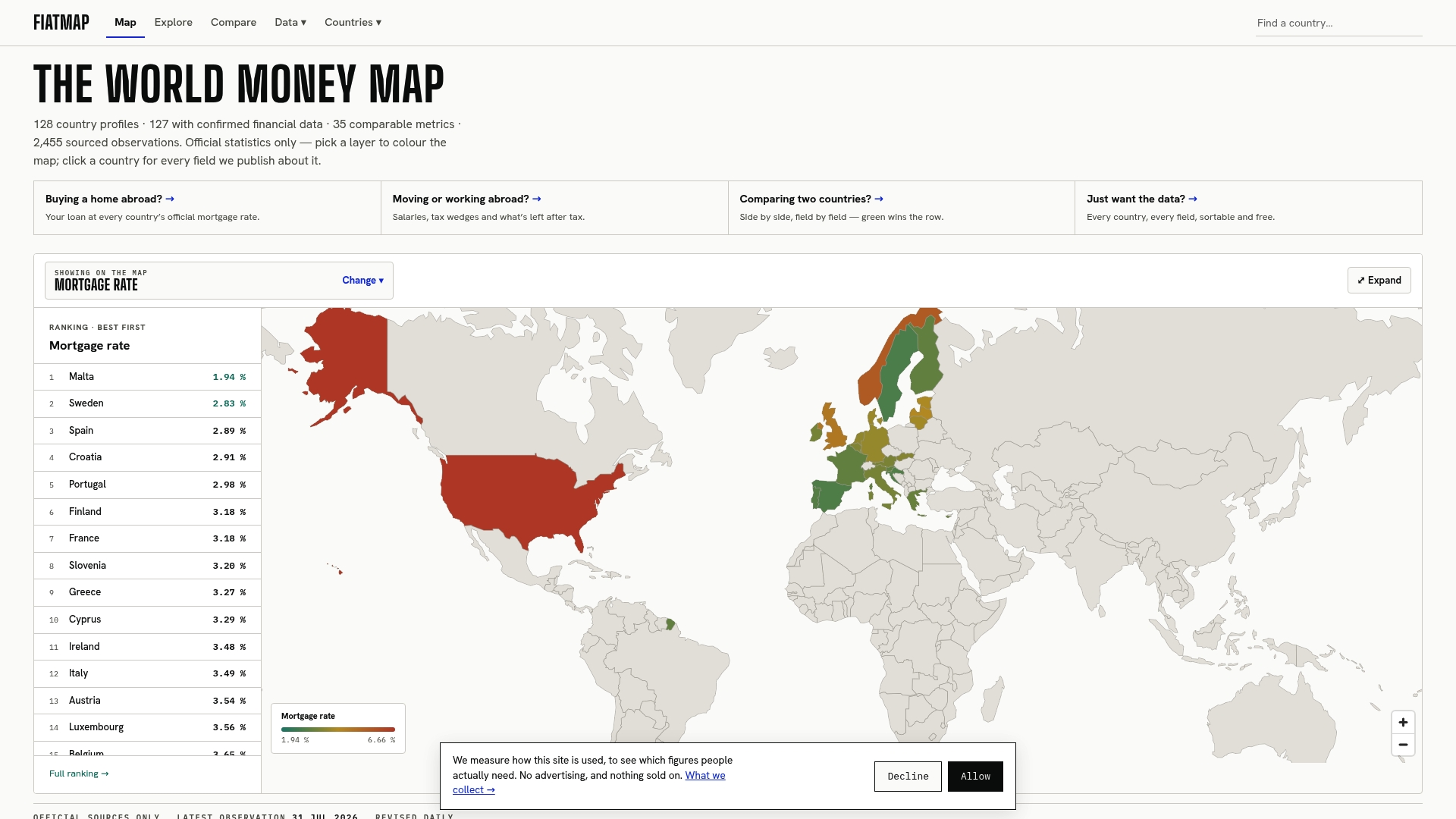
Fiatmap pulls CPI, exchange-rate, and deposit-rate data straight from official statistical agencies across 128 countries, so you’re comparing verified figures instead of secondhand estimates from a blog post. Start with the Global Money Dataset to line up a country’s recent exchange-rate moves against its CPI trend, then check the real deposit rate map to see whether savings there are actually keeping pace with prices. If you’re weighing a foreign mortgage or comparing loan costs across borders, the mortgage rate rankings add the other half of the picture. Pull up the country you’re watching and see where it actually stands.
Sources
For deeper reading on exchange-rate pass-through and inflation dynamics, see the World Bank’s pass-through estimates, the IMF’s state-dependent pass-through research, BIS working papers on exchange rates and monetary policy, and the Reserve Bank of Australia’s explainer on how exchange rates affect a domestic economy.
- World Bank annex — exchange rate pass-through estimates
- IMF working paper on state-dependent exchange-rate pass-through
- World Bank Policy Research Working Paper on pass-through and policy frameworks
- BIS working paper — exchange rates and monetary policy overview
FAQ
How does currency depreciation affect inflation?
Currency depreciation raises inflation mainly by making imports more expensive, a process called exchange-rate pass-through. The World Bank estimates that a 10% depreciation adds roughly 3 percentage points to CPI inflation within about a year in many developing economies, though the effect varies widely by country.
Does devaluing a currency cause inflation?
Devaluation typically causes inflation through the same pass-through mechanism as market-driven depreciation, since both make imported goods and inputs more expensive in local currency. The size of the effect depends heavily on how much of the economy relies on imports and how credible the central bank’s inflation-fighting commitment is.
Why does high inflation depreciate currency?
High domestic inflation erodes a currency’s purchasing power relative to currencies with more stable prices, which pushes investors and traders to sell it, driving the exchange rate down. This can create a feedback loop: inflation weakens the currency, and the weaker currency then adds further inflation through pass-through, a pattern that’s more common when fiscal deficits go unaddressed, as documented in World Bank case studies on devaluation-inflation spirals.
Does inflation cause the dollar to depreciate?
Rising U.S. inflation relative to other countries can weaken the dollar over time, since higher inflation erodes its relative purchasing power and can prompt investors to seek returns elsewhere. The relationship runs both directions, though, since dollar strength or weakness driven by Federal Reserve policy can itself trigger pass-through effects in other countries, an interaction the IMF’s research on state-dependent pass-through documents in detail.
Recommended
The figures on this site are collected from official statistics and each carries its own source and date — see /sources and the dataset. Where this article states a number, the country and ranking pages are what it should agree with.