You Don't Need 20%: Down Payment Requirements Range from 0% to 25%
2026-09-26

Most homebuyers do not need to put 20% down. Typical minimums run from 0% on VA and USDA loans to roughly 3% to 3.5% on many conventional and FHA loans, with jumbo and second-home financing usually starting higher. The trade-off is straightforward: a smaller down payment raises your loan-to-value ratio, which usually means mortgage insurance and a higher borrowing cost until you build equity.
TL;DR:
- Many loan programs allow down payments below 20%, with VA and USDA loans often requiring none at all and conventional loans sometimes as low as 3%.
- Lenders’ individual overlays and local regulations can raise minimum down payment requirements beyond the program baselines.
- A higher loan-to-value ratio from a smaller down payment generally increases mortgage insurance costs and interest rates, especially for lower credit scores or thinner credit histories.
- Acceptable sources of down payment include savings, gifts, home sale proceeds, and certain retirement withdrawals, but large recent deposits may require a seasoning period.
- Your actual monthly payment depends on how your down payment, mortgage rate, and market conditions interact, making scenario modeling essential before applying.
Table of Contents
- Snapshot of typical minimum down payments by loan type
- Loan-by-loan rules, fees and lender caveats
- How credit score and loan-to-value shape what you actually pay
- What counts as a down payment and how to document it
- Closing costs, reserves and mortgage insurance: the real cash you need
- A practical framework for setting your down payment target
- Modeling down payment scenarios with real mortgage rate data
- What buyers get wrong about the 20% rule
- Test your own numbers before you talk to a lender
- Sources
- FAQ
Snapshot of typical minimum down payments by loan type
Before getting into program rules, it helps to see how the main loan types stack up against each other. Lender overlays, credit score tiers and local program availability can all push these floors higher in practice, so treat the following as starting points rather than guarantees.
- VA and USDA loans: typically 0% down for eligible veterans, service members and rural-area buyers.
- Conventional loans: some programs allow as low as 3% down, though many borrowers put down more to avoid mortgage insurance or improve pricing.
- FHA loans: 3.5% down for borrowers with a credit score of 580 or higher, with a higher minimum for lower scores where the loan is still permitted.
- Jumbo and second-home or investment loans: commonly require somewhere between 10% and 25% down, depending on the lender and property type.
- Lender overlays and geography: individual lenders and country-specific rules can raise these minimums above the program floor.
Loan-by-loan rules, fees and lender caveats
Each loan type carries its own minimum, its own insurance structure and its own catch. Knowing the details before you shop saves you from being surprised at the underwriting stage.
Conventional loans offer some of the lowest official minimums, with certain programs allowing 3% down. Private mortgage insurance (PMI) typically applies whenever the down payment sits below 20%, since the loan-to-value ratio directly affects your costs, according to the Consumer Financial Protection Bureau. Lenders also apply their own overlays on top of the baseline program rules, so a 3% option advertised broadly may not be available to every borrower or in every state.

FHA loans require a minimum down payment of 3.5% for borrowers with a credit score of 580 or higher, and they carry both an upfront mortgage insurance premium and an ongoing annual premium whose size depends on the loan term and down payment amount, per HUD’s FHA program data. FHA’s own performance monitoring tracks early payment delinquency by product type, underscoring why underwriting and insurance costs are built into the program rather than treated as optional add-ons.
VA loans typically allow qualifying veterans and service members to purchase with no down payment at all, according to the VA’s home loan program overview. Lenders can still apply their own overlays on top of VA’s baseline eligibility, and most VA purchases include a funding fee that varies by service history and prior VA loan use.
USDA guaranteed loans can also allow 0% down for eligible rural properties, but they come with an upfront guarantee fee and an annual fee layered into the payment, according to USDA program guidance. These loans also enforce combined loan-to-value limits when down payment assistance is layered on top.
Jumbo loans and second-home or investment financing sit at the other end of the spectrum, generally requiring stronger credit files, larger cash reserves and higher down payments than a standard owner-occupied purchase, since lenders view these loans as carrying more risk.
Country-specific rules matter too. In Canada, the minimum down payment is 5% for homes priced at $500,000 or less, rising to 5% on the first $500,000 plus 10% on the portion between $500,000 and $1.5 million, and 20% for homes priced at $1.5 million or more, according to Canada’s official guidance. Mortgage loan insurance is generally required whenever the down payment falls below 20%. A homebuying guide for first-time buyers in Canada walks through how these thresholds interact with the rest of the purchase process.
How credit score and loan-to-value shape what you actually pay
A lower down payment means a higher LTV, and a higher LTV typically means a higher interest rate and a mortgage insurance requirement, since the lender is financing a larger share of the purchase, per the CFPB’s explanation of LTV. A concept sometimes called LVR in other markets works the same way, as this guide to loan-to-value ratios explains.
Lenders also sort borrowers into risk tiers based on credit score and debt-to-income ratio, and a thinner credit file can push your effective minimum above the program floor even when the loan type technically allows less.
What counts as a down payment and how to document it
Lenders need to see where your down payment money came from and that it is truly yours to use.
- Acceptable sources generally include personal savings, proceeds from a home sale, documented gift funds accompanied by a gift letter, employer assistance programs and certain retirement account distributions, subject to program rules.
- Common documentation includes recent bank statements, gift letters, records of any asset liquidation and proof of reserves after closing.
- Watch for pitfalls like “earmarked” funds that were recently deposited without a paper trail, since many lenders require a seasoning period before large deposits count.
For USDA guaranteed loans specifically, down payment assistance is allowed as long as the guaranteed loan keeps first-lien position, according to USDA’s loan origination guidance.
Closing costs, reserves and mortgage insurance: the real cash you need
Your down payment is rarely the only cash you need at the closing table. These stack on top of whatever you are putting down.
Beyond the down payment and closing costs, lenders often want to see reserves, extra funds left over after closing, and the CFPB recommends keeping an emergency cushion of roughly three to six months of expenses rather than draining every dollar into the purchase.
A practical framework for setting your down payment target
Deciding how much to put down is less about hitting a round number and more about matching your cash position to your goals.
- Calculate affordability first. Work out your comfortable monthly payment and the reserves you want left over after closing.
- Weigh liquidity against payment size. A larger down payment lowers your monthly cost but ties up cash you might need for emergencies or other goals.
- Check program eligibility and assistance. Confirm whether VA, USDA, FHA or a local down payment assistance program applies to your situation before assuming you need a large sum saved.
- Get pre-approved. A lender will confirm the specific minimum and overlays that apply to your credit profile and target property.
Pro Tip: If a small increase in your down payment, say from 8% to 10%, would eliminate a pricing penalty or shorten your mortgage insurance period, that increase is often worth more than the same dollars sitting in a savings account.
Modeling down payment scenarios with real mortgage rate data
Program rules only tell you the floor. What actually determines your monthly payment is the interaction between your down payment size, the mortgage rate you qualify for and the market you are buying in. Fiatmap’s mortgage rate glossary breaks down how rate and down payment together drive monthly cost, while its mortgage rates by country ranking lets you compare borrowing environments using official statistics rather than averages pulled from a single lender.
Because pricing and insurance rules are tiered, a story like the same mortgage, wildly different prices is worth reading before you assume any single quoted rate applies to you. Running your numbers through a few scenarios before contacting a lender puts you in a stronger position to negotiate.

What buyers get wrong about the 20% rule
I think the bigger mistake is letting that number delay a purchase when your finances and plan are otherwise solid. A smaller down payment with healthy reserves often beats an oversized one that leaves you cash-poor the day you move in.
— Torstein
Test your own numbers before you talk to a lender
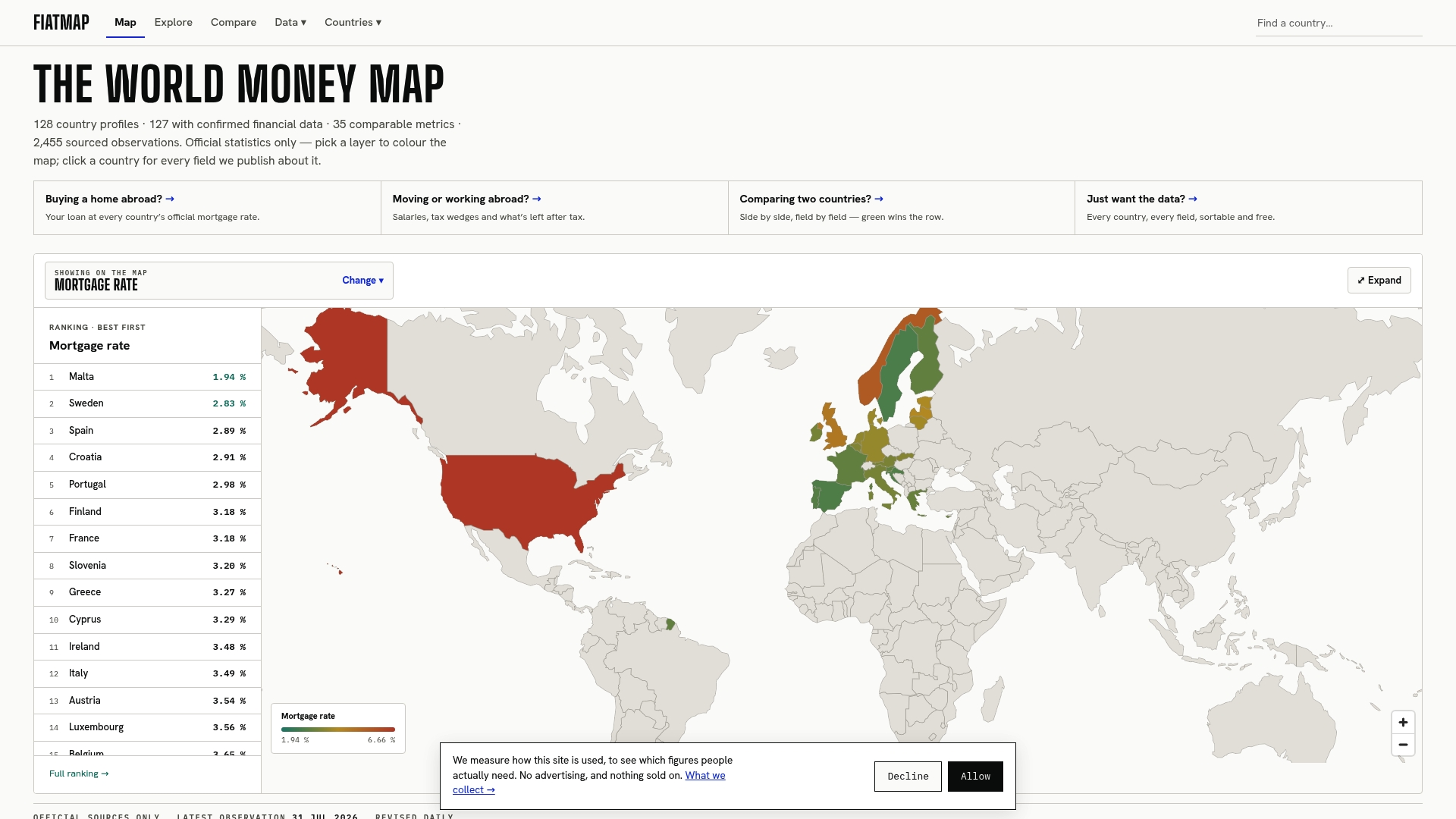
Program minimums and mortgage insurance rules only tell part of the story. What matters for your monthly budget is how your specific down payment, rate and market interact, and that is where a data-first tool helps more than another rule of thumb.
- Fiatmap’s mortgage calculator lets you test how monthly payments shift as you change your down payment percentage or mortgage rate assumption.
- The deposit rate map gives you macro context on what your savings could earn if held rather than put toward a larger down payment.
- All figures come from official national statistics across multiple countries, allowing comparison of real data rather than marketing estimates.
Fiatmap is not a lender and does not originate loans. It is a place to model scenarios so you walk into lender conversations with realistic numbers already in hand. Start at Fiatmap’s mortgage rate rankings to see how your target market compares before you apply.
This article is general information, not a substitute for advice from a qualified financial advisor. Consult a qualified financial professional about your own circumstances before acting on anything here.
Sources
- What is a loan-to-value ratio and how does it relate to my costs? - CFPB
- FHA single-family mortgage performance and MIP details (HUD FHAOT June 2024)
- VA home loan program overview - VA.gov
- USDA Single-Family Housing Guaranteed Loan Program guidance (HB-1-3555)
FAQ
What is required for a down payment?
Lenders generally require documented proof that the funds are yours or a legitimate gift, verified through recent bank statements and, if applicable, a signed gift letter.
How much of a down payment do I need for a $300,000 house?
VA and USDA loans can allow 0% down for eligible borrowers, meaning no down payment at all, though closing costs and reserves still apply.
What are the requirements to put a down payment on a car?
Auto loan down payment rules are set by individual lenders and dealers rather than a federal program, so there is no single official minimum the way there is for FHA or VA mortgages. Buyers with weaker credit or a higher loan amount relative to the car’s value are often asked for a larger down payment to reduce the lender’s risk.
Is a 10% down payment enough for a house?
It typically still triggers mortgage insurance since the loan-to-value ratio remains above the common threshold most lenders use to waive it.
Recommended
The figures on this site are collected from official statistics and each carries its own source and date — see /sources and the dataset. Where this article states a number, the country and ranking pages are what it should agree with.