Two Month Test: Compare Expat Cost of Living With PPPs and Live Rents
2026-10-04

Start with purchasing power benchmarks, not price tags: check a country’s relative price level against your home country, then confirm it with two or three current city rent listings before you trust any number. A single adult abroad often budgets differently than a family of four, so treat early estimates as a range, not a fixed figure. Once you have both the structural read and a local rent sample, you can build a tracked budget that actually holds up.
TL;DR:
- Comparing relative country price levels with official PPP data and current city rent samples is essential for accurate budget planning.
- Currency fluctuations can significantly impact real income, especially for expats paid remotely or with foreign investments, requiring contingency buffers.
- Visa or residency restrictions influence costs by limiting access to public services and tying income to specific employment or investment conditions.
- Regularly revisiting your budget every few months helps account for inflation and local price changes that can quickly erode initial estimates.
- Trusting national averages or gross salaries without local verification and tracking actual expenses for two months are common pitfalls to avoid.
Table of Contents
- What cost-of-living measures actually mean: PPPs, PLIs and exchange-rate conversions
- A step-by-step comparison framework for expats
- How to build an expat budget that survives contact with reality
- Authoritative data and tools: pairing structural benchmarks with live city data
- How currency fluctuations change your expat budget
- How your visa or residency status changes your real cost of living
- How inflation changes your budget the longer you stay
- What expat income and costs mean for your taxes
- A compact checklist and the mistakes that trip people up
- Compare countries and build your budget with our free tools
- FAQ
- Sources
What cost-of-living measures actually mean: PPPs, PLIs and exchange-rate conversions
Purchasing power parities (PPPs) are currency conversion rates that equalize the cost of buying the same basket of goods and services across countries, so a PPP comparison tells you what your income can actually buy locally, not just what it converts to at the bank. Price level indexes (PLIs) go a step further and show how expensive a country is relative to a reference average, usually expressed as a ratio above or below 100.
Market exchange rates answer a different question: how much foreign currency your home currency buys today. That number moves daily with financial markets and has nothing to do with local prices. A PPP-based comparison, by contrast, strips out currency swings and focuses on relative cost of living, which is why it holds up better for relocation planning than a quick currency conversion.
What gets included in the basket matters too. When public services like health care or education are folded into a national comparison, countries with strong public systems often look cheaper on paper, even though an expat without access to those systems would pay market rates. The World Bank’s ICP program compares 176 economies across 45 expenditure categories using this basket approach, which is the most complete structural dataset available for this kind of comparison.
- PPPs equalize purchasing power across currencies; exchange rates do not.
- PLIs show relative expense levels, with values above or below a reference average.
- Baskets that include public services can shift national rankings significantly.
- Expats without access to public programs should treat those categories as out-of-pocket.
Households across OECD countries face very different price levels, with OECD analysis from April 2025 finding household consumption prices in Switzerland running significantly above the OECD average, while Türkiye sat significantly below that average. That spread shows why a flat global cost-of-living number is nearly meaningless without a reference point.
A step-by-step comparison framework for expats
Comparing destinations well means layering two kinds of evidence: the slow-moving structural data and the fast-moving local reality. Skipping either one leaves gaps that catch people off guard after they move.
- Set a baseline with ICP or PPP data. Use the World Bank’s ICP figures to see how a country’s general price level compares with your current one, which tells you whether to expect a cheaper or pricier environment overall.
- Verify with current city rent samples. Pull three to five live listings in the neighborhoods you’d actually consider, since housing is the most volatile category and national averages hide huge city-to-city gaps.
- Check local grocery and transport prices. A few receipts or delivery app screenshots from locals or expat forums will tell you more than any national index.
- Adjust for expected take-home pay. Your gross salary offer means little until you subtract local income tax and social contributions, so convert to net pay before comparing.
- Factor in education and health costs if relevant. Private schooling and health insurance can swing a family budget by thousands per year in ways a single-adult estimate never captures.
Common pitfalls include trusting a single national average for a whole country, ignoring currency volatility between the offer and the move date, and forgetting that household needs scale differently than per-person averages. The ILO’s methodology for estimating worker needs groups costs into food, housing, health and education, and other essentials, which is a useful checklist for making sure nothing gets left out.
- Housing and rent, checked city by city, not nationally.
- Groceries and everyday transport, sampled locally.
- Take-home pay after local tax and contributions.
- Health insurance and schooling, if applicable to your household.
How to build an expat budget that survives contact with reality
A workable expat budget starts with categories, not guesses. List housing, utilities, groceries, transport, phone and internet, health insurance, schooling if relevant, money transfers home, and one-off relocation costs like visa fees, deposits, and shipping. Each category behaves differently: housing and insurance are usually fixed, while groceries and transport fluctuate month to month.
Separating fixed from irregular costs matters because irregular spending is where budgets quietly fail. Tracking actual spending for two to three months, rather than relying on a single estimate, catches the pattern of irregular costs like annual insurance renewals, seasonal utility spikes, or unplanned medical visits.
- Fixed costs: rent, insurance premiums, subscriptions, loan payments.
- Irregular costs: medical visits, home repairs, seasonal utility spikes, travel.
- One-off costs: visa fees, security deposits, shipping, initial furnishing.
- Recurring transfers: money sent home or to dependents elsewhere.
Automating fixed payments removes one layer of friction and helps you spot irregular spending more clearly, since what’s left over after automated bills is what you’re actually watching day to day. Building an emergency fund equal to a few months of fixed costs gives you room to absorb a surprise expense without derailing the whole plan.
Pro Tip: Track every expense for two full months before finalizing your budget: the first few weeks after a move always include one-time costs that make the picture look worse than it actually is.
Two household examples illustrate the range. A single adult renting in a moderately priced city typically allocates the largest share of their budget to housing, followed by groceries and transport, with health insurance scaled to local requirements. A family of four adds schooling and a larger housing footprint, which is where the ILO’s household needs framework is useful for scaling per-person estimates up to a household figure rather than simply multiplying by headcount.
Authoritative data and tools: pairing structural benchmarks with live city data
Structural datasets like ICP and OECD PPPs give you a dependable baseline, but they update periodically and never capture this month’s rent listings or this week’s exchange rate. Treating them as a starting point rather than a final answer is the difference between a budget that holds and one that falls apart in month three.
We built our purchasing power parity glossary to explain exactly how these adjustments work, sourced entirely from official statistics across 128 countries. Our take-home-pay map lets you compare expected after-tax income between countries, which is the piece most cost-of-living guides skip entirely.
A practical sequence looks like this:
- Choose a country baseline using ICP or OECD price-level data.
- Pull three to five current city rent samples for your target neighborhoods.
- Adjust your expected budget using take-home pay rather than gross salary.
- Run a two-month tracked spending test before committing to a long lease.
Our minimum wage rankings add useful context when converting individual cost estimates into household terms.
How currency fluctuations change your expat budget
Currency movement is the variable most cost-of-living guides underweight, and it is often the one that hurts expats most.
This matters most for expats who are paid remotely from a home-country employer or who receive a pension or investment income from abroad. Someone budgeting based on today’s exchange rate could find their effective income meaningfully lower a year later if their home currency weakens against the local one, with no change in their actual salary.
A few practical responses reduce this exposure. Holding a buffer in the local currency smooths out short-term swings, so a single bad week in the markets doesn’t force a budget crisis. Checking your conversion rate periodically, rather than assuming it stays constant, keeps your budget grounded in current reality instead of a snapshot from your relocation planning phase. For expats paid in a volatile currency relative to their destination, building a wider contingency margin into the monthly budget is safer than assuming stability.
Where possible, paying major recurring costs like rent in the local currency, rather than converting monthly from a foreign account, also removes one layer of exposure to daily rate swings.
How your visa or residency status changes your real cost of living
The type of visa or residency permit you hold shapes your cost of living more than most people expect going in. Some permits restrict access to public health systems, pushing expats onto private insurance that a citizen or permanent resident would not need. Others tie residency to a minimum income or investment threshold, which changes what kind of housing or lifestyle is realistic from day one.
Work visas tied to a specific employer often come with less flexibility to change jobs if the cost of living turns out higher than expected, which raises the practical importance of getting the initial budget right. Digital nomad and remote-work visas, increasingly common, often require proof of income from outside the country, which decouples your salary from local wage levels entirely and means local salary benchmarks won’t tell you much about your own situation.
Retirement and investor visas frequently come with specific tax treatments or residency-day requirements that affect both cost planning and timing. Family reunification routes typically mean budgeting for dependents’ schooling and health care from the start, categories that a single-applicant estimate would miss completely.
Because these rules vary so much by country and by permit type, the safest approach is to treat your specific visa category as its own budgeting input rather than assuming a generic “expat cost of living” figure applies to your situation.

How inflation changes your budget the longer you stay
A cost-of-living estimate made before you move is a snapshot, and inflation erodes it steadily the longer you live somewhere. Rent, groceries, and utilities in particular tend to move faster than general inflation headlines suggest, since housing markets in popular expat destinations often see demand-driven increases that outpace the broader consumer price index.
This is why a budget built once during relocation planning needs revisiting, not just once but on a recurring basis. Reviewing your budget every few months against actual local price changes, rather than relying on the figure you calculated before you left, catches drift before it becomes a shortfall. Our CPI glossary entry explains how consumer price index data differs from PPP-based comparisons, which is useful context when you’re trying to understand why your local costs crept up even though the exchange rate stayed flat.
Salary negotiations and cost-of-living adjustments, where offered by an employer, rarely keep pace automatically with local inflation, especially for expats paid from a foreign headquarters that doesn’t track local price movement closely. Building a habit of comparing your fixed costs year over year, rather than assuming last year’s numbers still hold, is the most reliable way to catch this before it strains your budget.
What expat income and costs mean for your taxes
Tax treatment is one of the most country-specific pieces of an expat budget, and it affects both your income side and your cost side. Many countries tax residents on worldwide income once they meet a residency threshold, while others only tax income earned locally, a distinction that can change your effective take-home pay substantially depending on where your income originates.
Double taxation treaties between some countries prevent the same income from being taxed twice, but not every country pair has one, and the rules for claiming relief vary. This is a case where the general principle is worth stating and the specifics belong to a tax professional familiar with both your home and host countries.
Beyond income tax, some costs that would be tax-deductible at home, like certain health insurance premiums or retirement contributions, may not carry the same treatment abroad, which changes the real cost of maintaining those benefits. Property purchases, in particular, often carry transfer taxes or stamp duties that vary widely by jurisdiction and are easy to underestimate when budgeting for a home purchase abroad.
Because tax rules depend entirely on your specific country pair, residency status, and income type, the only safe approach is to confirm your situation with a tax advisor or the relevant tax authority rather than relying on a general estimate.

A compact checklist and the mistakes that trip people up
A one-week starting checklist: confirm your net salary offer, estimate local tax with a professional, pull two current city rent samples, and check a PPP baseline for your target country.
The three mistakes that come up again and again: trusting a national average instead of a city-level check, budgeting from gross salary instead of take-home pay, and skipping the two-month tracking test that would have caught irregular costs early.
— Torstein
Compare countries and build your budget with our free tools
We source every figure on our platform from official statistics across 128 countries, which means the baseline you start from is the same data researchers and institutions use, not a crowdsourced estimate. Our interactive comparisons let you set a country baseline, check take-home pay, and see how mortgage and living costs stack up before you commit to a move.
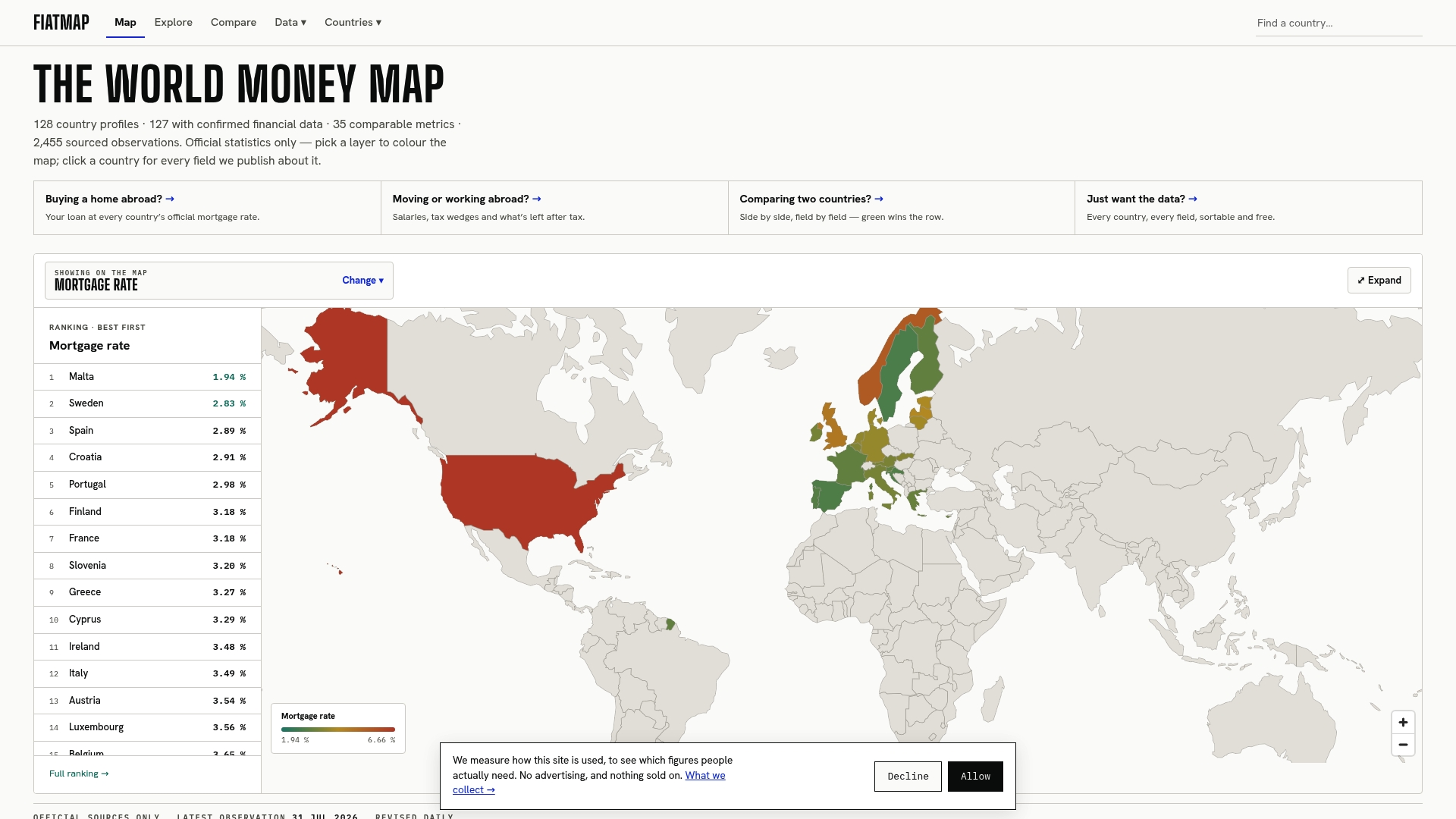
Three places to start: download the Global Money Dataset for a full comparative view, check our debt per person rankings to understand household financial pressure in your target country, and read through our purchasing power glossary entry to understand exactly how the adjustments work before you trust any single number.
| Step | What to check | Where to look |
|---|---|---|
| Baseline | Relative price level | World Bank ICP data |
| Verification | Current city rent | Local listings, 3 to 5 samples |
| Income | Expected take-home pay | Our take-home-pay map |
| Testing | Two-month tracked spending | Your own records |
For readers planning a specific country move, resources like this Paraguay cost of living guide or this Ireland rental guide are useful for pulling the local rent samples step two of our framework calls for. Start your comparison on Fiatmap and build a budget grounded in the same data institutions rely on.
FAQ
How much does it cost to live a year in Europe?
Annual costs vary enormously across Europe because national price levels differ widely: OECD data from April 2025 found Switzerland’s household consumption prices running about 50% above the OECD average, while other member countries sit well below it. Rather than one Europe-wide figure, check a country-level PPP benchmark alongside current city rent samples for the specific country you’re considering.
Can you live on $2,000 a month in the US?
Whether a specific monthly budget is workable depends entirely on the city and household size, since housing costs vary dramatically between metro areas. A defensible answer requires checking current local rent listings and comparing your expected take-home pay against the essential categories: housing, groceries, transport, and health insurance.
Is it cheaper to live in America?
There is no single answer, since cost of living in the United States depends heavily on which state and city you compare against your home country. The World Bank’s ICP program provides the structural price-level data needed to make that comparison properly, but it should be paired with city-level rent and grocery checks for an accurate picture.
What are the 10 most expensive countries to live in?
Rankings of the most expensive countries shift depending on whether the comparison uses PPP-adjusted price levels or raw exchange-rate conversions, and on which expenditure basket is used. The OECD’s 2025 analysis found Switzerland among the highest-priced countries relative to the OECD average, but a full top-ten list depends on the specific methodology and year of the data source consulted.
Sources
- International Comparison Program (ICP) data — World Bank
- Comparing apples with apples: new PPPs highlight persistent disparities in cost of living (OECD blog)
- A methodology to estimate the needs of workers and their families — ILO
Recommended
The figures on this site are collected from official statistics and each carries its own source and date — see /sources and the dataset. Where this article states a number, the country and ranking pages are what it should agree with.