Fixed Rate Mortgages by Country: Who Fixes, Who Floats
2026-11-09

The 30-year fixed mortgage is an American habit, not a global default. Belgium, Germany, France and the Netherlands lean on long fixed periods, while Spain, Italy, Portugal, Greece, Austria, Poland and Australia lean on variable rates. The UK and Canada sit in between, with fixes of about five years. Below we sort the countries, show the latest official figures, and explain why the same word, “fixed,” means very different things from one border to the next.
TL;DR
- Only the US routinely offers a 30-year fixed rate, according to a Reserve Bank of Australia comparison. The UK and Canada typically fix for about five years, and Australia for about two.
- In the euro area, fixed rates dominate in Belgium, France, Germany and the Netherlands. Variable or short-reset loans prevail in Austria, Greece, Italy, Portugal and Spain, per the ECB.
- A “variable share” depends on the definition: some statistics count any loan that can reset, even after a long fix.
- Shares move with the rate cycle. Australia’s fixed share fell below 5% of outstanding loans, and Danes are shifting from fixed to variable.
Table of Contents
- The big picture: three families of mortgage markets
- Fixed-rate periods by country
- How big is the variable share? Country snapshots
- Why the same word means different things
- Why countries differ
- Choosing between fixed and variable abroad
- Our perspective
- Compare rates on Fiatmap
- FAQ
- Sources
The big picture: three families of mortgage markets
It helps to group countries by how a borrower’s payment reacts to central bank decisions.
Long-fix markets. The US is the extreme case. In the euro area, the ECB’s 2009 housing finance report says that Belgium, Germany, France and the Netherlands make up about 65% of euro area housing loans, and that a longer-term fixation of the rate is the most usual procedure there. The OECD adds that in Belgium and Denmark most mortgages have fixed periods above ten years.
Medium-fix markets. In the Czech Republic and the United Kingdom, most mortgages are fixed, but the fixed period is mostly under ten years, according to the same OECD report. Canada and the UK both typically fix for about five years, the RBA notes.
Variable-rate markets. The ECB working paper finds adjustable-rate loans prevail in Austria, Greece, Italy, Portugal and Spain. The OECD says variable-rate loans are still the most common in some jurisdictions, and that in Poland it is almost the only type of contract available. Australia belongs here too, with fixed periods of around two years when borrowers do fix.
These families are not permanent. The mix shifts when rates rise or fall, and several countries have swung sharply in the last five years.
Fixed-rate periods by country
The table below pulls together the typical fixed term and the dominant structure, using only central bank, statistical office and OECD publications.
| Country or area | Typical structure | Typical fixed period |
|---|---|---|
| United States | Fixed dominant | 30 years |
| Canada | Mostly fixed, sizeable variable share | About 5 years |
| United Kingdom | Mostly fixed | About 5 years |
| Australia | Mostly variable | About 2 years when fixed |
| Belgium | Fixed dominant | Above 10 years for most loans |
| Denmark | Fixed dominant historically | Above 10 years for most loans |
| Germany, France, Netherlands | Fixed dominant | Long fixation most usual |
| Czech Republic | Mostly fixed | Mostly below 10 years |
| Spain, Italy, Portugal, Greece, Austria | Variable or adjustable prevail | Short resets |
| Poland | Variable almost only | Not applicable |
Sources for each row: the RBA’s 2023 comparison for the US, Canada, the UK and Australia; the OECD’s 2021 report for Belgium, Denmark, the Czech Republic and Poland; and the ECB papers cited above for the euro area.
One caveat: a “5-year fixed” in Canada or the UK is not a 5-year loan. The loan runs for decades, and the borrower renews or refinances at the end of the fixed period. That is why the rate cycle reaches these borrowers much faster than it reaches an American with a 30-year fixed.
How big is the variable share? Country snapshots
Official statistics give shares that look nothing like the headline “typical product.” Here are the most recent ones we can point to.
Spain: roughly two-thirds fixed
Spain is a good example of a market that has moved. Its statistics office reports that in February 2026 (provisional data), 64.8% of home mortgages were at a fixed rate and 35.2% at a variable rate. The average starting rate was 2.78% for fixed and 3.03% for variable loans, and the average term was 25 years. In Catalonia in June 2026, 61.7% of new mortgages were fixed (average 2.89%) and 38.3% variable (average 3.07%), citing INE data. Yet the ECB still classes Spain among the variable-rate countries, because it looks at the stock of older loans.

United Kingdom: 86% fixed
The UK’s Office for National Statistics reports that 86% of outstanding mortgages were being repaid at fixed rates in the third quarter of 2022, up from 51% in early 2016. The fix is short, though. The Bank of England reported that the effective rate on newly drawn mortgages was 4.20% in November 2025, against 3.90% on the outstanding stock. That gap shows borrowers rolling off older, cheaper deals.
Canada: a three-way split
The Bank of Canada publishes balances by rate type. For insured residential mortgages in July 2026, the total outstanding was $378,001 million. Of that, variable-rate loans were about 23%, fixed 3 to under 5 years about 32%, and fixed 5 years and over about 38%. On new lending in the same month, the variable rate was 3.75%, the 3-to-5-year fixed 3.99% and the 5-years-and-over fixed 4.05%. Fixed and variable rates sit within about 30 basis points of each other, so the choice is less obvious than in a market with a wide gap.

Australia: fixed nearly vanished
The RBA’s March 2023 Bulletin reports that fixed-rate loans peaked at almost 40% of outstanding housing credit in early 2022, roughly twice their usual share, after lenders priced fixed rates below variable ones during the pandemic. By 2025, the fixed share of outstanding housing loans had fallen below 5%, a historical low, as those loans rolled onto variable rates.
Denmark: a move away from fixed
Denmark is traditionally a fixed-rate country, yet the central bank reports that in 2025 the number of Danes with a fixed-rate mortgage fell by 43,000 (4.6%) while variable-rate borrowers rose by 32,000 (4.0%). Variable-rate loans make up a larger share of mortgage debt in and around the big cities, so national averages hide regional differences.
Euro area overall
The ECB’s 2004 analysis estimated that mortgages fixed for at least ten years were about 50% of outstanding euro area mortgage debt, while about a third was exposed to a rate change within a year. The figures are old, but the contrast between long fixation and one-year exposure still frames how to read newer data.
Why the same word means different things
When you compare variable shares across countries, check the definition first.
- The OECD defines the variable rate as the average of bank mortgage rates with an initial fixed period of under one year, and the fixed rate as the average with an initial fixed period of ten years or longer.
- National practice differs. The ECB notes that in some countries “variable” applies only to loans that adjust almost instantly to money market rates, while elsewhere it covers any contract whose rate will change at least once over its life, even after a long initial fix.
- Stock versus flow. The share of outstanding loans moves slowly. The share of new loans moves fast. Spain’s roughly 65% fixed share is a flow figure for one month, and the ECB’s classification reflects the larger historical stock.
So a table that says “Canada 5-year fixed, UK 5-year fixed, Germany 10-year fixed” compares marketing conventions as much as economics. A safe reading: first note the reset period, then the date, then whether it covers new or existing loans.
Why countries differ
The ECB’s working paper on fixed versus adjustable rates finds that local demand conditions dominate. New fixed-rate loans are more common where historical inflation volatility is lower, unemployment and short-term rates are more positively correlated, household financial literacy is lower, and where mortgages are widely used to back covered bonds and mortgage-backed securities. Funding structure matters as much as borrower taste.
Policy matters too. The RBA explains that the fixed share and loan term shape how quickly policy rate increases reach households with existing debt. A country with long fixes passes through rate changes slowly. A variable-heavy country passes them through almost at once. The RBA’s 2026 Bulletin adds that a lower fixed share makes household cash flows more sensitive to rates, although many households hold buffers in offset and redraw accounts.
Cycles also change the offer. During the pandemic, Australian lenders advertised fixed rates below variable ones, helped by cheap term funding from the central bank. When that funding ended, the product faded.
Choosing between fixed and variable abroad
If you are comparing countries as a buyer, expat or investor, a few habits keep the comparison honest.
- Compare like with like. Use the same fixed period, the same date and the same loan type. A 5-year fixed in the UK is not a 30-year fixed in the US.
- Look at the spread. In Canada the gap between variable and fixed was small in July 2026. In Spain the gap between average starting rates was about 25 basis points in February 2026. A narrow gap means less reward for taking variable risk.
- Know what happens at reset. Where fixes are short, the real question is the rate you will face in two or five years. The UK’s newly drawn rate being above the stock rate is a reminder.
- Remember that variable can be cheaper at the start. The OECD notes that contracts with variable rates often come on attractive terms at first because lenders pass some risk to households, which can lower costs initially but raise them over the contract’s life. Choose based on how much payment movement your budget can absorb. For a specific loan, talk to a licensed mortgage adviser in the country where you borrow.
- Mind the currency. A rate is only part of the cost if your income is in another currency. Compare inflation too, using our inflation ranking.
Our perspective
Most “mortgage rates by country” pages mix definitions. They put a 30-year US fixed beside a UK two-year deal and a Spanish variable rate, then call it a ranking. The numbers are real, but the comparison isn’t.
We built Fiatmap around official statistics only, because the label on a rate matters as much as the number. When you see a figure on a map or in a table, you should be able to trace it to a central bank or statistics office and see its date.
Our view is that the fixed-versus-variable question is really a question about timing and risk transfer. A long fix hands the risk to the lender. A short fix or a variable rate keeps it with you, and often prices it in. Looking at rates across 128 countries side by side is the quickest way to see that trade-off, and our mortgage rate glossary page is a good place to start with definitions.
Torstein
Compare rates on Fiatmap
Once you know how each country fixes, you can compare the rates themselves. Fiatmap shows mortgage rates, inflation and more than 35 other macro metrics for 128 countries, all drawn from official statistics, with downloads in CSV and JSON and a global mortgage calculator.
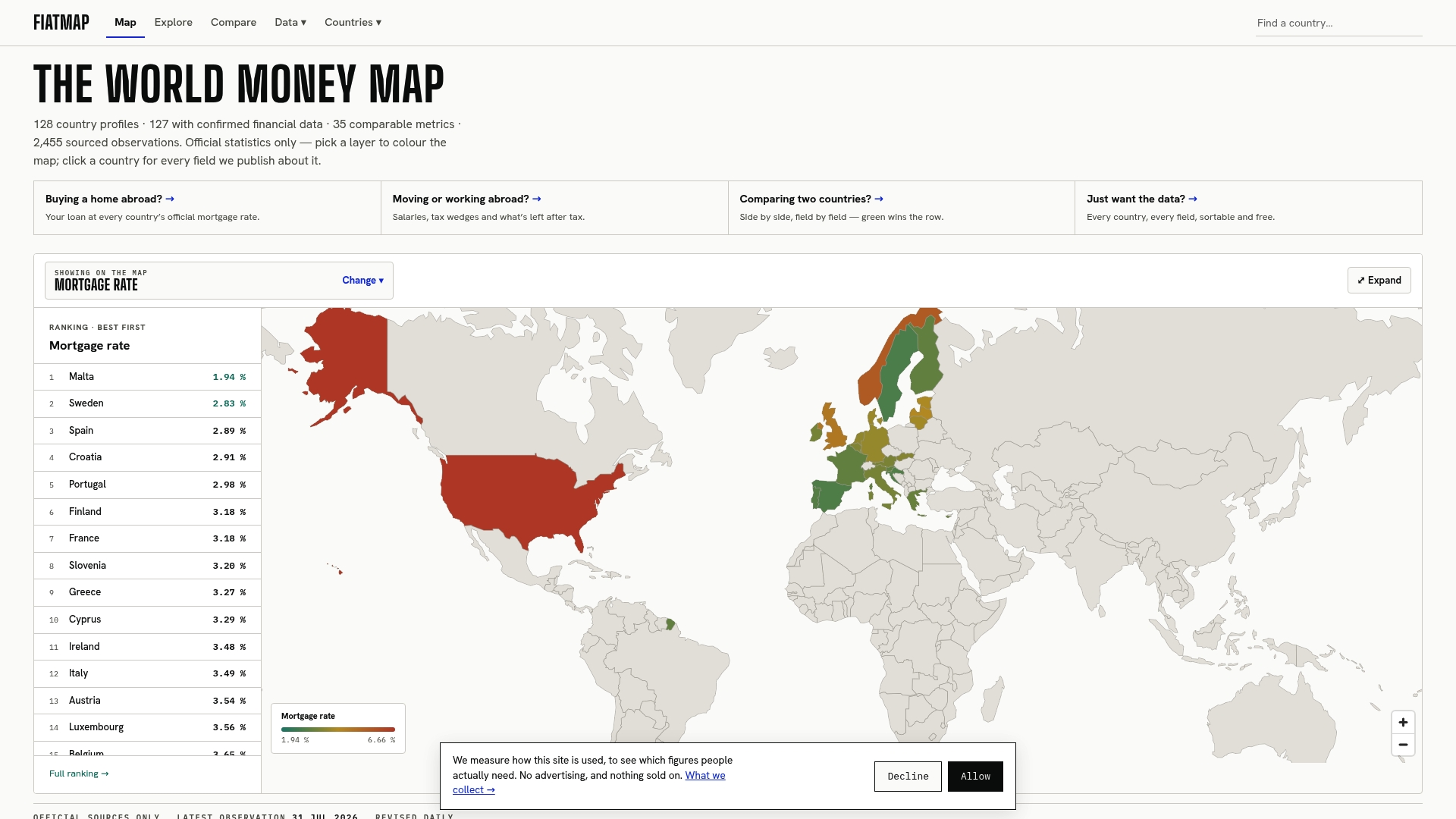
Start with our mortgage rates by country ranking, then see the highest and the lowest rates. Our story on the same mortgage priced in different countries shows how large the gap can be. For the wider picture, see lending rates on the map and mortgage market size by country.
FAQ
Which countries have mostly fixed-rate mortgages?
The US, with 30-year fixes, is the best known. In the euro area, the ECB identifies Belgium, France, Germany and the Netherlands as fixed-rate markets, and the OECD adds Denmark and, with shorter fixes, the Czech Republic and the UK. Canada is also mostly fixed, with terms of about five years.
Which countries rely mostly on variable-rate mortgages?
The ECB working paper lists Austria, Greece, Italy, Portugal and Spain as adjustable-rate markets. The OECD says Poland has almost only variable contracts. Australia’s fixed share of outstanding loans fell below 5% in 2025.
What is the variable mortgage share in each country?
It depends on the statistic. Spain reported 35.2% variable for February 2026, the UK 86% fixed for late 2022, and Canada about 23% variable on insured balances in July 2026. Check whether a figure covers new loans or the whole stock, and how the source defines “variable.”
Do fixed rates cost more than variable rates?
Not always. In Canada in July 2026, new variable loans (3.75%) were cheaper than fixed ones (3.99% to 4.05%). In Spain in February 2026, fixed starting rates (2.78%) were below variable (3.03%). The gap changes with the rate cycle and the lender’s funding.
Sources
- ECB Working Paper 2322: Fixed rate versus adjustable rate mortgages
- ECB: Housing Finance in the Euro Area (2009)
- ECB: Features of mortgage contracts in the euro area (2004)
- OECD: Mortgage finance across OECD countries (2021)
- RBA: Mortgage Interest Payments in Advanced Economies (February 2023)
- RBA Bulletin: Fixed-rate Housing Loans (March 2023)
- RBA Bulletin: Developments in Banks’ Funding Costs and Lending Rates (May 2026)
- INE Spain: Mortgage Statistics, February 2026
- ARA: Mortgage signings in Catalonia
- Bank of England: Money and Credit, November 2025
- ONS: How increases in housing costs impact households
- Bank of Canada: Interest rates for new and existing lending
- Bank of Canada: Funds advanced and outstanding balances
- Danmarks Nationalbank: Danish homeowners shift from fixed to variable interest rates
Recommended
The figures on this site are collected from official statistics and each carries its own source and date — see /sources and the dataset. Where this article states a number, the country and ranking pages are what it should agree with.