Investors: Size Inflation Hedging Assets by Horizon and Country
2026-10-01

Inflation-linked bonds, commodities, selective equities, gold, real estate, and cash or short-term instruments make up the core toolkit for hedging against inflation, but no single asset works in every situation. Effectiveness depends on whether inflation is driven by supply shocks, demand pressure, or monetary tightening, and on how long you plan to hold the position. Research from the IMF and country-level data from financial data platforms can help translate this general shortlist into decisions that fit a specific market.
TL;DR:
- Commodities respond quickly to supply shocks but can be highly volatile and have costs that erode returns over time.
- Inflation-linked bonds can lose market value when real yields rise, even though they adjust for CPI changes.
- Long-term investors tend to benefit more from equities and real estate, but these assets are subject to significant market fluctuations and local market conditions.
- Currency risk can undermine international inflation hedges because exchange rate movements may offset the hedge’s intended inflation protection.
- A diversified, horizon-based approach and ongoing monitoring of real yields, commodity prices, and break-even inflation improve hedge effectiveness.
Table of Contents
- What are the main asset classes used to hedge inflation?
- How does each asset class perform across different inflation shocks?
- How should horizon shape your inflation-hedging allocation?
- What risks and limitations should investors weigh before relying on these hedges?
- How Fiatmap’s country data helps size inflation hedges
- How do inflation expectations and surprise inflation move asset prices?
- How does currency risk affect international inflation hedging?
- What are the tax implications of inflation-hedging investments?
- Does active or passive management work better for inflation hedging?
- What should retail investors know about accessibility and liquidity?
- What this means for your portfolio
- Where Fiatmap fits into your hedging decisions
- Sources
- FAQ
What are the main asset classes used to hedge inflation?
Each asset class protects purchasing power through a different mechanism, and understanding that mechanism tells you when it will hold up and when it will not.
Inflation-linked bonds, such as US TIPS or European ILBs, adjust their principal or coupon to a reference price index. The market also watches break-even inflation, the gap between a nominal bond’s yield and an inflation-linked bond’s yield, as a read on what investors expect prices to do. The mechanics of this indexation connect directly to the CPI that governments publish and that central banks track against their inflation targets.
Commodities split into several useful subgroups: energy (oil, natural gas), industrial metals (copper, aluminum), and broad commodity indices that blend both with agricultural goods. Gold sits in its own category, prized as a safe haven more than a reliable inflation hedge. Equities offer two inflation-related angles: broad market exposure that tends to outpace inflation over long periods, and sectors with pricing power or real-asset backing that can pass costs through faster. Real estate hedges inflation when rents reset frequently, though local market frictions and transaction costs slow that pass-through. Cash and short-term instruments protect value for a few months but erode steadily the longer they’re held.
- Inflation-linked bonds adjust principal or coupons to a price index, directly tracking CPI changes.
- Commodities, especially metals and energy, respond fastest to supply-side inflation shocks.
- Equities and real estate offer long-run inflation protection but carry more volatility along the way.
How does each asset class perform across different inflation shocks?
The research is clear that timing and shock type matter more than any asset’s reputation as a hedge.
- Commodities tend to hedge supply-driven inflation well since prices for oil, metals, and food often rise before the shock shows up in core inflation data, but they bring volatility, storage costs, and roll costs that erode returns over time.
- Inflation-linked bonds compensate directly for realized CPI changes through their indexed structure, yet TreasuryDirect’s TIPS overview and ECB analysis of inflation-linked debt markets both note that rising real yields can still produce capital losses on these bonds even as their coupons adjust upward.
- Equities usually beat inflation over long horizons, but ECB research on financial stability shows stocks and bonds can fall together when monetary tightening pushes up discount rates, weakening the diversification investors count on.
- Gold often performs well during geopolitical stress and policy uncertainty, but its record as a pure inflation hedge is inconsistent rather than dependable; learn more about its role in diversification on the Galami Gold site.
- Real estate returns depend heavily on local rent and price dynamics, financing costs, and leverage, so results vary sharply by country and property segment.
Metals shocks can move core inflation for years, not months. The IMF’s October 2024 commodity special feature finds that a 10% increase in copper prices can raise core inflation cumulatively over a 48-month horizon, underscoring that metals-driven inflation isn’t a short-lived event central banks can wait out.
That persistence matters for allocation: a commodity hedge sized for a short price spike may need to stay in place far longer than investors expect.
How should horizon shape your inflation-hedging allocation?
Horizon changes which assets do the heavy lifting, and IMF research on long-term investors confirms that short-run hedges often stop working once you extend the holding period.
For a 0 to 3 year horizon, cash and short-term instruments combined with selective commodity exposure give the fastest response to an inflation shock, since these assets reprice quickly without the duration risk that hurts longer bonds. For a 3-plus year horizon, inflation-linked bonds and equities deserve more weight, with commodities and real assets used as tactical overlays rather than core holdings. BIS modeling of hedging portfolios shows that shortfall probability, the chance a hedge fails to keep pace with inflation, drops meaningfully as the holding period lengthens for most asset classes.
- A safety-first mix might lean on short-term instruments and inflation-linked bonds, accepting lower expected returns for steadier protection.
- A growth-oriented mix shifts weight toward equities and real assets, accepting more volatility for a higher expected real return over time.
- Rebalancing on a set schedule, rather than reacting to headlines, keeps the hedge sized to its original purpose instead of drifting with market moves.
Pro Tip: Treat your inflation hedge as a sleeve with a target size, not a one-time purchase, and revisit the weights when real yields or break-even inflation shift meaningfully.
Higher required real returns naturally push allocations toward riskier assets like equities and commodities, since safer instruments rarely clear a high real-return bar on their own.
What risks and limitations should investors weigh before relying on these hedges?
Hedges can fail in ways that surprise investors who treat them as automatic protection.
Correlation breakdown is the biggest structural risk. ECB research documents periods when stocks and bonds moved down together as monetary tightening raised discount rates across both asset types, undermining the diversification investors expect from holding both. Inflation-linked bonds carry their own duration and real-yield risk: indexed coupons help, but a sharp rise in real yields can still produce a capital loss on the bond itself. Commodities bring carry and storage costs that quietly reduce returns between rebalancing dates, and real estate carries transaction costs, financing exposure, and illiquidity that make it slow to adjust.
Index definitions, CPI baskets, and market liquidity differ enough between countries that an inflation-linked bond or a real estate hedge in one market can behave nothing like its counterpart elsewhere.
Checking a country’s inflation rate and real rate environment before sizing a hedge is not optional, it’s part of the analysis.
How Fiatmap’s country data helps size inflation hedges
Comparing two countries side by side often reveals which hedge makes sense locally. An investor weighing a eurozone inflation-linked bond against increased commodity exposure can check the inflation map alongside real deposit rates to see whether cash is already losing less ground in one market than another, or consult mortgage rate rankings when real estate is part of the comparison. A country with deeply negative real deposit rates and rising inflation points toward inflation-linked instruments or commodities; a country with positive real rates may not need as aggressive a hedge. Fiatmap draws exclusively from official statistics and offers downloadable data for deeper modeling.

How do inflation expectations and surprise inflation move asset prices?
Markets price in expected inflation well before it shows up in the data, which is why break-even inflation, not the latest CPI print, often drives bond and equity moves. When inflation comes in above what break-evens implied, nominal bonds tend to sell off sharply since their fixed coupons are now worth less in real terms, while inflation-linked bonds benefit directly from the upward principal adjustment.
Equities react more unevenly to inflation surprises. A surprise driven by strong demand can support corporate earnings even as it raises the inflation outlook, while a surprise tied to a supply shock, like a sudden spike in energy costs, tends to squeeze margins and weigh on equity prices at the same time it lifts commodity-linked holdings. Gold’s response to a surprise often hinges on whether the surprise also raises policy uncertainty, since that uncertainty, not inflation alone, is what tends to draw safe-haven demand.
For investors, the practical lesson is that the size and direction of an inflation surprise relative to expectations, not the inflation rate itself, is what tends to move markets. Watching break-even inflation alongside actual CPI releases gives a clearer read on whether the market is being surprised than watching the headline number in isolation.
How does currency risk affect international inflation hedging?
An inflation hedge denominated in a foreign currency carries an extra layer of risk that a domestic hedge does not. A commodity position or foreign inflation-linked bond can protect purchasing power in its home currency while still losing value in an investor’s own currency if the exchange rate moves against them, effectively canceling out the inflation protection the asset was meant to provide.
This matters most for inflation-linked bonds, since their entire value proposition rests on tracking a specific country’s CPI. A European investor holding US TIPS is hedging US inflation, not their own, unless the currency exposure is separately managed. Commodities priced in US dollars carry a related but distinct risk: a weakening dollar can lift commodity prices in dollar terms for reasons unrelated to inflation in the investor’s home country, which can either amplify or dilute the hedge depending on the investor’s base currency.
Some investors hedge the currency exposure separately, accepting the cost of a hedge to isolate the inflation protection they actually want. Others accept the currency risk as a diversification benefit in its own right, reasoning that currency and inflation cycles do not always move together. Either way, the decision should be deliberate rather than an accident of which assets happened to be available.
What are the tax implications of inflation-hedging investments?
Tax treatment varies significantly by country and by asset type, and it can erode the real return a hedge is supposed to deliver. Inflation-linked bonds raise a specific issue in some jurisdictions: the annual upward adjustment to principal can be taxed as income in the year it accrues, even though the investor does not receive that cash until the bond matures or is sold. This is sometimes called phantom income, and it can materially reduce the after-tax return of a hedge that looks attractive before taxes.
Commodity exposure through futures-based funds, physical holdings, or exchange-traded products is taxed differently depending on the structure and the investor’s country of residence, with some jurisdictions applying collectible tax rates to physical gold that differ from rates on other investments. Real estate carries its own set of rules around rental income, depreciation, and capital gains that vary by country and by whether the property is held directly or through a fund.
None of this is a reason to avoid a hedge, but it is a reason to model the after-tax return rather than the headline return before sizing a position. A tax-advantaged account can neutralize some of these frictions, particularly the phantom income issue with inflation-linked bonds, where available. Because rules differ by residency and entity type, a qualified tax professional familiar with the investor’s specific jurisdiction is the right source for a definitive answer, not a general guide.

Does active or passive management work better for inflation hedging?
Passive approaches, index funds and ETFs tracking a broad commodity index, an inflation-linked bond index, or a real-asset equity index, offer low costs and predictable exposure to the asset class as a whole. For investors who want a hedge without ongoing decisions about which specific metal or which maturity to hold, passive vehicles deliver the asset class’s general behavior at a lower fee than most active alternatives.
Active management can add value in inflation hedging specifically because the asset classes involved, commodities and inflation-linked bonds in particular, have components that behave quite differently from each other. An active manager choosing between energy and industrial metals, or selecting shorter-duration inflation-linked bonds when real yields are expected to rise, is making decisions that a broad passive index cannot make for itself. The IMF’s research on tactical allocation suggests that adjusting a hedge’s composition as the inflation regime changes can improve outcomes compared to a static allocation.
The trade-off is cost and skill risk. Active strategies charge more, and there is no guarantee the manager’s tactical calls will beat a simple passive benchmark over time. A reasonable middle ground many investors use is passive exposure to the broad asset class, inflation-linked bonds or a commodity index, with any active tilting applied at the margin, in a smaller satellite position, rather than across the full hedge.
What should retail investors know about accessibility and liquidity?
Not every inflation hedge is equally easy for an individual investor to access. Inflation-linked bonds and broad commodity exposure are available through mutual funds and ETFs with no special account requirements and modest minimum investments, often the price of a single share. Direct TIPS purchases are available to individual investors through government platforms in some countries, including the United States, without a broker.
Physical gold and direct real estate are the least liquid options on this list. Physical gold involves storage and insurance costs that eat into returns, and selling it quickly at a fair price is harder than selling a gold ETF. Direct real estate requires substantial capital, carries high transaction costs, and can take months to sell, which makes it a poor fit for an investor who needs to adjust their hedge quickly in response to new data.
For most retail investors, ETFs and funds tracking inflation-linked bonds, commodities, or real estate investment trusts offer the most practical balance of accessibility, liquidity, and cost. These vehicles let an investor build a diversified hedge with a modest amount of capital and the ability to adjust the position as conditions change, without the operational burden of holding the underlying assets directly.
What this means for your portfolio
Three things matter more than picking the “best” hedge: match the instrument to your horizon, size positions to the inflation regime you’re actually in rather than the one you remember from history, and accept that every hedge on this list has failed under some conditions.
Watch three signals on an ongoing basis: real yields, since rising real yields hurt inflation-linked bonds even as their coupons adjust; commodity prices, since persistent metals moves can signal multi-year core inflation pressure; and break-even inflation, since it shows what the market already expects and therefore what would count as a surprise.
— Torstein
Where Fiatmap fits into your hedging decisions
Building a horizon-based hedge means comparing inflation and rate conditions across countries, not just within one. Reliable financial data platforms pull official statistics into a single view so you can check a country’s inflation trend against its real deposit rates before deciding whether local cash is holding its value or whether a bigger tilt toward inflation-linked bonds or commodities makes more sense.
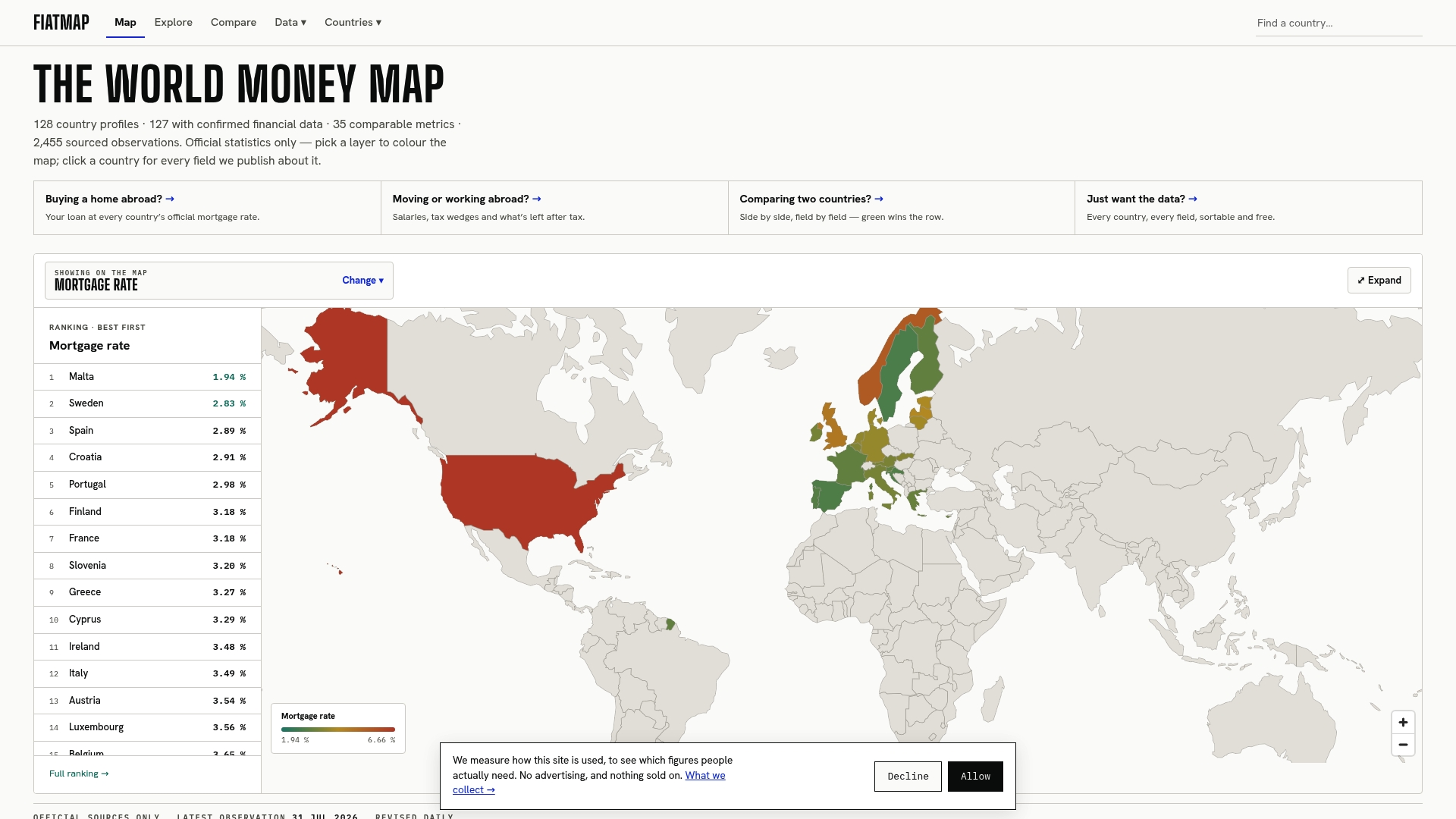
- Review mortgage rates by country when real estate exposure is part of your hedge.
- Download the Global Money Dataset to model hedge scenarios with official, sourced figures.
The data is free to explore, sourced only from official statistics, and built for comparing conditions across 128 countries at once.
This article is general information, not a substitute for advice from a qualified financial advisor. Consult a qualified financial professional about your own circumstances before acting on anything here.
Sources
- Inflation Hedging for Long-Term Investors — IMF WP (2016)
- ECB — Financial stability research on asset correlations (2022)
FAQ
What is an inflation hedge asset?
An inflation hedge asset is an investment whose value tends to hold up or rise when consumer prices increase, protecting purchasing power rather than losing it over time. Common examples include inflation-linked bonds, commodities, real estate, and certain equities, though each works through a different mechanism and under different conditions.
What is the best investment to hedge inflation?
There is no single best option because effectiveness depends on the investor’s horizon and the type of inflation shock. For short horizons, cash and short-term instruments plus selective commodities respond fastest, while IMF research finds inflation-linked bonds and equities tend to serve long-term investors better.
What is the best asset against inflation?
Inflation-linked bonds are the most direct hedge since their principal adjusts to a reference price index, but TreasuryDirect and ECB research both note they can still lose market value when real yields rise. Equities and commodities complement this protection depending on whether the inflation is demand-driven or supply-driven.
Which investment is a hedge against inflation?
Several asset classes serve as partial hedges, including inflation-linked bonds, commodities like energy and metals, real estate, and broad equities held over long periods. BIS research shows the shortfall probability of failing to beat inflation drops for most of these assets as the holding period lengthens.
How does Fiatmap help compare inflation across countries?
Fiatmap sources inflation, real rate, and mortgage data exclusively from official statistics across 128 countries, letting investors compare conditions on an interactive inflation map before sizing a hedge. The platform also offers downloadable datasets for deeper modeling of country-specific hedging decisions.
Recommended
The figures on this site are collected from official statistics and each carries its own source and date — see /sources and the dataset. Where this article states a number, the country and ranking pages are what it should agree with.