26 Central Banks on Inflation Targeting Regimes and Fiatmap Data
2026-09-30

The BIS counts at least 26 central banks running some version of this regime across both advanced and emerging economies, and most have grown more flexible on horizons even as their numerical targets got stricter. The core trade-off never disappears: firmer anchoring of expectations against room to absorb shocks to output and financial stability.
TL;DR:
- Most inflation-targeting central banks now adopt narrower point targets with longer, vaguer horizons to balance credibility and flexibility.
- Frameworks with escape clauses or vague horizons enable countries to manage supply shocks or crises without breaking their stated targets.
- External spillovers from major economies’ monetary policy can influence inflation outcomes in smaller or emerging markets with looser or Lite frameworks.
- The 2% inflation target is a pragmatic safety margin rooted in avoiding deflation and maintaining policy space at the effective lower bound.
- Cross-country comparisons require careful data sourcing, consistent metrics, and awareness of structural differences in CPI definitions and measurement practices.
Table of Contents
- Core Features of an Inflation-Targeting Framework
- A Typology of Regimes: Full-Fledged, Implicit Anchors, and Lite Targeting
- How Inflation Targeting Works: Forecasts, Reaction Functions, and Communication
- Why 2% and Not 0%: The Logic Behind the Common Target
- How Inflation-Targeting Frameworks Have Evolved: 1990 to 2026
- Implementation Differences and the Credibility Puzzle
- Strengths, Limitations, and Common Criticisms of Inflation Targeting
- A Practical Checklist for Designing or Evaluating an Inflation-Targeting Regime
- Data and Measurement: Reading CPI, Core, and Cross-Country Statistics
- International Coordination and Spillover Effects
- Case Studies: Where Inflation Targeting Has Worked and Where It Has Struggled
- Forward Guidance and Unconventional Tools Within Inflation Targeting
- Growth and Distribution: What Inflation Targeting Does and Does Not Deliver
- What This Framework Gets Right and Where Readers Should Look Next
- Comparing Inflation Targets and Country Data With Fiatmap
- Sources
- FAQ
Core Features of an Inflation-Targeting Framework
A framework earns the label “inflation targeting” when it combines four elements: a public numerical goal, a chosen price metric, an operational horizon, and a communication regime built around forecasts. Drop any one of these and you get something looser, an implicit anchor or a managed-float arrangement with an inflation preference, not a full inflation-targeting regime.
Central banks also choose between headline and core measures. Headline CPI captures the full basket including food and energy, while core inflation strips out the volatile components to give policymakers a cleaner read on underlying price pressure. Fiatmap’s core inflation explainer breaks down why many banks watch core measures operationally even while communicating headline figures to the public, since headline is what households actually experience at the till.
Transparency is not decorative. It’s the mechanism through which the target does its anchoring work. A bank that publishes its inflation and interest-rate forecasts lets markets, wage negotiators, and firms setting prices align their expectations with the stated goal before it happens, not after. The IMF’s explainer on inflation targeting frames this operational form as inflation-forecast targeting: the policy rate responds to where inflation is expected to be in 12 to 24 months, not to last month’s print.
On the instrument side, the policy rate remains the primary lever, but many central banks also lean on balance-sheet tools when rates alone cannot do the job. Fiatmap’s central bank balance sheet glossary page covers how asset purchases and balance-sheet expansion or contraction supplement rate policy, particularly near the effective lower bound.
Several structural constraints limit how precisely any of this can be executed:
- Monetary policy works through transmission lags, so a rate move today mostly affects prices 12 to 24 months out, not next quarter.
- The effective lower bound (ELB) caps how far rates can fall before cuts stop working as intended.
- Inflation data gets revised, sometimes materially, which means real-time policy decisions are made on imperfect information.
- Forecast errors compound the further out the horizon stretches, weakening the precision of forward guidance at longer terms.
These constraints are why no inflation-targeting central bank claims to hit its number every month. The commitment is to the trajectory, not the print.
A Typology of Regimes: Full-Fledged, Implicit Anchors, and Lite Targeting
Not every central bank that mentions a price goal runs the same regime. Three broad categories help place a country’s framework on a spectrum from rigorous to aspirational.
- Full-fledged inflation targeting means a public numerical target, an explicit horizon, regular forecast publication, and an institutional commitment that overrides other objectives when they conflict. New Zealand’s Reserve Bank set the template in 1990 as the first adopter, according to BIS records, and Canada and the United Kingdom followed within a few years with similarly explicit frameworks.
- Implicit inflation targeting describes central banks that behave as if they have a target, responding to inflation deviations in their reaction function, without publishing a formal number or committing to a specific horizon. The mechanics resemble full-fledged targeting, but the public commitment and transparency requirements are weaker or absent.
- Inflation-targeting lite sits between the two: a numerical target exists, but it competes openly with other goals, such as exchange-rate stability or growth, and the central bank retains wide discretion to miss the target without much explanation. This is common among emerging markets managing capital flows or currency pressure alongside price stability.
Escape clauses reshape all three categories in practice. A central bank that can suspend its target during a defined supply shock, or that widens its tolerance band during a crisis, is still “targeting” inflation, but the credibility of that commitment depends on how narrowly the escape clause is drawn and how transparently it gets invoked. A vague horizon, “the medium term” with no further definition, functions similarly to an implicit escape clause: it gives room to miss without technically breaking the framework.
How Inflation Targeting Works: Forecasts, Reaction Functions, and Communication
The mechanics of inflation targeting run on expectations, not on the inflation rate itself. A central bank practicing inflation-forecast targeting sets its policy rate based on where its models say inflation is heading, adjusting today for a deviation that hasn’t happened yet. The IMF describes this as the operational core of the regime: publish the forecast, explain the gap between forecast and target, and let the policy rate close that gap over the stated horizon.
This is intuitively related to the Taylor rule, which says the policy rate should rise when inflation runs above target and when output runs above potential. In inflation-forecast targeting, the practical version of that rule swaps in the expected inflation gap rather than the observed one. A bank raises rates today because inflation is forecast to overshoot in 18 months, not because it overshot last quarter. That distinction matters for how markets read policy signals: a rate hike alongside a forecast of falling inflation reads very differently from a hike alongside a forecast of continued overshoot.
Models, data infrastructure, and communication together do the anchoring. A central bank without credible forecasting capacity cannot practice inflation-forecast targeting convincingly, no matter what number it announces. This is why the regime concentrated among economies with strong statistical agencies and modeling teams before spreading more broadly.
Flexible inflation targeting, the dominant style since the 2008 financial crisis, lets central banks weigh output and financial stability alongside the inflation number itself, without formally abandoning the numerical anchor:
- The policy rate can move more gradually when a strict inflation-only rule would demand a sharper adjustment that risks unnecessary output loss.
- Financial stability concerns, credit growth, asset prices, can justify holding rates steady even when inflation sits slightly off target.
- Longer return horizons give room to absorb one-off shocks (an energy spike, a tax change) without an aggressive rate response.
- Communication about why the bank is tolerating a temporary miss substitutes for a mechanical rule, provided the explanation is consistent and credible.
Pro Tip: *When comparing two countries’ frameworks, check the stated return horizon before the target number itself.
Why 2% and Not 0%: The Logic Behind the Common Target
It reflects a set of pragmatic trade-offs about deflation risk, policy room, and measurement noise, laid out in central bank literature including an ECB occasional paper on target design.
The core argument runs through the effective lower bound. Nominal interest rates cannot fall much below zero without disrupting bank lending and deposit markets, so a central bank needs room to cut rates during a downturn.
Measurement noise adds a second layer. A positive target absorbs that bias without requiring policy to chase an unmeasurable “true zero.”
The 2% target is a pragmatic choice to provide a safety margin against deflation and the effective lower bound; a 0% target risks unintended deflation because of measurement error and limits to negative nominal rates. Rationale summarized in ECB occasional paper on target design
Point versus range targets carry their own trade-offs. Critics, including Kevin Warsh in commentary reported by the Associated Press, have argued that today’s inflation dynamics are structural enough, and measurement imprecise enough, that rigid point targets create false precision, and that range-based targets would better reflect genuine uncertainty.
Neither move has attracted consensus support among major central banks so far.
How Inflation-Targeting Frameworks Have Evolved: 1990 to 2026
The regime looks different today than it did when New Zealand adopted it in 1990. The BIS Quarterly Review tracks these shifts across a database covering changes to frameworks at 26 central banks through 2025, and the pattern is consistent enough to call a trend rather than a set of isolated country stories.
More than twenty central banks now run some form of inflation targeting, with adoption dates stretching from New Zealand in 1990 to India in 2016, according to the BIS database. That spread across three decades means the regime has been tested through very different macro environments: disinflation in the 1990s, the pre-crisis moderation of the 2000s, the 2008 financial crisis, and the post-pandemic inflation surge.
Two structural shifts stand out in the data:
- Many frameworks moved from wide target ranges toward point midpoints, tightening the numerical anchor even as the stated language around it grew less mechanical.
- Return horizons lengthened and grew vaguer at the same time, giving central banks more room to miss the point target temporarily without triggering a credibility crisis.
- Explicit weight on employment and financial stability objectives increased, more visibly in advanced economies than in emerging markets, reflecting the post-2008 recognition that inflation-only mandates missed financial imbalances building beneath stable prices.
- The shift accelerated around two junctures: the 2008 to 2009 financial crisis, when several banks formally acknowledged financial stability as a secondary concern, and the 2021 to 2023 post-pandemic inflation surge, which tested how much flexibility a “flexible” framework could absorb before losing credibility.
The implication for policy design is that a numerical target and operational flexibility aren’t in tension, they’re two dials that move somewhat independently. A central bank can tighten its point target while loosening its horizon, and many have done exactly that. For a reader evaluating a given country’s framework, checking the target and the horizon together, rather than the number alone, gives a far more accurate picture of how strict the regime really is in practice.
Implementation Differences and the Credibility Puzzle
Not every inflation-targeting central bank operates from the same starting point, and history explains a large share of the variation. Countries emerging from decades of high or volatile inflation carry that legacy into their reaction functions, often responding more forcefully to inflation risk than a purely forward-looking model would predict.
An IMF working paper (WP/25/79) documents this pattern directly: central banks with a history of high inflation show stronger policy-rate responses to expected-inflation gaps than banks without that history, with some specifications showing an additional response on the order of 26 basis points per unit of expected-inflation deviation. The paper frames this as a credibility puzzle: a bank that has already anchored expectations successfully doesn’t need to react as hard to a given forecast gap, while a bank still building credibility has to overreact just to keep expectations from drifting.
This path dependence shows up in concrete design choices between advanced and emerging economies:
- Advanced economies more often run point targets with narrow tolerance bands, reflecting institutional credibility built over long, relatively stable track records.
- Emerging markets more often retain wider bands or lite frameworks, partly to manage exchange-rate pass-through and capital-flow volatility that advanced economies face less acutely.
- Horizon length tends to be shorter and stricter in economies still establishing credibility, since a vague horizon reads as weakness rather than sophistication when trust hasn’t been earned yet.
- Reaction-function coefficients, the basis-point response per percentage point of expected-inflation gap, run measurably higher in economies with high-inflation histories, per the IMF’s analysis.
The policy implication is that credibility, once damaged, has to be earned back through demonstrated consistency, not proclaimed through a stronger-sounding target. A country repairing its reputation after a high-inflation episode faces a longer road than one starting fresh, and impatience with that process, cutting rates too early to declare victory, tends to cost more credibility than it saves in short-term relief.
Strengths, Limitations, and Common Criticisms of Inflation Targeting
Inflation targeting earns its place as a durable framework because it gives markets, wage setters, and firms a single, checkable number to plan around. When that anchor holds, it reduces the second-round effects of temporary price shocks: a spike in oil prices is less likely to feed into wage demands and a broader inflation spiral if everyone expects the central bank to bring inflation back to target regardless.
The limitations are just as real: for readers who want a practical tool to see how inflation erodes purchasing power over time, the Inflation Calculator — Future Cost & Buying Power — Mali offers a straightforward resource.
- Supply shocks, energy spikes, harvest failures, sit outside the central bank’s control, yet a strict framework still gets judged against inflation prints driven by forces monetary policy cannot address directly.
- The effective lower bound constrains the response available during severe downturns, forcing reliance on less-tested balance-sheet tools.
- Financial stability risks, credit bubbles and asset-price inflation, can build up even while headline inflation sits comfortably at target, a blind spot exposed sharply by the 2008 crisis.
- Measurement issues, basket composition, substitution bias, and how housing costs get captured, mean the “true” inflation rate a target is meant to hit is itself an estimate.
Scholars and central bankers have proposed adjustments rather than wholesale replacement: widening tolerance bands to reduce false signals from normal noise, formally incorporating financial stability indicators into the reaction function rather than treating them as an afterthought, and lengthening horizons explicitly rather than leaving them vague. None of these change the basic architecture, they refine how much room the framework gives itself before declaring a miss.
Judging whether a given country’s framework is working comes down to a few observable signals: whether long-run inflation expectations (from surveys or market breakevens) stay close to the target through shocks, whether the central bank’s forecasts have tracked realized inflation reasonably well over multiple cycles, and whether the bank’s communication about misses has stayed consistent rather than shifting the justification each time.
A Practical Checklist for Designing or Evaluating an Inflation-Targeting Regime
Whether you are building a framework from scratch or grading an existing one, the same set of questions applies.
- Choose the metric first. Decide between headline and core inflation, and be explicit about which one drives policy decisions versus which one gets communicated publicly; Fiatmap’s CPI and core inflation glossary pages lay out the practical difference.
- Choose the target form. A point target communicates clearly but invites criticism on small misses; a range built around a midpoint tolerates normal noise but reads as less accountable. Check Fiatmap’s inflation target page for how different countries structure this choice.
- Assess institutional capacity honestly. Forecasting models, timely data systems, and a governance structure independent enough to hold the line under political pressure are prerequisites, not add-ons.
- Build the escape clause deliberately. Define in advance what qualifies as a shock large enough to justify a temporary miss, and commit to publicly explaining any invocation rather than leaving it to discretion after the fact.
- Set monitoring indicators before a crisis hits. Market-based breakeven inflation rates, long-run survey expectations, and the consistency of the bank’s own forecast track record all signal whether the anchor is holding.
Pro Tip: Track long-run (5 to 10 year) survey-based inflation expectations rather than short-run market pricing when judging anchor credibility. Short-run breakevens move with every headline print; long-run expectations only shift when markets genuinely doubt the framework.
Data and Measurement: Reading CPI, Core, and Cross-Country Statistics
Comparing inflation-targeting frameworks across countries is only as reliable as the data behind the comparison, and CPI definitions are not standardized globally. Basket composition, treatment of housing costs, and revision practices all differ by country, which means a raw side-by-side of headline CPI numbers can mislead as much as it informs unless you know what sits underneath each figure.
Metric choice compounds this. A country targeting core inflation while another targets headline will show different volatility profiles even under identical underlying price pressure, simply because one measure strips out food and energy and the other doesn’t. Fiatmap’s HICP glossary page covers how the European Union’s harmonized measure differs structurally from national CPI calculations elsewhere, a distinction that matters directly when comparing eurozone countries to non-European inflation targeters.
A few practical habits help when working with official statistics across countries:
- Check whether a country’s headline number has been revised since first release before drawing conclusions from a single print.
- Confirm whether the series is seasonally adjusted, since raw month-on-month comparisons across countries with different seasonal patterns can distort apparent trends.
- Compare like metrics: core to core, headline to headline, rather than mixing measures across countries in a single table.
- Use the inflation rate rankings and real policy rate map together, since a policy rate only makes sense relative to the inflation it’s responding to.
The inflation, mortgage rate, and macroeconomic figures come exclusively from official national and international statistical sources, which is the baseline requirement for any cross-country comparison of this kind to hold up.
International Coordination and Spillover Effects
Inflation-targeting regimes are formally domestic mandates, but monetary policy set in one large economy rarely stays contained within its borders. A rate move by a major central bank shifts capital flows, exchange rates, and borrowing costs for countries far outside its jurisdiction, particularly emerging markets with dollar-denominated debt or currencies pegged loosely to a major reserve currency.

This creates a coordination problem without a formal coordinating body. Each inflation-targeting central bank sets policy for its own inflation forecast, yet a sharp tightening cycle in one large economy can import inflationary or disinflationary pressure into smaller economies through currency depreciation or capital flight, regardless of what those economies’ own inflation forecasts say. Emerging-market central banks running lite or implicit frameworks often have to weigh exchange-rate stability alongside their inflation target precisely because of this spillover channel, which is one reason their frameworks tend to retain more discretion than those of larger, more insulated economies.
There is no binding international mechanism that forces central banks to account for these spillovers in their own reaction functions, and inflation-targeting frameworks are explicitly designed around domestic objectives. The practical takeaway for analysts is that a country’s inflation outcomes cannot be read purely from its own framework and data. External financial conditions set elsewhere shape a meaningful share of the picture, especially for smaller, more open economies.
Case Studies: Where Inflation Targeting Has Worked and Where It Has Struggled
New Zealand’s 1990 adoption remains the reference case for a successful full-fledged framework: a small, open economy committed to a public target, built forecasting capacity around it, and maintained the regime through multiple economic cycles without abandoning the core commitment, according to the BIS. Canada and the United Kingdom followed within a few years with similarly durable frameworks, and the IMF notes that no central bank that has implemented inflation-forecast targeting in earnest has later abandoned it outright, a resilience the IMF ties to the transparency and forecasting discipline the regime demands.
Struggles tend to cluster around two situations: economies trying to run inflation targeting while also managing significant exchange-rate pressure, where the lite version of the framework leaves enough discretion that credibility never fully solidifies, and economies hit by large supply shocks that push inflation persistently outside the target band despite policy doing what the framework says it should. In both cases, the framework itself isn’t necessarily the failure point. The gap between what a target promises (price stability) and what the economy’s structural conditions allow (exchange-rate stability, supply resilience) is where the strain shows up.
The lesson for evaluating any single country’s record is to separate framework design from execution and from conditions outside the central bank’s control. A missed target during a global energy shock says less about the regime’s soundness than a missed target during a period of otherwise calm global conditions.
Forward Guidance and Unconventional Tools Within Inflation Targeting
Forward guidance, a central bank’s explicit communication about the likely future path of policy, sits at the center of how modern inflation targeting operates, particularly once the policy rate approaches the effective lower bound and conventional cuts run out of room. Guidance about how long rates will stay low, or what conditions would trigger a change, extends the anchoring effect of the framework beyond what the current rate alone can do.
Balance-sheet tools, asset purchases, targeted lending programs, and yield-curve measures, became a standard complement to rate policy during and after the 2008 crisis and again during the pandemic response, precisely because the ELB limited how far conventional tools could go. Fiatmap’s central bank balance sheet glossary page covers how these tools function mechanically, expanding or shrinking the bank’s holdings to influence longer-term rates and credit conditions when the short-term policy rate alone cannot.
Within an inflation-targeting framework, these unconventional tools don’t replace the target, they extend the toolkit for hitting it under constrained conditions. The credibility of forward guidance and balance-sheet policy still rests on the same foundation as ordinary rate policy: consistency between what the bank says and what it does, and a forecast-driven rationale that markets can check against outcomes over time.
Growth and Distribution: What Inflation Targeting Does and Does Not Deliver
Inflation targeting’s core promise is price stability, not growth maximization, and it’s worth being precise about that distinction. A credible framework can support growth indirectly by reducing the uncertainty that high or volatile inflation imposes on investment and wage-setting decisions, but the regime was never designed as a growth-maximizing tool, and evaluating it as one sets up a mismatch between what it promises and what it targets.
Distributional effects are more contested and less settled. Tight monetary policy aimed at bringing inflation back to target can weigh more heavily on borrowers, younger households, and lower-income groups more exposed to job losses during a slowdown, while savers and asset holders can benefit from higher real returns during the same period. Flexible inflation targeting, by allowing more gradual paths back to target, is partly a response to this concern, giving central banks room to avoid the sharpest, most distributionally uneven adjustments a strict rule would demand.
None of this settles the growth-versus-stability debate cleanly. What the framework does deliver, when it holds credibly, is a more predictable environment for the decisions that drive long-term growth: business investment, wage negotiation, and household saving, all of which function more efficiently when the future price level is less of a gamble.
What This Framework Gets Right and Where Readers Should Look Next
Inflation targeting works best as a coordination device, not a precision instrument. The framework’s critics are usually right about the details (measurement noise is real, supply shocks aren’t the central bank’s fault) and usually wrong to treat those details as reasons to abandon the anchor itself.
For students, start with the BIS database to see the cross-country variation firsthand. Analysts comparing countries should pair target design with actual inflation and rate data rather than trusting stated frameworks alone. Policymakers weighing reform should read the IMF’s credibility research before assuming a stronger-sounding target fixes a credibility problem that only consistent action can solve.
— Torstein
Comparing Inflation Targets and Country Data With Fiatmap
Reading about inflation targeting in the abstract only gets you so far. Seeing how the target, the actual inflation rate, and the policy rate line up across 128 countries at once is where the framework stops being theory and starts being comparable evidence, and that comparison is what Fiatmap is built for.
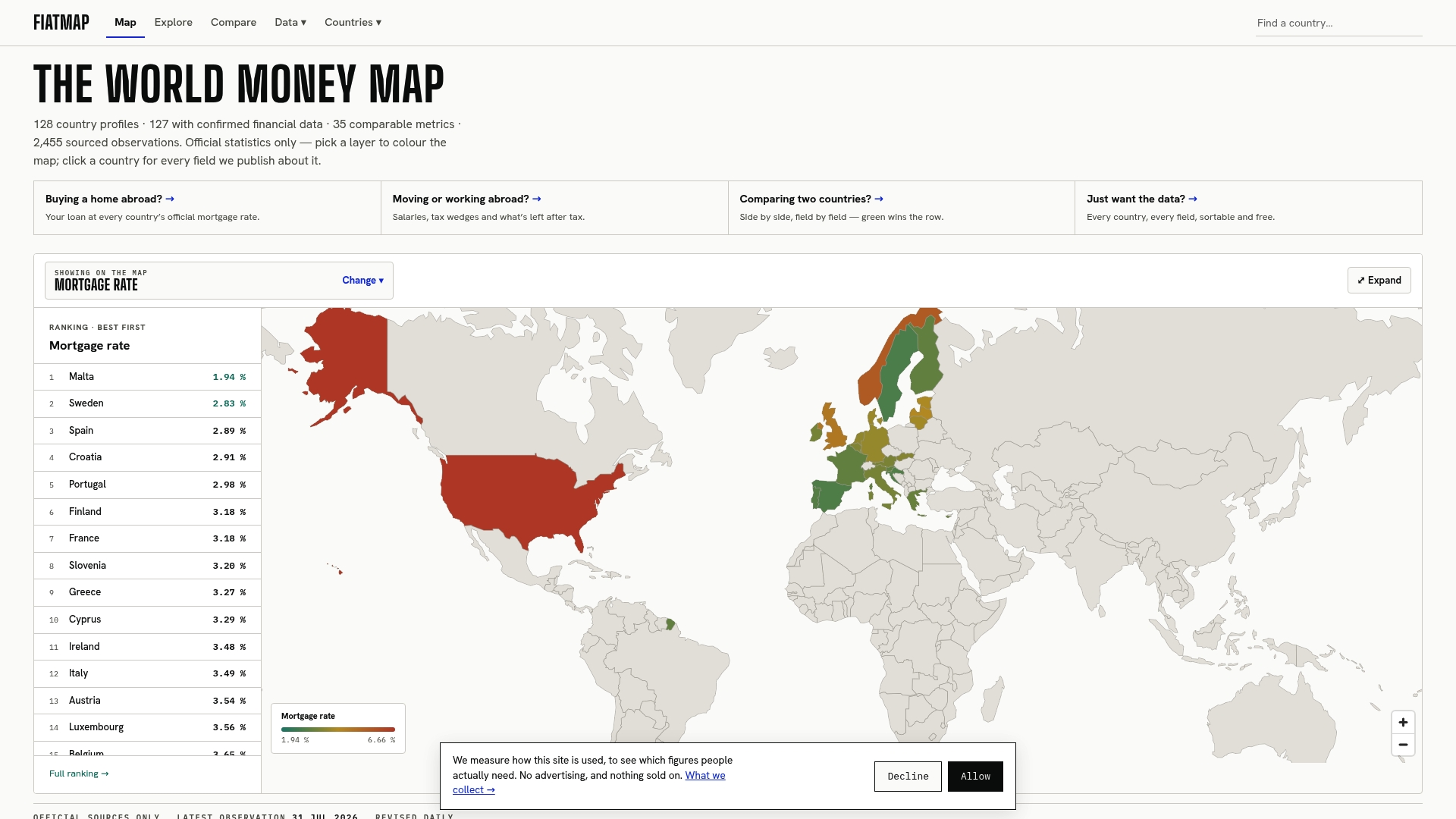
Fiatmap draws its inflation, mortgage rate, and broader macroeconomic figures exclusively from official statistical sources, which matters when a single misaligned CPI definition can throw off an entire cross-country comparison.
- Use the real policy rate map to see how tight or loose policy actually is once you adjust for inflation, not just the headline rate.
- Reference the inflation target and CPI glossary pages when you need a quick, sourced definition mid-analysis.
The full Global Money Dataset is free to download under CC BY 4.0 licensing for analysts who want the raw official-statistics figures behind these comparisons rather than a pre-built chart.
This article is general information, not a substitute for advice from a qualified financial advisor. Consult a qualified financial professional about your own circumstances before acting on anything here.
Sources
- Moving targets? Inflation targeting frameworks 1990 - 2025 (BIS Quarterly Review, March 2025)
- Inflation Targeting: Holding the Line (IMF F&D)
FAQ
Why is the inflation target usually 2% and not 0%?
The ECB frames 2% as a pragmatic safety margin against both problems.
What are Kevin Warsh’s views on inflation targeting?
Kevin Warsh has argued, in comments reported by the Associated Press, that inflation dynamics today are structural enough and CPI measurement imprecise enough that rigid point targets create false precision. He has pointed toward range-based targets as a more honest reflection of that uncertainty.
What are the main types of inflation?
Economists commonly distinguish types by cause rather than by a single fixed list: demand-pull inflation from excess demand, cost-push inflation from rising input costs, built-in inflation from wage-price spirals, and imported inflation from currency depreciation or global price shocks, among other variants discussed in the broader macroeconomic literature. Definitions vary by textbook, so treat any exhaustive numbered list as a teaching simplification rather than a fixed standard.
Where did the 2% inflation target come from?
New Zealand set the early template with its 1990 framework, and the 2% figure spread as other central banks adopted similar frameworks over the following decades, according to BIS records. The specific number reflects the deflation-safety-margin logic described in central bank research rather than any single founding decision.
How can I compare inflation targets across different countries?
Check each country’s stated target type (point versus range), its metric (headline versus core), and its actual inflation outcomes against that target using consistent official statistics. Fiatmap’s inflation rate rankings let you view actual rates across countries side by side using officially sourced figures.
Recommended
The figures on this site are collected from official statistics and each carries its own source and date — see /sources and the dataset. Where this article states a number, the country and ranking pages are what it should agree with.