Fiatmap Examples Make Interest Rate Parity Practical for Investors
2026-09-03

Interest rate parity says that the gap between two countries’ interest rates gets absorbed by their currencies’ forward or expected exchange-rate moves, so hedged returns end up equal no matter which currency you started in. There are two versions: covered interest rate parity (CIRP), which uses a forward contract and holds almost exactly in practice, and uncovered interest rate parity (UIP), which relies on expectations and holds poorly over short horizons. The practical upshot: forward exchange rates are not predictions, they are arithmetic built from interest differentials.
TL;DR:
- Covered interest parity generally holds in calm markets, with forward rates closely reflecting interest differentials, but transaction costs and risk premiums can cause deviations.
- Uncovered interest parity rarely predicts actual exchange rate movements accurately over short horizons due to the influence of risk premiums and currency-specific factors.
- During financial crises, deviations from interest rate parity often occur due to funding stress and capital constraints rather than arbitrage opportunities.
- Using real market data to compare current rates and forward quotes helps identify whether deviations indicate market stress or genuine arbitrage chances.
- Trust CIRP as a reliable arithmetic rule for hedging, but treat UIP-based forecasts as rough estimates rather than precise predictions.
Table of Contents
- What Is Interest Rate Parity, Exactly?
- Covered Interest Rate Parity: The Formula That Actually Holds
- Uncovered Interest Rate Parity: Where Expectations Take Over
- The Formulas and Math, Step by Step
- Why Covered Arbitrage Rarely Pays Off Anymore
- What the Assumptions and the Evidence Actually Tell You
- Testing These Formulas With Fiatmap’s Data
- Where the Textbook Version Falls Short
- Sources
What Is Interest Rate Parity, Exactly?
Interest rate parity theory is a no-arbitrage rule. It says you cannot earn a risk-free profit by borrowing in one currency, converting to another, investing at a higher rate, and converting back, because the exchange rate mechanism erases the gap. Some finance textbooks argue “interest rate parity” is a slightly misleading name. What actually equalizes is total return across currencies, not the nominal interest rates themselves, which is why some academic sources prefer calling it “rate-of-return parity.”
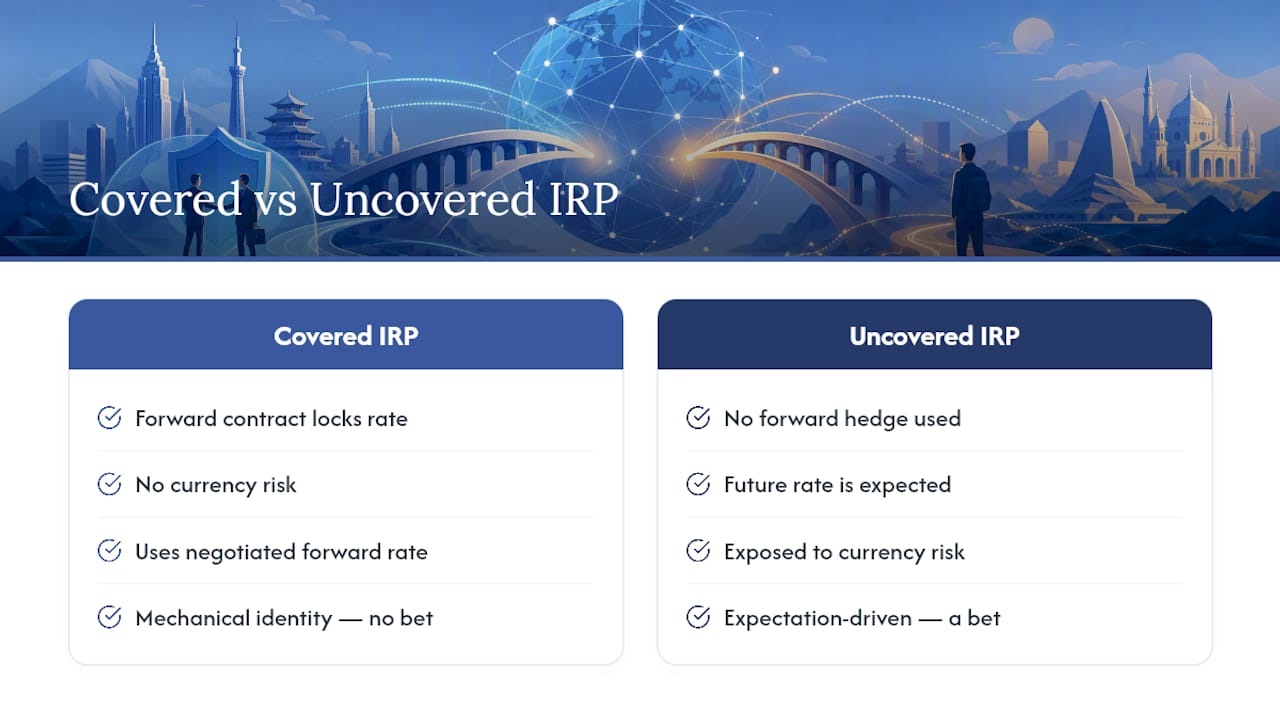
That distinction matters once you split the concept into its two working versions. Covered interest rate parity locks in the future exchange rate with a forward contract, removing currency risk entirely. Uncovered interest rate parity leaves the future exchange rate unhedged and depends on what traders expect that rate to be. One is close to a mechanical identity. The other is closer to a bet dressed up in an equation.
Covered Interest Rate Parity: The Formula That Actually Holds
CIRP states that the forward exchange rate must equal:
F = S × (1 + id) / (1 + if)
Here, S is the spot exchange rate (domestic currency per unit of foreign currency), F is the forward rate, id is the domestic interest rate, and if is the foreign interest rate. The logic behind it runs through four steps:
- Borrow one unit of foreign currency at rate if.
- Convert it to domestic currency at the spot rate S.
- Invest the proceeds domestically at rate id.
- Simultaneously lock in a forward contract at rate F to convert back and repay the foreign loan.
If F is priced correctly, both paths deliver identical returns, and nobody can lock in a free profit. Corporate Finance Institute’s explanation of CIRP frames this as the forward contract eliminating foreign exchange risk entirely, which is what makes covered interest arbitrage a mechanical no-arbitrage condition rather than a forecast.
Say the U.S. dollar/euro spot rate is 1.1000. The one-year forward rate should be:
F = 1.1000 × (1.05 / 1.03) ≈ 1.1214
That is the entire mechanism in one calculation. In practice, bid-ask spreads, transaction costs, and clearing fees mean real-world forward quotes wobble a few basis points from the textbook number, but rarely more than that in calm markets.
Uncovered Interest Rate Parity: Where Expectations Take Over
UIP swaps the forward contract for a guess. The equation looks similar:
E(St+1) = S × (1 + id) / (1 + if)
Instead of a contractually locked forward rate, E(St+1) is the market’s expected future spot rate. The idea is intuitive: a currency paying a higher interest rate should be expected to depreciate by roughly the size of that rate advantage, so an investor gains nothing extra by chasing the higher yield. It’s a clean theory. It rarely survives contact with real data.
- UIP assumes the interest differential fully predicts currency depreciation, but empirical tests consistently show mixed or weak short-term support, according to Peter Isard’s IMF working paper on uncovered interest parity.
- A large part of the failure traces to a time-varying risk premium: investors demand extra compensation for holding higher-yielding currencies, so the expected depreciation that UIP predicts doesn’t fully materialize.
- Higher-yield currencies have historically drifted stronger, not weaker, for extended stretches. That’s the opposite of what UIP predicts, and it’s a well-documented anomaly known as the forward premium puzzle.
- Despite this, UIP survives in macro models because it’s tractable. Model builders need some rule connecting rates to exchange-rate expectations, and UIP is the simplest one available.
Picture a currency with a 4-point rate advantage over the dollar. If it instead holds flat or strengthens, that gap between prediction and outcome is exactly the empirical weak spot researchers keep flagging. For anyone using interest differentials to forecast exchange rates, that gap is the single biggest reason to treat UIP-based forecasts as a rough guide, not a number to bet the mortgage on.
The Formulas and Math, Step by Step
The core algebra is short enough to do on a napkin. Starting from CIRP, you can rearrange F = S × (1 + id)/(1 + if) to solve for any missing variable, which is useful when you know three of the four inputs and need the fourth.
For small interest rates, there’s a shortcut approximation: the forward premium or discount roughly equals the interest rate differential itself, id − if. This is the same math Investopedia’s breakdown of covered interest rate parity uses to explain swap points, the pips added to or subtracted from the spot rate to arrive at the forward quote.
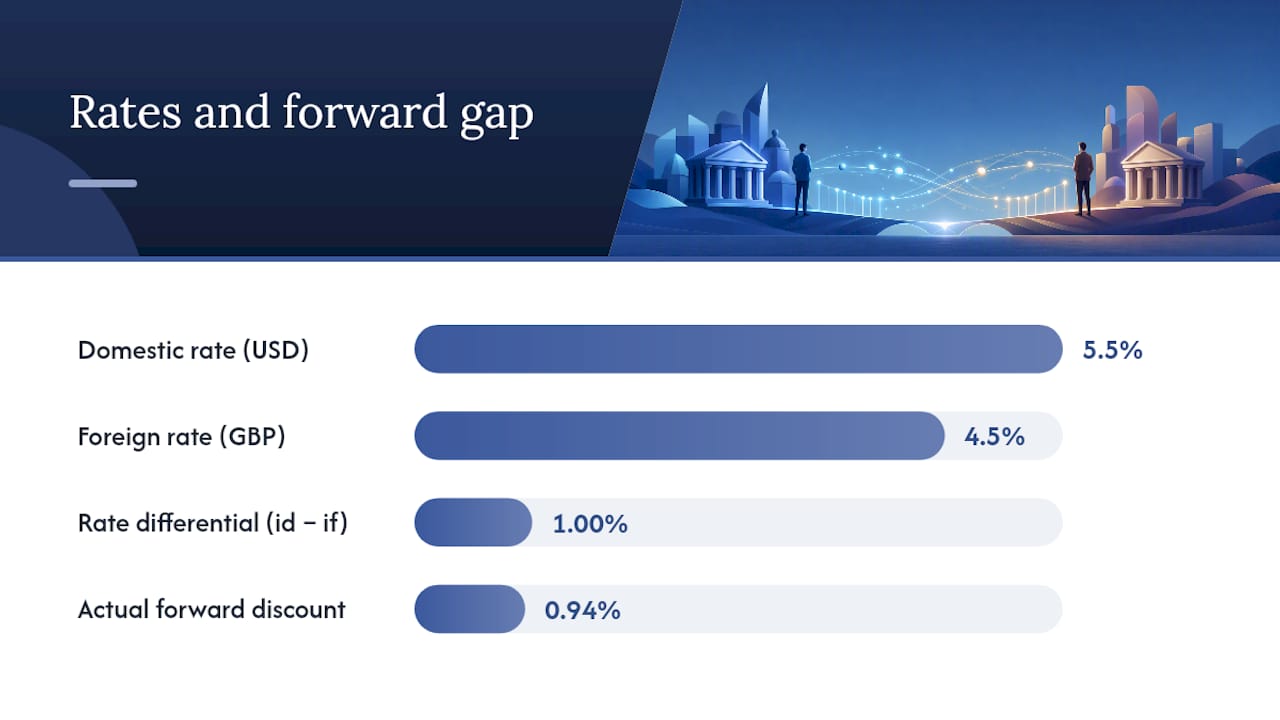
Worked example 1 (CIRP): Spot GBP/USD is 1.2500. rate is 5.5%. Because the dollar earns the higher rate, the pound should trade at a forward premium against it.
F = 1.2500 × (1.045 / 1.055) ≈ 1.2382
- A dollar investor converting to pounds at 1.2500, earning 4.5%, then converting back at 1.2382 nets the same return as holding dollars at 5.5%.
- The swap points here are roughly 118 pips (1.2500 minus 1.2382, scaled), reflecting the rate gap almost exactly.
- The approximation id − if = 1.0% closely tracks the actual forward discount of about 0.94%, confirming the shortcut works well at low rates.
If the realized spot rate a year later is actually 1.2650, the pound strengthened instead of weakening. That’s not a rounding error. It’s the forward premium puzzle showing up in a single currency pair.
Why Covered Arbitrage Rarely Pays Off Anymore
Covered interest arbitrage sounds simple on paper: borrow low, convert, invest high, hedge the currency risk with a forward, and pocket the difference. The problem is that everyone with a trading desk runs the same math in real time, so any gap tends to close within seconds under normal conditions.
- Transaction costs (bid-ask spreads on spot and forward contracts) eat into small deviations before you can act on them.
- Funding and counterparty risk mean borrowing at the “risk-free” rate isn’t actually risk-free once you factor in what a bank will really charge you.
- Capital and regulatory rules, especially post-2008 balance-sheet constraints, limit how much banks can deploy toward arbitrage even when a gap exists.
During the 2007 to 2008 financial crisis, CIP deviated meaningfully from theory, not because the formula broke, but because banks facing funding stress couldn’t access the capital needed to exploit the gap, according to research on CIP deviations during crisis periods. The deviations were real money left on the table, but only for institutions with spare balance-sheet capacity, which was limited at the time.
Pro Tip: If you ever see a forward rate that looks “off” from what CIRP predicts, check whether it’s a crisis-adjacent moment first. Persistent gaps almost always trace back to funding stress or capital constraints at major banks, not a genuine free lunch waiting for you.
What the Assumptions and the Evidence Actually Tell You
IRP theory rests on three assumptions that rarely hold perfectly outside a textbook: full capital mobility across borders, perfect substitutability between domestic and foreign assets, and zero transaction costs. Real markets fall short on all three to varying degrees, which is exactly why CIRP holds closely but not perfectly, and why UIP holds loosely at best.
- CIP and CIRP generally hold in calm markets, with deviations concentrated in stress periods tied to funding constraints rather than pricing errors.
- UIP performs weakly over short horizons, largely because of the time-varying risk premium investors demand for holding higher-yield currencies.
- The IMF’s own assessment keeps UIP in macro models anyway, valuing its tractability over its short-run forecasting accuracy, per Isard’s working paper.
For anyone using this in practice: trust forward rates as an arithmetic reflection of interest differentials, not as a market forecast. If you’re hedging a foreign cash flow, CIRP-based forward pricing is dependable. If you’re trying to predict where a currency will actually be in twelve months, treat UIP as one input among several, not a standalone forecast.
Testing These Formulas With Fiatmap’s Data
You don’t need a Bloomberg terminal to run these calculations yourself. Maps like the real policy rate map give you the id and if inputs across many countries, sourced directly from official statistics rather than aggregator estimates.
- Pull current policy or deposit rates from the deposit rate map to plug into the CIRP formula from the examples above.
- Check the real interest rate glossary entry if you want to adjust nominal rates for inflation before running a rate-of-return parity comparison.
- Cross-reference bank spread data to estimate how much friction might separate a theoretical CIRP forward rate from what a bank would actually quote you.
- If currency exposure affects a cross-border mortgage decision, the mortgage cost abroad calculator shows how rate differentials translate into real payment differences.
For a broader read on structural currency dynamics beyond pure rate math, StokdUp’s piece on the reserve currency argument is worth a look, particularly for how currency status shapes demand independent of interest differentials.
Where the Textbook Version Falls Short
Most explanations of interest rate parity stop at the formula and call it a day. That’s a mistake, because the formula tells you almost nothing about when to trust it. CIRP deserves your confidence; it’s arithmetic enforced by arbitrage, and the crisis-era deviations prove the exception rather than disprove the rule. UIP deserves far less. Treating it as a forecasting tool, which plenty of casual currency commentary still does, ignores decades of evidence that the risk premium swamps the interest differential more often than not.
The bigger error I see is people trying to memorize the formulas without touching real numbers. Grab actual policy rates, actual spot quotes, and run the calculation yourself once. You’ll notice within minutes whether a currency pair’s forward rate reflects interest differentials cleanly or carries a wider gap that hints at funding stress or capital controls. That single exercise teaches you more about how currency markets actually price risk than any amount of formula memorization. Start with the rate data, not the theory.
— Torstein
Sources
- Uncovered Interest Parity: Peter Isard; IMF Working Paper 06/96
- Empirical observations on CIP deviations during crises (MIT repository)
Recommended
The figures on this site are collected from official statistics and each carries its own source and date — see /sources and the dataset. Where this article states a number, the country and ranking pages are what it should agree with.