Investors: Use Fiatmap Data to Pick International Real Estate
2026-09-17
Most investors don’t need to buy a condo in Lisbon to get international real estate exposure. If you lack hands-on the ground and deep knowledge of a specific market, start with a global or regional REIT ETF. It’s liquid, tax-simple, and lets you test the thesis before you sign a foreign deed. Direct ownership makes sense only once you’ve done the legal and tax homework covered below, or you’re chasing a lifestyle goal like residency.
TL;DR:
- Most international investors should start with liquid REIT ETFs rather than direct ownership unless they have deep local knowledge or plan to use the property personally.
- Global real estate investment is expected to reach about $1.2 trillion in 2026, with growth concentrated in logistics, data centers, and senior housing sectors driven by demographic and technological shifts.
- International property yields tend to be lower in markets with strong data transparency and legal stability, where institutionals accept lower returns for reduced risk.
- Foreign ownership restrictions, transaction taxes, and local property laws vary widely, making thorough legal and tax due diligence essential before committing funds.
- Financing for non-resident buyers is often costly or limited, with cash purchases or home equity loans being common options, and currency risks can significantly impact net returns.
Table of Contents
- What’s Happening in the International Real Estate Investment Market in 2026?
- Why Add International Property to Your Portfolio?
- How Do You Actually Invest in International Real Estate?
- What Legal and Tax Rules Should You Check Before Buying Abroad?
- How Should You Finance a Foreign Property Purchase?
- How Do You Choose the Right Country for Real Estate Investment?
- How Do You Vet a Property and Plan Your Exit?
- How Fiatmap Helps You Compare Countries Before You Commit
- How Do Culture and Language Shape a Foreign Property Deal?
- What Are Your Property Management Options Abroad?
- What Insurance Do You Need for Property Owned Abroad?
- Where the Real Opportunity Sits Right Now
- Compare Country Data Before You Commit Capital
- Sources
- FAQ
What’s Happening in the International Real Estate Investment Market in 2026?
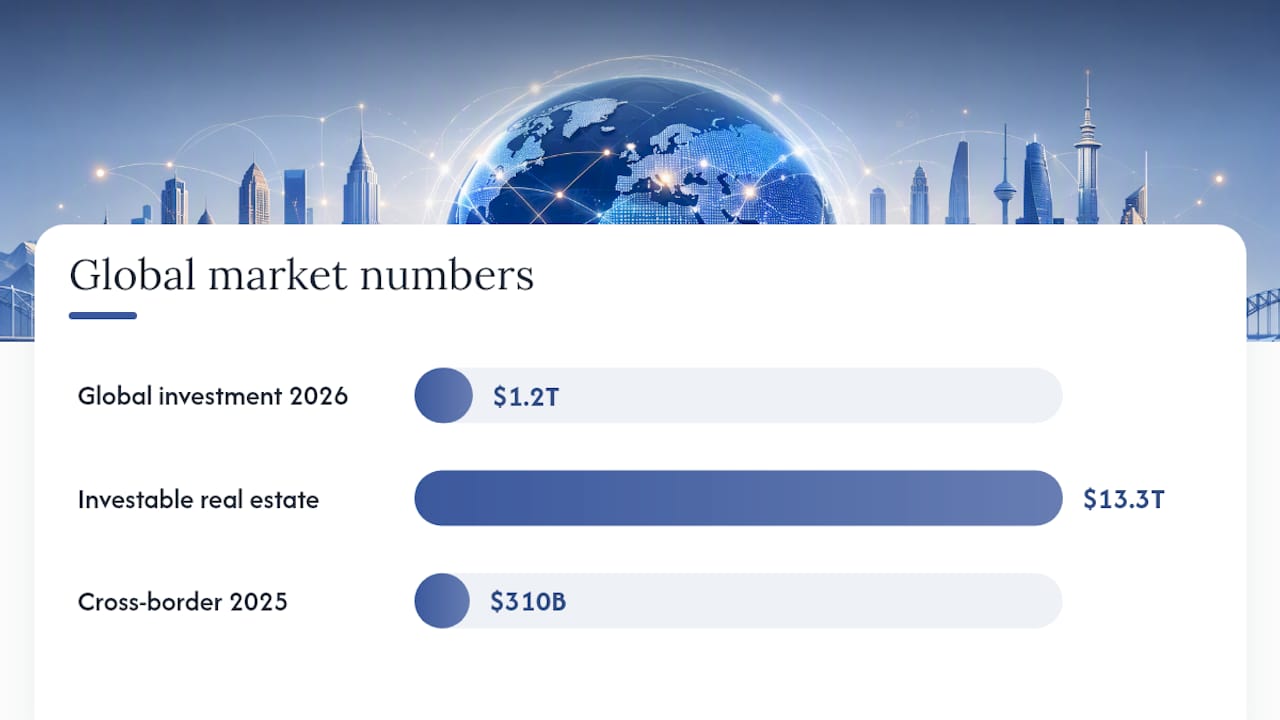
Global property investment is climbing out of a multiyear slump, and the numbers back it up. Savills projects total global real estate investment could reach roughly $1.2 trillion in 2026, with Asia Pacific leading the expansion and demand holding up across most property types. That’s not a straight-line recovery. Savills also notes the rebound since 2024 has been stop-start, with geopolitical shocks periodically rattling sentiment even as institutional allocators keep committing capital to income-producing assets.
By the Numbers: Global investable real estate sits at approximately $13.3 trillion in professionally managed assets, with cross-border transactions totaling about $310 billion in 2025 — a market large enough that shifts in regional allocation move pricing meaningfully.
Sector matters as much as geography right now. Growth is concentrated in build-to-rent housing, student and senior housing, logistics warehouses, and data centers, driven by demographic shifts, e-commerce fulfillment needs, and AI infrastructure demand. Capital flows tell their own story: Asian institutional capital has been targeting U.S. logistics and multifamily assets, while Gulf sovereign wealth funds continue chasing trophy assets in gateway cities like London and New York. That competition pushes prime yields down in the most liquid markets.
Transparency plays a quiet but real role in pricing. Markets with strong data disclosure, reliable title systems, and stable legal frameworks tend to trade at tighter yields because institutional buyers accept a lower return for lower uncertainty. Less transparent markets can offer higher headline returns, but that premium often compensates for real access and enforcement risk, not just illiquidity.
Why Add International Property to Your Portfolio?
The case for crossing borders isn’t about chasing the hottest market. It’s about getting exposure your home market simply doesn’t offer.
- Diversification across economic cycles. Property markets in different countries rarely peak and trough together, so international holdings can smooth returns when your domestic market stalls.
- Currency diversification. Owning assets priced in a second currency hedges against depreciation of your home currency, though it cuts both ways.
- Access to scarce sectors. Data centers, cold storage logistics, and senior housing are underbuilt in many domestic markets but expanding fast elsewhere.
- Yield versus growth tradeoffs. Some markets offer higher current income (rental yield); others offer better long-term appreciation. Rarely both at once.
If you want the diversification benefit without the operational headache, passive listed exposure through REITs or global property funds gets you most of the way there. Direct ownership adds concentrated, illiquid risk that only pays off if you understand the specific market well.
How Do You Actually Invest in International Real Estate?
There’s no single right vehicle. The right one depends on how much control you want versus how much complexity you’re willing to manage.
- REITs and ETFs. The simplest entry point. You get liquidity, daily pricing, and none of the tax filing headaches of owning foreign property directly. The tradeoff is you don’t control asset selection and your returns track a basket, not a specific building.
- Pooled funds and co-investment vehicles. These give you access to institutional-grade deals (large logistics parks, build-to-rent portfolios) that individuals can’t buy alone. Expect management fees in the 1 to 2% range annually, plus lockup periods that can run several years.
- Direct ownership. Full control over the asset, financing, and exit timing. This is also where the real work lives: foreign tax registration, local property management, currency conversion on every rent payment, and exposure to a single market’s downturn. Direct ownership is worth the operational burden mainly when you plan to use the property yourself, know the local market from experience, or are pursuing a residency-linked investment program.
- Fractional and platform-based ownership. A newer middle ground. Digital platforms let you buy a slice of a specific property, combining some of the targeted exposure of direct ownership with more liquidity than a whole asset. Due diligence on the platform operator matters as much as due diligence on the property itself.
Most portfolios benefit from mixing vehicles: listed REITs for liquid core exposure, a fund allocation for targeted sector bets, and direct ownership reserved for markets where you have a genuine edge or personal use case.
What Legal and Tax Rules Should You Check Before Buying Abroad?
Every country writes its own rulebook for foreign buyers, and assuming your home country’s norms apply elsewhere is how deals go wrong. UBS recommends defining your goal first — personal use, income, tax positioning, or residency — because that goal determines which legal structure actually makes sense.
Ownership restrictions vary sharply by country. In Mexico, foreigners can’t directly hold land within roughly 50 kilometers of the coast or 100 kilometers of a border; instead, they use a fideicomiso, a bank trust structure that holds title on their behalf. In Thailand, foreigners can own condominium units outright but only up to a 49% foreign ownership quota per building, and land ownership itself is largely off limits. Both examples show why country-specific ownership mechanisms need verification before you make an offer, not after.
Beyond the ownership structure, resolve these before you sign anything:
- Transaction taxes. Transfer taxes, stamp duties, and notary fees vary widely and can add several percentage points to your purchase price.
- Ongoing property taxes. Annual property tax rates and how they’re assessed (market value versus fixed cadastral value) affect long-term holding costs.
- Home-country reporting. Most tax authorities require you to report foreign property income and, in some cases, foreign asset holdings above a threshold. Ask whether your home country credits foreign taxes paid to avoid double taxation.
- Capital gains exposure. Understand how capital gains tax is calculated both locally and at home when you eventually sell.
- Residency and visa implications. Some countries tie property purchases to residency permits or golden visa programs, but these rules change often. Always verify current status directly with an immigration attorney rather than relying on older articles.
- Required documents and advisers. Line up a local real estate attorney, an independent (not seller-referred) surveyor, and an accountant familiar with cross-border filings, including obligations like ECI tax filing for foreign persons if you’re a non-resident earning income connected to that country.
Pro Tip: Hire your attorney and tax adviser before you make an offer, not after it’s accepted. Renegotiating structure once you’re under contract costs more than paying for the advice upfront.
How Should You Finance a Foreign Property Purchase?
Financing terms for non-residents are almost always worse than what locals get. Some markets barely offer foreign-buyer financing at all, which pushes many international investors toward cash purchases or financing secured against assets back home.
Three financing paths dominate:
- Cash purchase. Simplest and fastest to close, but it ties up capital and removes the leverage that amplifies returns in a rising market.
- Local mortgage. Slower to arrange and often requires larger deposits, but it keeps your debt and your rental income in the same currency, which reduces currency mismatch risk.
- Bridge or home-equity financing. Using equity from a domestic property to fund the purchase avoids foreign lender requirements entirely, though it concentrates risk back onto your home market.
Currency exposure deserves its own line item in your model. If you earn in one currency and your rental income arrives in another, a currency move can erase a year of yield overnight. Forward contracts and specialist currency brokers are the standard tools for locking in exchange rates on both the purchase and ongoing repatriation of rental income.
Reality Check: Non-resident buyers frequently see higher deposit requirements than residents, often requiring substantial upfront capital beyond typical domestic levels.
To calculate a realistic after-tax yield, start with gross rent, subtract local property taxes and management fees, then adjust for currency depreciation risk and the cost of repatriating profits. A property yielding 6% gross can easily net below 3% once local taxes, management costs, and currency drag are factored in.
How Do You Choose the Right Country for Real Estate Investment?
Ranking countries systematically beats chasing whatever market is trending on social media. A repeatable framework looks at eight factors: market transparency, liquidity (how fast you can sell), legal access for foreign buyers, mortgage and financing cost, inflation trajectory, GDP growth, capital control risk (can you get your money out?), and climate exposure.
How you weight these depends on your objective:
- Income-focused investors should weight liquidity and legal access highest. You need to exit cleanly if the income thesis breaks.
- Growth-focused investors can tolerate lower liquidity in exchange for markets with strong GDP growth and rising demand.
- Residency-focused buyers need to prioritize legal frameworks and visa-linked incentives over pure yield.
Here’s how that framework maps to real market categories, based on transparency and cross-border flow patterns:
| Market type | Example regions | Typical profile | Best fit for |
|---|---|---|---|
| Core / liquid | United States, United Kingdom, Singapore | High transparency, tighter yields, strong legal protection | Income-focused, risk-averse capital |
| Higher-yield / value | Select Southern Europe (Portugal, parts of Spain) | Moderate transparency, better entry yields, EU legal framework | Growth-focused investors comfortable with slower liquidity |
| Emerging / opportunistic | Select MENA and Asian secondary markets | Lower transparency, higher headline yields, variable capital control risk | Opportunistic investors with local expertise or advisers |
Higher-transparency markets consistently trade at tighter yields than opaque ones, which is the tradeoff behind every row in that table: safety costs yield, and yield costs safety. Before shortlisting a country, run its mortgage rates and inflation trend through a mortgage rate comparison map or similar country-level dataset. A 6% headline yield means very little in a country running 8% annual inflation.
How Do You Vet a Property and Plan Your Exit?
Due diligence abroad takes longer than at home, largely because you can’t verify things in person as easily and legal systems move at different speeds.
- Verify title. Confirm clean, transferable title through an independent local attorney, not one referred by the seller or developer.
- Check market comparables. Get recent, comparable sales data, not just the listing agent’s opinion of value.
- Assess rental demand. Vacancy rates and tenant demand data matter more than a developer’s rental guarantee.
- Confirm the tax structure. Know your annual property tax, transaction tax, and capital gains exposure before you commit.
- Line up service providers. A property manager, accountant, and attorney should all be in place before closing, not after.
Watch for red flags that justify walking away entirely: ambiguous or disputed title, restrictions on repatriating sale proceeds, or a market with no reliable public sales data. Expect total transaction costs, including taxes, legal fees, and agent commissions, to run 8 to 15% on top of the purchase price in most international markets. Build an exit plan before you buy: know the typical time-on-market for resale in that country and whether currency controls could delay repatriating your proceeds.
Pro Tip: Ask your local attorney specifically how foreign sellers have repatriated proceeds in the last two years. Rules on paper and rules in practice sometimes diverge.
How Fiatmap Helps You Compare Countries Before You Commit
Comparing 128 countries by hand is not realistic. Fiatmap pulls mortgage rates, inflation, and more than 35 macroeconomic metrics from official statistics into one comparable view, so you can stress-test a market before wiring a deposit.
A practical sensitivity check: pull a shortlisted country’s mortgage rate and inflation trend side by side, then ask whether the real interest rate still leaves room for positive yield after inflation. Run the same check for currency depreciation history before assuming your rental income holds its value at home.
- Compare financing cost across markets with the lending rate map.
- Check inflation trajectory with the inflation map.
- Weigh the opportunity cost of cash versus property using the real deposit rate map.
How Do Culture and Language Shape a Foreign Property Deal?
A contract that reads as standard in one country can carry entirely different implied obligations in another. Negotiation norms shift too. In some markets, verbal agreements and relationship-based trust carry real weight before contracts are signed. In others, everything runs strictly through written, notarized documentation and skipping a step invalidates the deal.
Language gaps create some of the costliest mistakes in cross-border property deals. A mistranslated clause in a purchase contract, a misunderstood zoning restriction, or a miscommunicated maintenance obligation can surface only after closing. Always work with a bilingual attorney rather than relying on a translation app or the seller’s English-speaking agent, whose incentives don’t align with yours.
Property management adds another layer. If you’re not fluent in the local language, you’re dependent on your property manager to relay tenant complaints, maintenance issues, and legal notices accurately. Hire a manager who speaks your language and can produce written monthly reports, not just verbal updates that are easy to gloss over from a distance.
Cultural expectations around tenant relationships and dispute resolution differ too. Eviction processes that take weeks in one country can take over a year in another, largely due to tenant-protection norms baked into local culture and law, not just legal text. Factor that timeline risk into your income projections before you buy in an unfamiliar jurisdiction.
What Are Your Property Management Options Abroad?
Three basic models cover most international owners: full-service local property managers, remote self-management through digital tools, and hybrid arrangements using a local point of contact plus a management company.
Full-service local managers handle tenant screening, rent collection, maintenance, and legal compliance. This is the lowest-effort option and the right default for most owners who don’t live near the property.
Remote self-management works only if you have a trusted local contact for emergencies and speak the language well enough to handle disputes directly. It saves the management fee but exposes you to slower response times on maintenance issues and legal notices that arrive in a language you may not read fluently.
The biggest challenge across every model is oversight from a distance. You can’t inspect the property regularly, verify a contractor’s invoice against actual work performed, or gauge whether a vacancy is due to market conditions or poor management. Request photo documentation and itemized invoices for every maintenance job, and consider a second, independent local contact who can verify your property manager’s reports periodically. Resources on landlord compliance obligations are worth reviewing regardless of which country you’re investing in, since baseline tenant-protection and safety requirements tend to rhyme across jurisdictions even when the specifics differ.
What Insurance Do You Need for Property Owned Abroad?
Standard homeowner’s insurance from your home country almost never covers property located overseas. You need a local policy, purchased through a local or specialist international insurer, and the coverage gaps between countries can be significant.
Confirm coverage for the risks specific to that market: flood and earthquake coverage in seismically active regions, hurricane or cyclone coverage in coastal zones, and political risk or expropriation coverage in markets with less institutional stability. Landlord liability coverage matters if you’re renting the property out, since a tenant injury claim follows local liability law, which may differ sharply from what you’re used to at home.
Currency also affects your insurance math. A payout denominated in local currency may not fully cover rebuilding costs if that currency has depreciated significantly since your last policy renewal. Review and adjust your coverage amount annually rather than assuming last year’s figure still matches replacement cost.
Vacant or partially occupied properties often carry different (and sometimes higher) premium requirements, so disclose your actual occupancy pattern honestly. Insurers in several markets void claims retroactively if they discover a property was vacant longer than disclosed at the time of a loss.
Where the Real Opportunity Sits Right Now
The momentum in 2026 sits with logistics, data centers, and multifamily housing, sectors benefiting from structural demand rather than a cyclical bounce. Asia Pacific’s strength and continued institutional flows into U.S. logistics and multifamily assets reflect capital chasing durable income, not speculation on a recovery narrative.
Core investors should stay in transparent, liquid markets and treat higher-yield opportunistic plays as a small satellite allocation, not the core position. Opportunistic investors with real local knowledge can justify concentrated bets in less transparent markets, but only with the legal and tax groundwork done first. Before ranking your own shortlist, pull country-level mortgage and inflation data yourself rather than trusting a single market’s headline yield claim.
— Torstein
Compare Country Data Before You Commit Capital
Every strategy in this guide comes down to one thing: knowing the real numbers before you wire money to a country you’ve never financed property in. Fiatmap gives you free access to official mortgage rates, inflation trends, and macroeconomic data across 128 countries, sourced exclusively from official statistics rather than aggregated guesses.
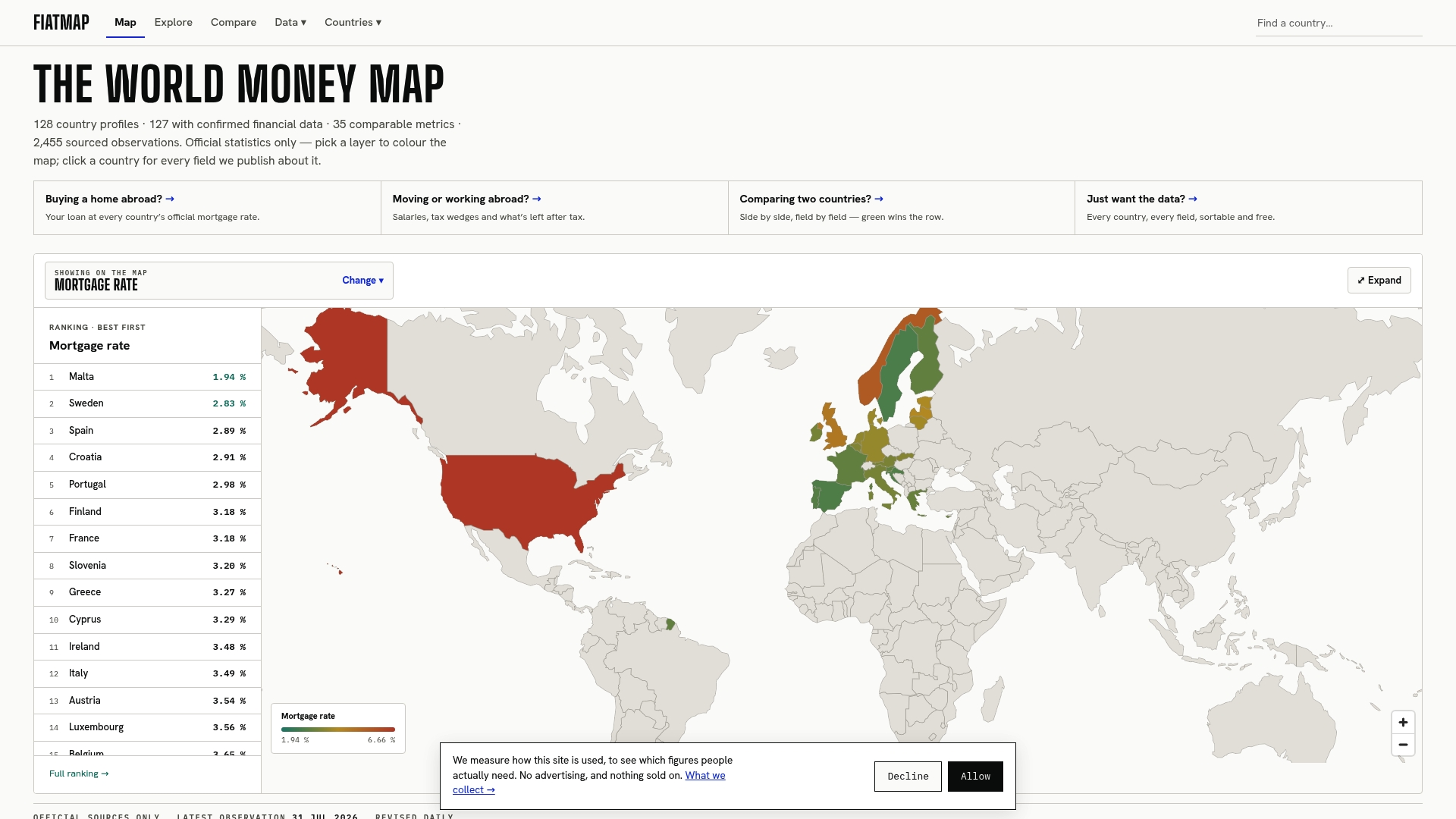
Before you shortlist a market, run its numbers through the global mortgage calculator to see what financing actually costs there compared with your home market. Then check inflation and house-price growth trends for each country on your list using the house price growth rankings to see whether a headline yield still holds up after real-world price movement. Start with the full country dataset and build your own comparison before you make a single call to an agent overseas.
Sources
- Global real estate investment recovery continues in 2026 | Savills Impacts
- The Global Property Investment Landscape Explained | Property Research Partners
- Investing in international real estate | UBS
- How to Buy Property Abroad as an American (2026 Guide) | expatsi
FAQ
Is International Real Estate a Good Investment?
For diversification and access to sectors underbuilt at home, yes, but it depends heavily on execution. Global investment flows are projected to reach $1.2 trillion in 2026, signaling institutional confidence, but individual outcomes hinge on legal structure, currency risk, and whether you started with listed exposure or an unvetted direct purchase.
What Is the 7% Rule in Real Estate?
It’s a quick filter, not a substitute for the full after-tax yield calculation covered earlier in this guide, since taxes, management fees, and currency drag can cut that headline number substantially.
What Creates 90% of Millionaires?
What’s better documented is that property ownership, both domestic and international, remains a common component of diversified high-net-worth portfolios.
What Is the Best International Real Estate ETF?
There’s no single best ETF, since the right one depends on your target region and sector exposure, whether that’s global diversified property, U.S. logistics, or Asia Pacific focused funds. Compare expense ratios, sector concentration, and currency exposure across a few options rather than defaulting to whichever fund is largest, and use country-level data like inflation rankings to sanity-check the regions each fund is weighted toward.
How Much Do Non-Resident Buyers Typically Need for a Deposit?
Some countries offer little to no financing for foreign buyers at all, which is why many international investors use cash or home-equity financing instead.
Recommended
The figures on this site are collected from official statistics and each carries its own source and date — see /sources and the dataset. Where this article states a number, the country and ranking pages are what it should agree with.