Calculate Your Loan to Value Ratio: 80% Rule and Worked Example
2026-09-06
The loan-to-value (LTV) ratio is your loan balance divided by the property’s value, expressed as a percentage. It’s one of the biggest levers in what your mortgage actually costs: a lower LTV typically gets you a better interest rate and lets you skip mortgage insurance, according to the Consumer Financial Protection Bureau. You can run your own numbers with a tool like Fiatmap’s mortgage calculator or with Fannie Mae’s underwriting guidelines as a reference point.
TL;DR:
- A higher property appraisal value can lower your LTV and improve your financing options, especially when home prices have recently increased.
- LTV thresholds vary by loan type, with conventional loans typically capping at 80% to avoid PMI, while FHA, VA, and USDA loans allow higher limits.
- Paying down your mortgage principal, increasing your down payment, or raising your home’s appraised value can significantly reduce your LTV.
- Reassessing your LTV at refinancing or PMI removal can unlock lower rates or eliminate insurance if your home’s value has risen.
- Lenders adjust interest rates, insurance requirements, and approval conditions based on your LTV, with lower ratios signaling less risk.
Table of Contents
- How to Calculate Your Loan-to-Value Ratio
- Combined Loan-to-Value and Other Variants
- Why Your LTV Ratio Shapes Rates, Insurance, and Approval
- Common LTV Thresholds by Loan Program
- How to Lower Your LTV Before or After Closing
- Calculating LTV Accurately: Tools and Common Mistakes
- Does Your LTV Ratio Determine Loan Approval?
- LTV Requirements Differ by Loan Type
- Why LTV Is Central to Lender Risk Assessment
- Residential vs. Commercial: How Property Type Changes LTV
- How LTV Affects When and How You Can Refinance
- Three Things to Do With Your LTV Number Right Now
- Run Your Own LTV and Mortgage Scenarios
- Where to Verify Program-Specific LTV Rules
- Sources
How to Calculate Your Loan-to-Value Ratio
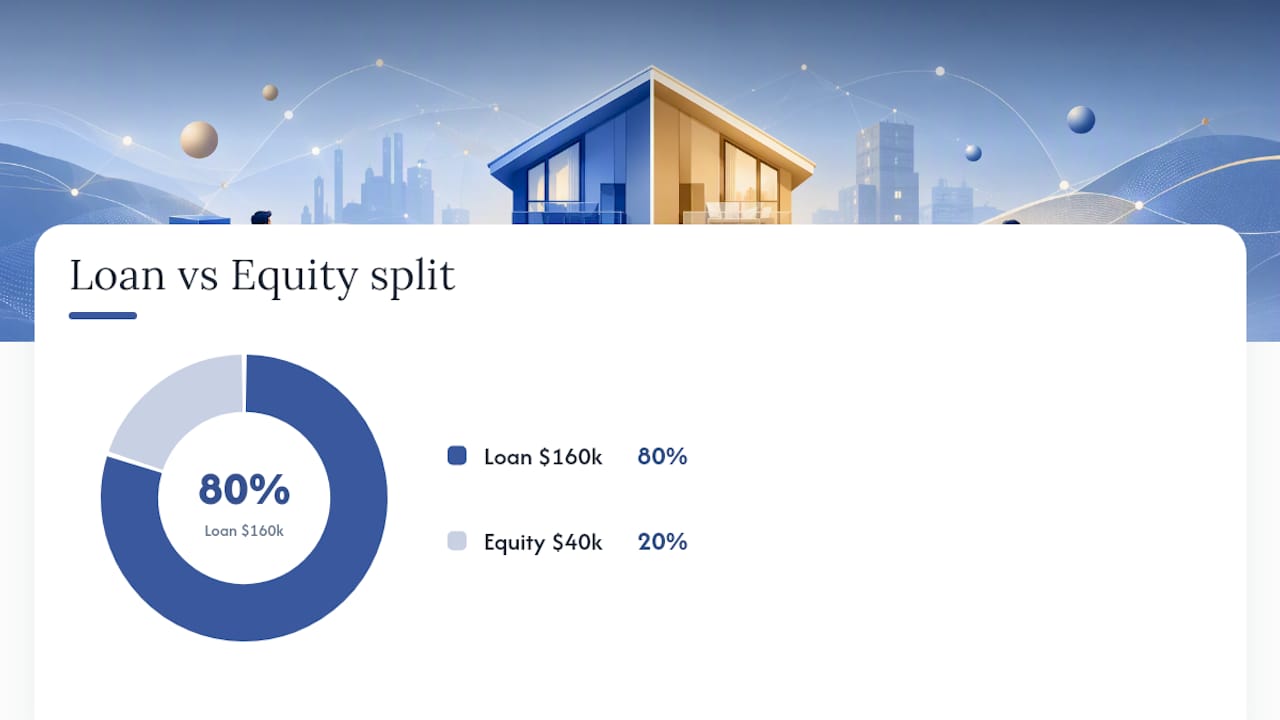
The formula behind LTV couldn’t be simpler: divide your loan amount by the property’s value, then multiply by 100 to get a percentage. The two numbers you need are the loan balance (what you’re actually borrowing) and either the appraised value or the purchase price, depending on the situation.
Here’s the calculation broken down step by step:
- Find your loan amount. If you’re buying a $200,000 home with a 20% down payment ($40,000), your loan amount is $160,000.
- Find the property value. Lenders use the lower of the appraised value or the purchase price. If your home is under contract for $200,000 and the appraisal also comes back at $200,000, that’s your denominator.
- Divide and multiply. $160,000 ÷ $200,000 = 0.8, or 80% LTV.
That “lower of the two” rule trips people up constantly. Say you agree to pay $210,000 for a house, but the appraisal comes in at $200,000. Your lender will calculate LTV using $200,000, not the higher purchase price, according to Chase’s mortgage education resources. That gap between contract price and appraised value is exactly why deals sometimes fall apart or require renegotiation.
Lenders recheck your LTV whenever the loan balance or the property value changes materially, which usually means at refinancing, at the point you request PMI removal, or after a major renovation that could bump up appraised value.
Combined Loan-to-Value and Other Variants
CLTV, or combined loan-to-value, accounts for every lien on your property, not just your primary mortgage. You add up the balances on all your loans, including home equity lines of credit (HELOCs) and second mortgages, then divide by the property’s value.
Say you own a $200,000 home with a $100,000 first mortgage and you take out a $30,000 HELOC. It’s:
- $100,000 + $30,000 = $130,000 total debt
- $130,000 ÷ $200,000 = 0.65, or 65% CLTV
Lenders care about CLTV because it reflects your total leveraged position, not just one slice of it. You’ll also see variants like HCLTV (high-combined loan-to-value, which factors in the full HELOC limit rather than just the drawn balance) and TLTV (total loan-to-value). These terms shift slightly by lender, according to Wikipedia’s overview of loan-to-value ratios, so always confirm which version your specific lender is using before assuming you know your number.
Why Your LTV Ratio Shapes Rates, Insurance, and Approval
Lenders treat LTV as a core risk signal, alongside your credit score and debt-to-income ratio. The National Association of Realtors notes that LTV rarely stands alone in a lending decision. A strong credit score can offset a higher LTV, and a weak one can undercut an otherwise solid LTV.
Where 80% earns its reputation: Cross above an 80% LTV on a conventional loan and most lenders will require private mortgage insurance (PMI), according to Investopedia. PMI typically runs between a fraction of a percent and a few percent of the loan amount annually, adding noticeable monthly cost on top of principal and interest.
That’s not a rounding error. It’s the difference between a 20% down payment feeling painful upfront and a 10% down payment costing you thousands over the life of the loan.
A few other things move the needle:
- Interest rates often step up in tiers as LTV rises. A borrower at 90% LTV frequently pays a noticeably higher rate than one at 75%, even with identical credit profiles.
- Refinancing resets your LTV entirely. If home values in your area have risen since purchase, a new appraisal could drop your LTV without you paying down a dollar of principal.
- Lenders reevaluate LTV any time you request PMI removal, apply for a HELOC, or refinance, not just at origination.
Common LTV Thresholds by Loan Program
LTV limits vary by loan program, and the differences are significant enough to shape which mortgage product makes sense for you. Conventional loans generally cap around 80% LTV if you want to avoid PMI, though you can still qualify with a higher LTV and just carry the insurance. Zillow’s breakdown shows FHA loans allow up to 96.5% LTV, while VA and USDA loans can go as high as 100% LTV for eligible borrowers, per the CFPB.
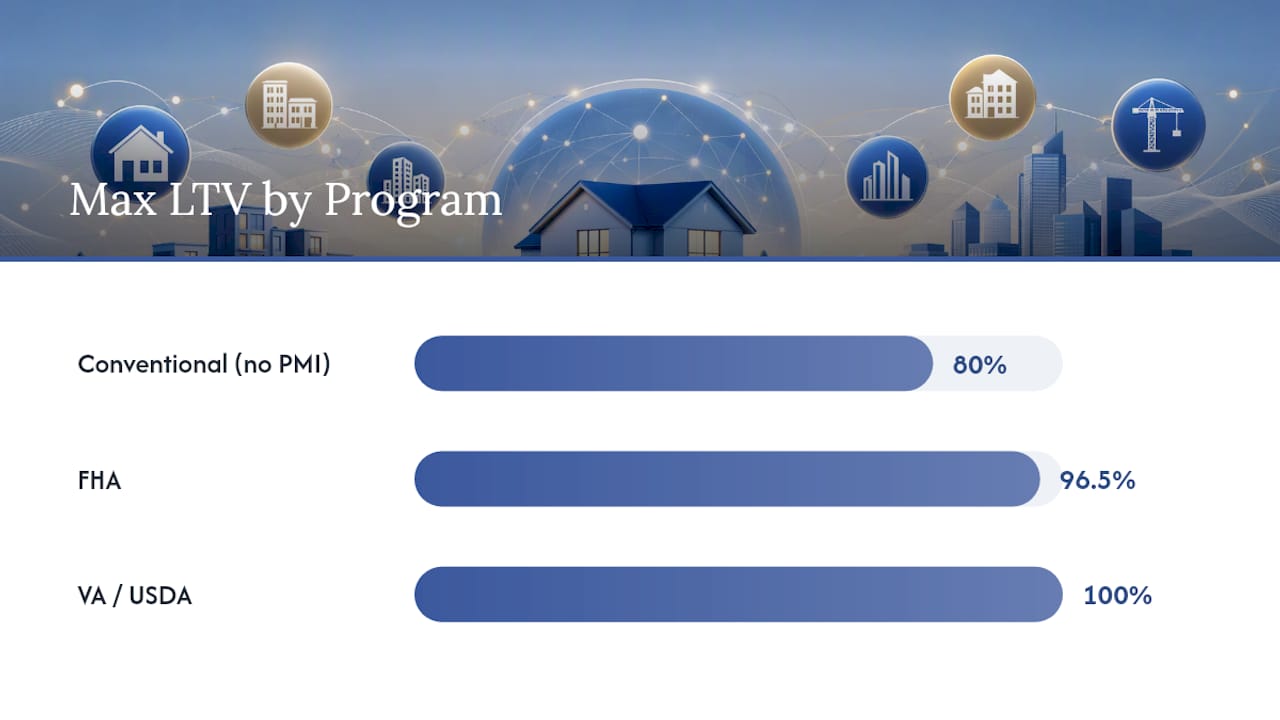
Exact thresholds shift by lender and by country, so always confirm current program rules directly with your lender or a government housing agency before assuming a number applies to you.
Here’s roughly what to expect at each band:
- 80% or below: No PMI on a conventional loan, and generally your best available rates.
- 80% to 95%: PMI or an FHA mortgage insurance premium (MIP) applies, with costs scaling up as LTV climbs.
- Above 95%: You’re likely looking at FHA, VA, or USDA territory, with tighter underwriting scrutiny elsewhere.
How to Lower Your LTV Before or After Closing
You have more control over your LTV than most homebuyers realize, both before you sign and years into the loan.
- Increase your down payment. Every dollar you put down at purchase reduces the loan amount and drops your LTV directly. Seller concessions that reduce your effective purchase price help the same way.
- Pay down principal faster. Extra payments toward principal shrink the loan balance side of the equation, lowering LTV over time even if the home’s value stays flat.
- Increase the appraised value. Targeted renovations, kitchen or bathroom updates especially, can raise your home’s appraised value and improve your LTV without touching the loan balance.
- Time a new appraisal strategically. If home prices in your area have climbed, requesting a fresh appraisal before refinancing or applying for PMI removal can lower your LTV on paper without any extra payments.
A piggyback loan (splitting your financing into a first and second mortgage) is another route some buyers use to avoid PMI while still keeping a smaller primary loan.
Pro Tip: If your home’s value has risen substantially since purchase, ask your lender about PMI removal before your next refinance. You may hit 80% LTV years earlier than your amortization schedule suggests.
Calculating LTV Accurately: Tools and Common Mistakes
Getting an accurate LTV depends on having the right inputs: your current loan balance (or balances, if you have a second mortgage or HELOC), the appraised value or purchase price, and any additional liens on the property.
The most common mistake is using the listing price instead of the appraised value once an appraisal exists. Another is forgetting to include a second lien, which understates your real leveraged position and can throw off your CLTV. A third is ignoring closing costs when estimating cash-to-close, which is a separate calculation from LTV but often gets tangled up with it.
A calculator handles the arithmetic, but the inputs are still on you to get right. Fiatmap’s mortgage calculator draws on official statistics rather than estimates, which makes it useful if you’re comparing scenarios across different loan amounts or even different countries. Pair it with mortgage rate data by country if you want to see how LTV and pricing interact outside your local market.
Does Your LTV Ratio Determine Loan Approval?
LTV alone won’t make or break your application, but it heavily influences how a lender views the risk they’re taking on. A lower LTV signals more equity cushion, which means less exposure for the lender if home values dip or you default. That’s why borrowers at 70% LTV often sail through underwriting with fewer conditions than someone stretching to 95%.
Approval odds hinge on the combination of LTV, credit score, and debt-to-income ratio working together, not any single number in isolation.
High LTV doesn’t automatically mean rejection. It usually means added conditions: mortgage insurance, a higher rate, stricter income verification, or a smaller loan amount than initially requested. Lenders sometimes counter a high LTV application with an offer to lend less, effectively forcing the borrower’s hand on the down payment.
That process often takes longer and asks for more documentation, so borrowers near the top of a program’s LTV limit should expect the process to take extra time.
LTV Requirements Differ by Loan Type
A first mortgage on a home purchase isn’t judged by the same LTV yardstick as a home equity loan or a cash-out refinance. Lenders tend to be more conservative once your home already carries debt.
That’s tighter than what many first-time buyers get on a purchase loan.
Investment property loans and second-home loans typically carry stricter LTV limits than primary residence loans; lenders assume more risk when the borrower isn’t living in the home. Jumbo loans, which exceed conforming loan limits, also tend to require lower LTV than standard conforming mortgages, since the loan amounts are larger and less easily resold.
Why LTV Is Central to Lender Risk Assessment
LTV exists as a underwriting metric because it answers one blunt question for lenders: how much would we actually lose if this loan defaulted and we had to sell the property? Even a distressed sale at a discount likely covers the loan balance.
That’s precisely why LTV factors into loan pricing models, mortgage insurance requirements, and the secondary market where loans get bought and sold. Loans with lower LTV are viewed as safer assets, which is part of why they often qualify for better rates. Fannie Mae and Freddie Mac, the government-sponsored enterprises that buy a large share of conventional mortgages, apply LTV-based pricing adjustments that ripple down to the rate borrowers see at closing.
Risk assessment isn’t static, either. Lenders monitor portfolio-level LTV exposure across their loan books, and during periods of falling home prices, elevated average LTVs across a lender’s portfolio can trigger tighter underwriting standards for new applicants industry-wide. That’s part of why lending standards loosen and tighten in cycles that don’t always track interest rates directly.
Residential vs. Commercial: How Property Type Changes LTV
Residential LTV limits and commercial LTV limits operate on almost different logic entirely.
Commercial real estate lending is far more conservative. A stabilized office building with long-term tenants might get a more favorable LTV than raw land or a specialty property like a hotel, which carries higher income volatility.
The gap comes down to liquidity and predictability. A single-family home has a deep pool of comparable sales and buyers, making it easier to value and easier to resell if a lender ever has to foreclose. Commercial properties are valued more on income potential than comparable sales, and that income can swing with occupancy rates, lease terms, and local business conditions. Lenders price that uncertainty into a lower LTV ceiling, effectively asking commercial borrowers to bring more equity to the table from day one.
How LTV Affects When and How You Can Refinance
Your LTV at the moment you want to refinance determines both which refinance products you qualify for and what that refinance will cost. Rate-and-term refinances, where you’re just chasing a lower rate, are generally the most forgiving on LTV. Cash-out refinances face stricter limits because you’re increasing the loan balance relative to the home’s value.
Timing matters more than most borrowers assume. If home prices have risen since you bought, your LTV may have improved without you doing anything, simply because the value side of the equation grew. That can open the door to refinancing without PMI, or to a cash-out refinance you couldn’t have qualified for a year earlier. A fresh appraisal is worth requesting before locking in refinance terms if you suspect your neighborhood has appreciated.
The reverse is also true. In a market where prices have flattened or dipped, a borrower who financed with a small down payment might find their LTV has barely moved, or gotten worse, closing off refinance options that looked available on paper. Checking current mortgage rates by country alongside your own LTV gives a clearer read on whether refinancing now actually saves money once insurance and closing costs are factored in.
Three Things to Do With Your LTV Number Right Now
Calculate your current LTV first. Take your loan balance, divide it by your home’s most recent appraised value, and see where you land.
From there, decide if a scenario comparison makes sense. Anyone weighing a refinance, a HELOC, or a move to a different market benefits from running the numbers before committing to anything, especially since LTV thresholds and typical rates vary by country and lender. Tools like Fiatmap exist for exactly that kind of comparison.
— Torstein
Run Your Own LTV and Mortgage Scenarios
Once you know your LTV, the next useful step is seeing how it plays out against real mortgage pricing, not just theoretical bands. Fiatmap’s mortgage calculator lets you plug in your loan amount and property value to see the resulting LTV instantly, then layer that against mortgage rate data pulled from official statistics across 128 countries.
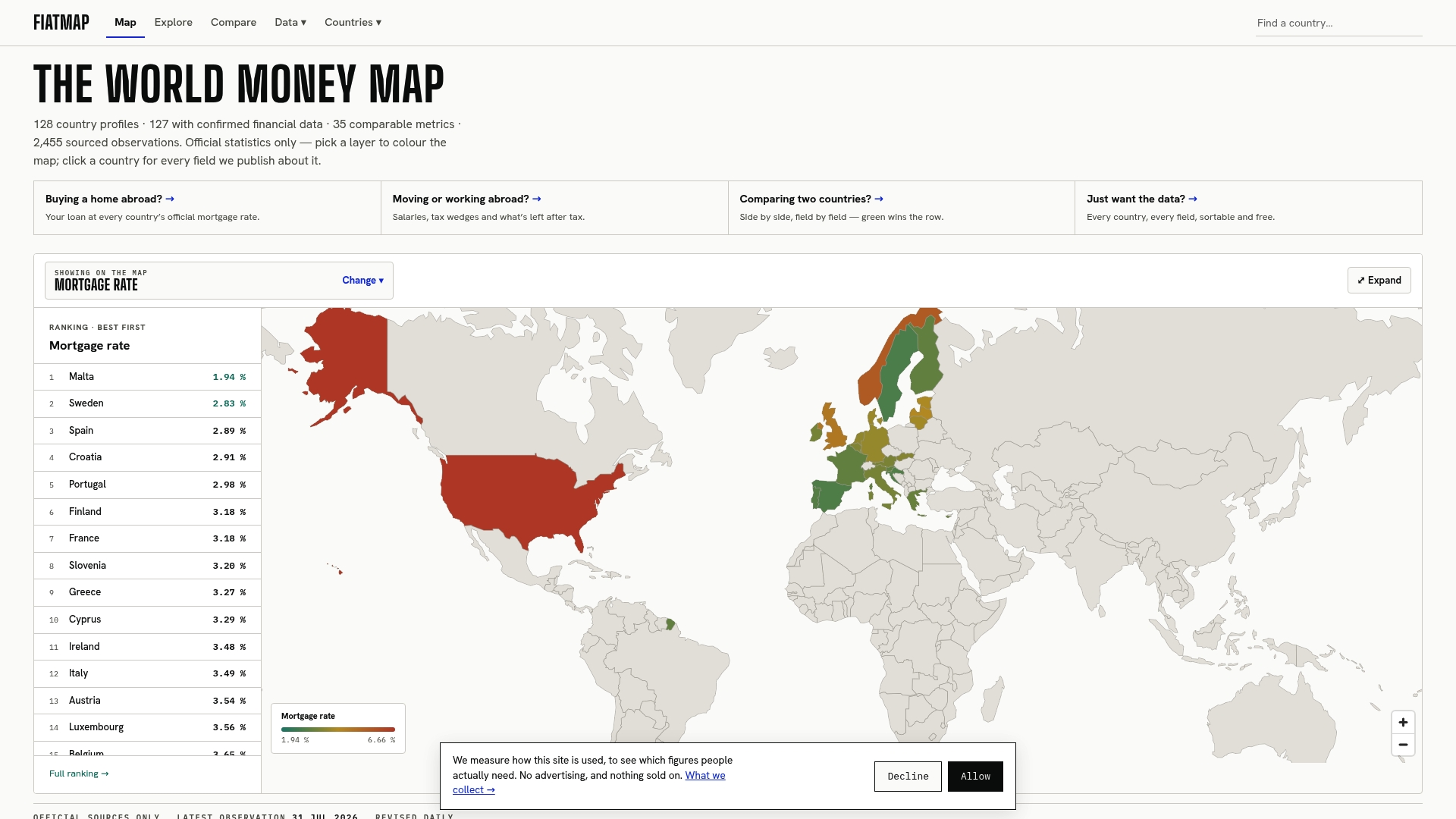
That global range matters if you’re relocating, buying a second home abroad, or just curious how your local lending terms stack up. A borrower comparing an 80% LTV loan in one country against the same LTV in another can see wildly different rate outcomes, and Fiatmap’s mortgage rate rankings make that comparison concrete instead of guesswork. Every dataset behind the tool comes from official government and central bank statistics, not estimates. Head to the mortgage calculator to run your own numbers and see where your LTV places you against current market rates.
Where to Verify Program-Specific LTV Rules
For regulatory detail beyond this overview, check the CFPB for consumer guidance, FDIC for regulatory context, and Fiatmap for calculators and country-level data.
This article is general information, not a substitute for advice from a qualified financial advisor. Consult a qualified financial professional about your own circumstances before acting on anything here.
Sources
- What is a loan-to-value ratio and how does it relate to my costs? | Consumer Financial Protection Bureau
- Loan-To-Value (LTV) Ratio: What It Is, How To Calculate, and Example | Investopedia
- Loan-to-value ratio | National Association of Realtors
Recommended
The figures on this site are collected from official statistics and each carries its own source and date — see /sources and the dataset. Where this article states a number, the country and ranking pages are what it should agree with.