Plug $300,000 at 6.5% to See Mortgage Amortization with Fiatmap
2026-09-24

Mortgage amortization is the fixed schedule that splits every monthly payment between interest and principal until the loan hits zero on its payoff date. The practical takeaway: your earliest payments are mostly interest, so extra principal paid in year one saves far more than the same dollar paid in year twenty. Pull up an amortization schedule or calculator before you sign anything, and run a few extra-payment scenarios using the Car Loan Calculator with Amortization Schedule to see the payoff for yourself.
TL;DR:
- Paying extra principal early on can significantly reduce total interest and loan duration, especially in the first few years when interest payments are highest.
- The interest-to-principal ratio flips from about 86% interest in month one to nearly all principal by the final year, dramatically speeding up equity buildup.
- Comparing 15-year and 30-year loans requires focusing on total interest over the life, as shorter terms typically save thousands but often have higher monthly payments.
- Refinancing resets the amortization schedule, while recasting adjusts the payment based on a lump-sum principal reduction without involving new loan costs.
- Regularly rechecking amortization projections is crucial after changes in income, rates, or goals, as initial assumptions may no longer be valid.
Table of Contents
- Principal vs. Interest: How the Split Changes Over Time
- The Amortization Formula and a Worked Example
- Reading an Amortization Schedule Without Getting Lost
- Extra Payments, Refinancing, and Recasting: Your Real Levers
- Amortization Period vs. Loan Term, and When Amortization Goes Negative
- Choosing Between a 15-Year and 30-Year Schedule
- How Fiatmap Shows Amortization Across Different Rate Environments
- Why Amortization Deserves a Second Look After Closing
- Test Your Own Mortgage Numbers With Fiatmap
- Sources
- FAQ
Principal vs. Interest: How the Split Changes Over Time
Every payment on a standard mortgage does two jobs. It covers the interest the lender charges for that month, and whatever is left over chips away at the principal, the actual amount you borrowed. Because interest is calculated on the remaining balance, and that balance is highest at the start of the loan, the first several years of payments are lopsided toward interest. Freddie Mac’s guide to amortization puts it plainly: early payments are interest-heavy, and later payments apply more to principal.
It’s worth a one-line detour here, because the word “amortization” gets used two different ways. Loan amortization spreads payments across principal and interest. Accounting amortization spreads the cost of an intangible asset, like a patent, across its useful life. Cornell Law School’s legal dictionary draws that distinction clearly, and it’s worth remembering so you don’t confuse a mortgage table with a business ledger.
Think of your loan balance as a bathtub draining slowly. In the beginning, the water level (your balance) is high, so the interest “faucet” running into the tub is wide open. As the balance drains:
- Interest owed each month shrinks in dollar terms
- More of your fixed payment flows to principal instead
- The balance drops faster in percentage terms each year
- Your equity builds at an accelerating pace in the loan’s second half
The Amortization Formula and a Worked Example
The standard fixed monthly payment formula is:
PMT = PV × [r(1+r)^n] / [(1+r)^n − 1]

Here, PV is the loan amount (present value), r is the monthly interest rate (annual rate divided by 12), n is the total number of payments, and PMT is the fixed monthly payment. Investopedia’s breakdown of the amortization formula confirms these are the only three inputs a lender’s calculator actually needs.
Here’s a step-by-step example using a $300,000 loan at 6.5% annual interest over 30 years (360 payments):
- Convert the annual rate to monthly: 6.5% ÷ 12 = 0.005417
- Plug PV = $300,000, r = 0.005417, n = 360 into the formula
- The result: a fixed payment of roughly $1,896 per month
- For payment one, interest equals $300,000 × 0.005417 = $1,625; principal is $1,896 minus $1,625, or about $271
- Subtract that $271 from $300,000 to get the new balance, then repeat the calculation for payment two
The interest-to-principal ratio flips almost completely by the loan’s final years. In month one, roughly 86% of the payment covers interest. By the final year of a 30-year loan at this rate, that ratio reverses, with almost the entire payment going to principal. Note that the very last payment is often a few cents different from the rest, an adjustment for rounding across hundreds of rows, as LibreTexts’ business math materials/13%3A_Understanding_Amortization_and_its_Applications/13.03%3A_Amortization_Schedules) explain in detail.
Reading an Amortization Schedule Without Getting Lost
An amortization schedule is just this calculation repeated for every payment, laid out in a table. Each row typically includes seven pieces of information:
- Payment number or date
- Starting balance for that month
- Total payment amount
- Portion applied to interest
- Portion applied to principal
- Ending balance after the payment
- Cumulative interest paid to date
The milestones tell the real story. In year one of that $300,000, 6.5% loan, you’ll pay around $19,300 in interest against roughly $3,500 in principal. By year 15, the split has moved close to even. In the final year, principal dominates almost entirely, and the ending balance drops to zero on schedule.
You don’t always need the full 360-row table. Lenders and borrowers often pull partial schedules for a specific stretch, like the interest paid in a single tax year for mortgage-interest deductions, or the exact remaining balance three years from now when comparing refinance offers. A partial view answers a narrow question without the noise of three decades of rows.
Extra Payments, Refinancing, and Recasting: Your Real Levers
Extra principal payments are the single most direct way to shrink both your timeline and your interest bill. On that same $300,000, 6.5% loan, adding just $100 to every monthly payment can cut years off a 30-year term and save a meaningful chunk of total interest. Fidelity’s overview of amortization notes that even modest, consistent extra payments compound into large savings over the life of a loan, because every extra dollar in year three stops accruing interest for the following 27 years.
Biweekly payment plans achieve something similar through timing. Paying half your monthly amount every two weeks results in 26 half-payments a year, the equivalent of 13 full monthly payments instead of 12. That one extra payment annually lands almost entirely on principal.
Refinancing and recasting work differently. Refinancing replaces your loan with a new one, often at a new rate and a fresh 30-year clock, which can lower your payment but restart the interest-heavy front end. Recasting keeps your existing rate and term but re-amortizes the schedule after a lump-sum principal payment, lowering your monthly payment without new closing costs in most cases.
Pro Tip: Check your loan documents for a prepayment penalty clause before making large extra payments. Some loans, particularly certain investment-property mortgages, charge a fee for paying down principal faster than scheduled.

Amortization Period vs. Loan Term, and When Amortization Goes Negative
The amortization period is how long it would take to pay off the loan at your current payment schedule. The loan term is how long your current rate and terms actually last before renewal or payoff is due. These are not always the same number, and confusing them causes real financial surprises.
A common example: a 5-year term with a 25-year amortization. You make payments as if paying the loan off over 25 years, but after 5 years the entire remaining balance comes due or the loan renews at a new rate. This structure is common outside the U.S. and shows up in some commercial and balloon-payment mortgages domestically.
- Balloon mortgages amortize on paper over a long period but require a lump-sum payoff far sooner
- Adjustable-rate mortgages (ARMs) recalculate your rate periodically, which changes the interest/principal split on the new schedule
- Negative amortization occurs when your payment doesn’t even cover the month’s interest, so unpaid interest gets added to your balance instead of reducing it
- Watch for negative amortization in loans with payment caps or interest-only introductory periods, where the minimum due can be less than interest owed
Choosing Between a 15-Year and 30-Year Schedule
Run any calculator with the same four inputs every time: loan principal, interest rate, term length, and a field for extra monthly payments. The output that matters most isn’t the monthly payment, it’s total interest paid over the life of the loan.
- Compare total interest, not just monthly payment, between a 15-year and 30-year option
- Test what a $50 to $200 monthly extra payment does to total interest under each term
- Check whether the loan allows extra principal payments without penalty
- Before calling a lender, gather your income documentation, current debts, target purchase price, and a rough credit score estimate so the quote you get is realistic
How Fiatmap Shows Amortization Across Different Rate Environments
The math behind amortization doesn’t change from country to country, but the interest rate absolutely does, and that rate is what determines whether your loan costs feel manageable or brutal. Fiatmap’s mortgage rate rankings by country let you see how the same loan amount plays out under wildly different national rate environments.
- The same $300,000 principal and 30-year term produces very different total interest depending on the national rate, as Fiatmap’s analysis of identical mortgages across countries demonstrates
- Every figure comes from official government and central bank statistics, not estimates.
- The mortgage calculator lets you plug in a principal and term to compare outcomes across rate environments in seconds
Why Amortization Deserves a Second Look After Closing
Most borrowers study amortization once, at closing, then never open the schedule again. That’s a mistake. Rates, income, and life plans all shift, and each shift changes whether extra payments or a refinance actually makes sense. Rerun the numbers whenever something changes, not just when you sign.
— Torstein
Test Your Own Mortgage Numbers With Fiatmap
Most amortization calculators show you one country’s rate in isolation. Fiatmap’s mortgage rate rankings let you compare the exact same loan principal and term against national rates from 128 countries side by side, sourced entirely from official statistics rather than lender marketing pages.
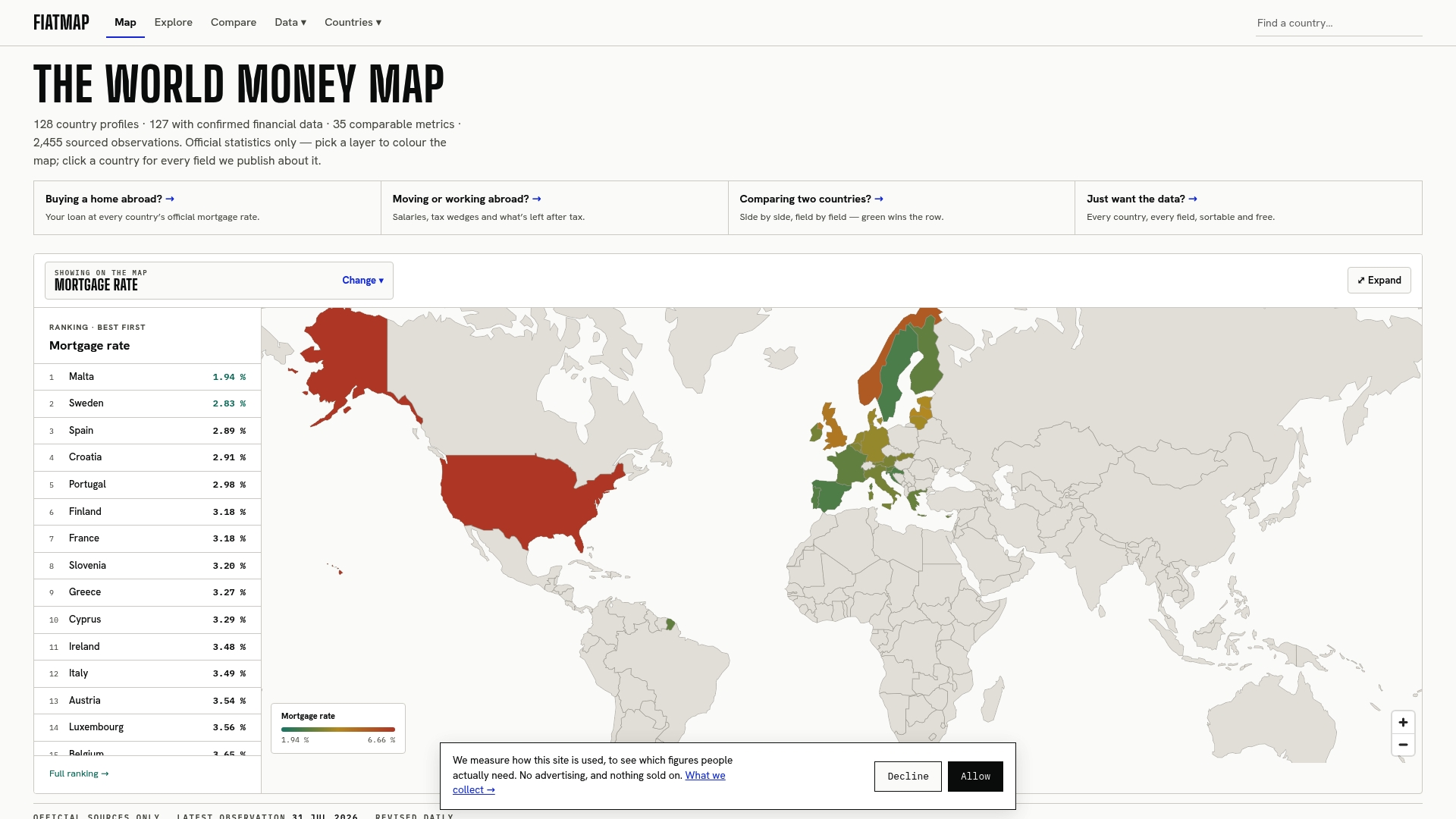
Plug a principal and term into the mortgage calculator and you can see, in seconds, how a rate difference of even one or two points reshapes total interest over 30 years. Every dataset behind these tools is available for download in CSV or JSON format through Fiatmap’s global money dataset, free under a CC BY 4.0 license, if you want to build your own amortization models or verify a lender’s numbers independently. Fiatmap provides data and comparison tools, not lending advice or loan origination. Start by looking up your country’s current mortgage rate ranking, then run your loan numbers against a few alternatives to see what the same debt would cost somewhere else.
This article is general information, not a substitute for advice from a qualified financial advisor. Consult a qualified financial professional about your own circumstances before acting on anything here.
Sources
- Understanding amortization - My Home by Freddie Mac
- Amortization Schedule: Definition, Formula, and Calculation - Investopedia
FAQ
How Does Mortgage Amortization Actually Work?
Each payment is split between interest, calculated on your remaining balance, and principal, which reduces that balance. Early on, most of the payment covers interest, and that ratio flips toward principal as the balance shrinks over the loan term.
What Does a 5-Year Term With a 25-Year Amortization Mean?
It means your payments are calculated as if you’re paying the loan off over 25 years, but the entire agreement, including your rate, only lasts 5 years. At the end of that term you either renew the loan at current rates or pay off whatever balance remains.
What Does a 10-Year Term With a 25-Year Amortization Mean?
The setup is the same idea over a longer window: your monthly payment reflects a 25-year payoff schedule, but the loan term itself, meaning your locked rate and conditions, expires before the scheduled payoff. You’ll renegotiate or refinance the remaining balance at that point, likely at a new rate.
What Is the Simplest Way to Understand Amortization?
Picture your loan balance as water draining from a tub. The interest you owe each month is based on how much water (balance) is still in the tub, so it starts high and shrinks as the balance drains. Every payment you make removes a little more water permanently, and that removal speeds up over time.
Is Amortization Period the Same as Loan Term?
No, and mixing them up causes real confusion when reading loan paperwork. The amortization period is the full length it would take to pay off the loan at your current schedule, while the loan term is how long your current rate and conditions actually last before renewal or full payoff is due.
Recommended
The figures on this site are collected from official statistics and each carries its own source and date — see /sources and the dataset. Where this article states a number, the country and ranking pages are what it should agree with.