3 Months' Interest vs IRD: Mortgage Prepayment Penalty Can Cost $4,875
2026-09-04
A mortgage prepayment penalty is a fee some lenders charge when you pay off a loan early, whether through refinancing, selling, or a large lump-sum payment. Not every loan has one, and most conventional mortgages written after January 2014 face strict caps if they do. Your first move: pull out your Note and loan estimate and check the prepayment clause before you plan any early payoff.
TL;DR:
- Most prepayment penalties are based on months of interest or the interest rate differential, and lenders may use the higher of the two for calculation.
- Prepayment penalties are typically front-loaded during the first three to five years of a loan and are often waived afterward, especially on open or assumable mortgages.
- Government-backed loans like FHA, VA, and USDA usually do not include prepayment penalties, but many conventional and non-QM loans do, especially for investment properties.
- Borrowers should ask their lender for the exact penalty calculation method in writing to properly evaluate the potential cost of early payoff.
- Waiting until after the penalty window or negotiating to remove or reduce the penalty can save money, especially if refinancing benefits outweigh the cost.
Table of Contents
- What Is a Mortgage Prepayment Penalty and Why Do Lenders Charge One?
- Types of Prepayment Penalties: Hard, Soft, and How They’re Structured
- How Lenders Calculate the Penalty: IRD vs. Months of Interest
- When Does a Prepayment Penalty Actually Trigger?
- Federal and State Rules That Limit Prepayment Penalties
- How to Avoid or Reduce a Mortgage Prepayment Penalty
- A Worked Example: Comparing IRD to Months of Interest
- Where to Find the Prepayment Clause and What to Ask Your Lender
- Using Fiatmap’s Mortgage Data to Model Your Own IRD Scenario
- When Paying the Penalty Actually Makes Sense
- Model Your Own Numbers Before You Decide
- Sources
What Is a Mortgage Prepayment Penalty and Why Do Lenders Charge One?
A prepayment penalty, sometimes called a prepayment charge or breakage cost, is money the lender collects when you retire a loan faster than the payment schedule calls for. Lenders build these into loans to protect the interest income they expected to earn over the loan’s life. When you refinance or sell early, that projected income disappears, and the penalty is the lender’s way of recovering part of it.
Not every loan carries this risk. Government-backed products, FHA, VA, and USDA loans, typically exclude prepayment penalties entirely. Conventional loans and especially non-QM (nonqualified mortgage) products are where you’re most likely to find one written into the contract.
Here’s where the term shows up in practice:
- Adjustable-rate and fixed-rate conventional loans from certain lenders, particularly non-QM products
- Investment property loans, which carry penalties more often than owner-occupied mortgages
- Loans originated before the Ability-to-Repay/Qualified Mortgage rule took effect in January 2014, which can carry older, less restrictive terms
Prepayment penalties aren’t as common as they once were, but they haven’t disappeared. Anyone shopping outside the standard conforming-loan box, especially investors and self-employed borrowers using bank-statement loans, should assume one might be lurking until proven otherwise.
Types of Prepayment Penalties: Hard, Soft, and How They’re Structured
Lenders write these penalties in a handful of standard formats, and the difference between them can mean thousands of dollars.
A hard penalty applies no matter why you pay off the loan early, whether you sell the house, refinance, or just write a big check. A soft penalty only kicks in if you refinance; selling the home is usually exempt. That distinction matters enormously if you think you might move before you’d refinance.
Beyond that hard/soft split, the fee itself gets calculated a few different ways:
- Percentage of the outstanding balance, often 1% to 3%, sometimes stepping down each year (a sliding scale)
- A fixed number of months’ interest, commonly three to six months, charged on the balance at your contract rate
- A flat fixed amount stated in the Note, rarer but still used by some smaller or private lenders
- Interest Rate Differential (IRD), common in Canada and with some U.S. non-QM lenders, comparing your rate to a current comparable rate
Most contracts also include a prepayment privilege, an annual allowance, commonly around 10% to 20% of the balance, that you can pay down without triggering any fee. Look for language like “the borrower may prepay up to” a stated percentage; anything beyond that threshold is where the penalty clock starts.
How Lenders Calculate the Penalty: IRD vs. Months of Interest
Two formulas dominate real-world prepayment penalty math, and knowing which one your lender uses changes your estimate significantly.
The simpler method is months-of-interest. The lender takes your outstanding balance, applies your contract interest rate, and charges you that amount for a set number of months, usually three.
The formula looks like this:
- Take your outstanding principal balance
- Multiply it by your annual interest rate
- Divide by 12 to get one month’s interest
- Multiply by the number of penalty months stated in your Note (commonly three)
The second method, Interest Rate Differential, is more complex and usually more expensive when rates have dropped since you signed. Canada’s Financial Consumer Agency lays out the standard approach: compare your contract rate to the current posted rate for a comparable term, apply that rate difference to your remaining balance, and extend it over the months left in your term.
- Find the difference between your contract rate and the lender’s current posted rate for a similar remaining term
- Multiply that rate difference by your outstanding balance
- Multiply the result by the number of years (or fraction of a year) remaining on your term
The math genuinely stings when rates fall. If your contract rate is meaningfully higher than what the lender is currently posting, the IRD calculation can produce a penalty several times larger than the flat months-of-interest method, because the lender is pricing in the interest income it’s actually losing by letting you walk away from a higher rate. Always ask which method applies to your loan; some lenders use “the higher of the two,” which guarantees you get whichever number costs more.
One more wrinkle: lenders often add administrative or discharge fees on top of the calculated penalty, and rounding conventions vary. Get the exact formula in writing rather than estimating from a generic template.
When Does a Prepayment Penalty Actually Trigger?
The penalty clause activates around specific events, not just any payment above your monthly minimum.
- Full payoff through sale or refinance almost always triggers a penalty if one exists in your contract
- Large lump-sum payments that exceed your annual prepayment privilege can trigger a partial penalty on the excess amount
- Small extra principal payments within your privilege allowance (typically that 10% to 20% annual threshold) usually carry no penalty at all
- The penalty window is almost always front-loaded, commonly the first three to five years of the loan, and disappears entirely afterward
A few structural exceptions are worth knowing. Some mortgages are “open,” meaning they allow full prepayment at any time without penalty, though they typically carry a higher rate to compensate. Others allow porting, transferring your existing rate and term to a new property, which can sidestep the penalty if you’re moving rather than simply paying off debt. If your loan is assumable, a buyer taking over your existing mortgage may avoid triggering the penalty altogether, since the loan itself isn’t being paid off.
Federal and State Rules That Limit Prepayment Penalties
Dodd-Frank changed the landscape substantially. For most conventional loans originated after January 2014, prepayment penalties are capped and time-limited with percentage limits that apply during the first several years, with no penalty permitted after that.
A few structural points worth flagging:
- Government-backed loans (FHA, VA, USDA) are generally exempt from prepayment penalties entirely, regardless of when they originated
- State law varies, and some states ban or further restrict prepayment penalties beyond the federal floor, so check your state’s statutes alongside federal rules
- Older loans originated before the 2014 rule change may still carry penalties with longer windows or higher percentages than current caps allow
- Non-QM loans, common with investment properties and self-employed borrowers, aren’t bound by the same qualified-mortgage caps and can carry steeper or longer-lasting penalties
The CFPB is the right first stop for federal guidance, but pair it with your own state’s consumer finance or banking regulator page, since state protections don’t always mirror federal ones.
How to Avoid or Reduce a Mortgage Prepayment Penalty
You have more leverage here than most borrowers realize, especially before you sign anything.
- Shop loans specifically for prepayment terms, not just rate and fees. Ask every lender point-blank whether the loan includes a prepayment penalty and get the answer in writing.
- Negotiate at origination. Chase’s own borrower guidance notes that penalty terms are sometimes negotiable before closing, particularly if you’re a strong borrower or the lender wants your business. Ask to have the clause removed or reduced.
- Use your annual prepayment privilege fully each year rather than stockpiling extra cash for one large payoff that could exceed the allowance.
- Time a full payoff or refinance for after the penalty window closes, if your finances allow you to wait a year or two.
- Run the break-even math before refinancing. Sometimes paying the penalty still saves money if the new rate is low enough; sometimes it doesn’t.
- Look at porting or assumability if you’re moving rather than simply eliminating debt, since either can avoid the penalty trigger.
Pro Tip: Ask your lender for the exact penalty calculation method in writing before you sign, not after. “Months of interest” and “IRD” can produce wildly different dollar amounts on the same loan, and you want to know which one applies while you still have negotiating room.
A Worked Example: Comparing IRD to Months of Interest
Here’s how the two methods actually play out on the same loan, using rounded figures to keep the math clear.
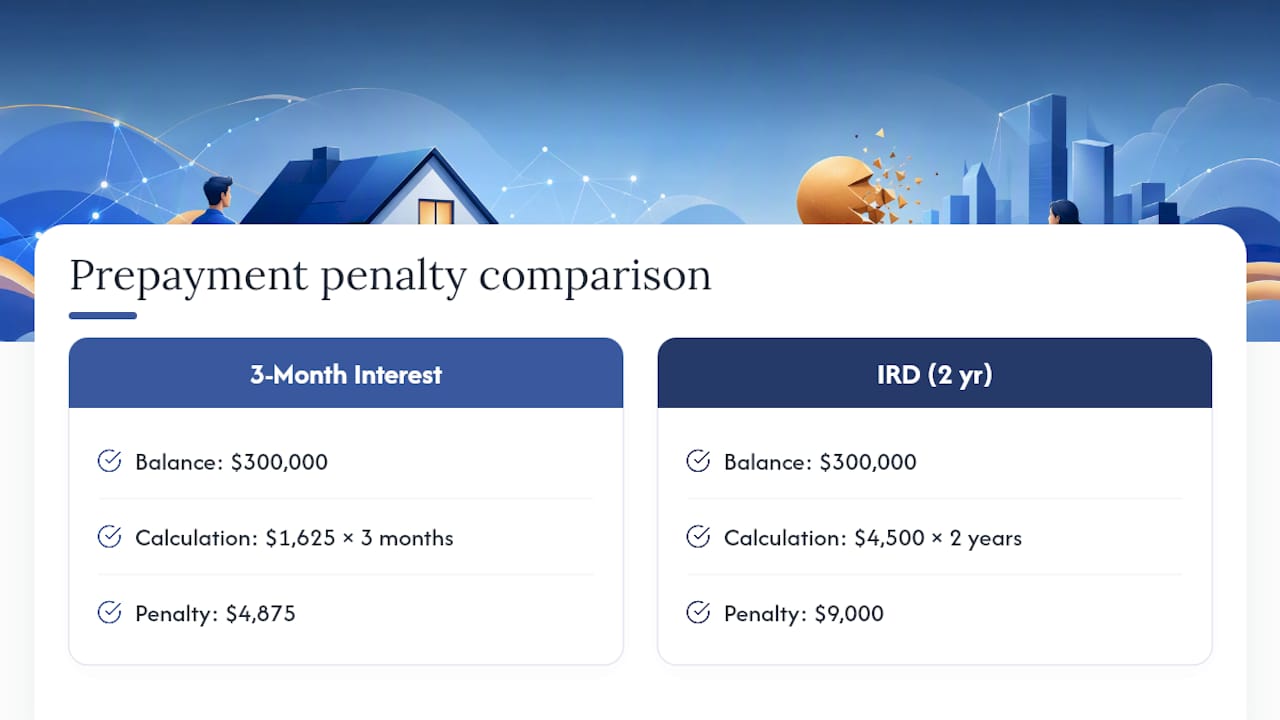
Divide by 12 for one month ($1,625), multiply by three months: $4,875 penalty.
Apply that to the $300,000 balance ($4,500 per year), then multiply by the 2 years remaining: $9,000 penalty.
Run that same comparison against your own balance, rate, and remaining term before deciding.
Where to Find the Prepayment Clause and What to Ask Your Lender
The clause almost never hides in fine print you’d never see. Check these documents in order:
- The Note, the core promissory document you signed at closing; search for “prepayment” specifically
- Any riders or addenda attached to the Note, which sometimes carry loan-specific penalty terms
- Your loan estimate and closing disclosure, both of which are required to flag a prepayment penalty if one exists
When you call the lender, ask directly: Does this loan have a prepayment penalty? What method calculates it, months of interest or IRD? What’s the exact-posted rate you’d use for that calculation today? Request a written payoff estimate, not a verbal one. The CFPB recommends exactly this: get clarification in writing whenever the terms feel ambiguous. If the lender won’t provide a clear written answer, a housing counselor or real estate attorney can review the Note for you.
Using Fiatmap’s Mortgage Data to Model Your Own IRD Scenario
Running an IRD estimate requires a defensible comparable rate, and that’s where market-level data helps. Fiatmap’s mortgage-rate glossary breaks down what a posted rate actually represents, and its country-by-country mortgage-rate rankings let you see current market rates as a sanity check against whatever figure your lender quotes.
A practical approach:
- Pull your lender’s stated posted rate for your remaining term
- Cross-check it against Fiatmap’s ranking data for your country as a rough market benchmark
- Plug both your contract rate and the comparable rate into the IRD formula above
- Flag any large gap between your lender’s number and the market rate, and ask the lender to explain it
Treat data from financial comparison tools as scenario-planning aids, not legal substitutes. Always confirm the exact posted rate your lender used in writing before finalizing any decision.
When Paying the Penalty Actually Makes Sense
Most borrowers treat a prepayment penalty as something to avoid at all costs. That’s the wrong frame. The real question is whether the penalty costs less than the present value of the interest you’d save by refinancing or paying off the loan now.
If a lower rate saves you $400 a month and the penalty is $4,875, you’re whole again in about a year. Wait out a penalty window only when the math doesn’t clear that bar, or when you’re within a few months of the window closing anyway. Patience costs nothing; an unnecessary penalty does.
— Torstein
Model Your Own Numbers Before You Decide
Every scenario in this guide depends on getting your comparable rate right, and specialized mortgage-rate data tools can provide current, officially sourced mortgage-rate information to help run your own IRD math with a number you can actually defend to your lender.
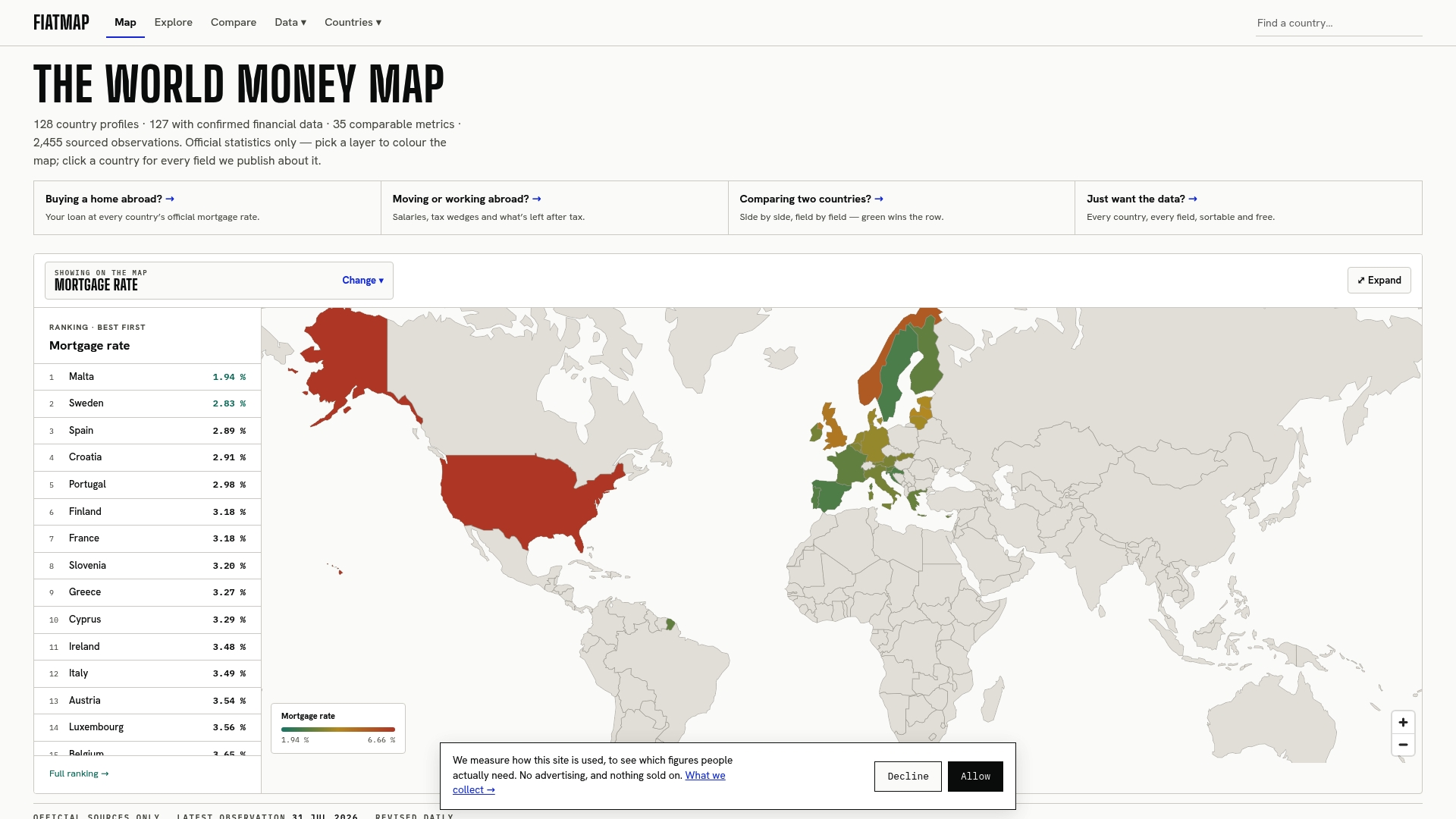
Start with the mortgage-rate glossary to understand exactly what a posted rate measures, then move to the mortgage rates by country ranking to find a current comparable figure for your market. If you want to see how dramatically the same loan can price differently depending on where and when it’s written, the same mortgage, wildly different prices data story is worth a look before you call your lender. Pull the numbers, run your own break-even calculation, and walk into that lender call with a figure they can’t talk you out of.
Sources
For the legal baseline, start with the CFPB’s guidance on prepayment penalties and its Ability-to-Repay/Qualified Mortgage rule resources. For IRD mechanics, Canada’s Financial Consumer Agency publishes a clear worked example. Cross-check calculation methods against Bankrate’s breakdown and Chase’s borrower guidance. Above all, request your written payoff estimate directly from your lender before making any final decision.
Recommended
The figures on this site are collected from official statistics and each carries its own source and date — see /sources and the dataset. Where this article states a number, the country and ranking pages are what it should agree with.