6–24 Months: When an Open Mortgage Beats a Closed One in Canada
2026-09-11
An open mortgage lets you repay any amount, anytime, without penalty, but it comes at a higher rate. A closed mortgage locks you into lower payments in exchange for restrictions on prepayment and real penalties if you break it early. For most Canadian buyers, closed wins on cost. Open only pulls ahead if you expect to sell or pay off the loan within a year or two; see more details in this Sell My House Fast For Cash RI blog for practical seller-focused scenarios.
TL;DR:
- An open mortgage’s higher rate can outweigh its benefits unless you plan to pay off or sell within one to two years.
- Closed mortgages offer lower rates, predictable payments, and optional prepayment privileges that can reduce total interest paid over time.
- Breaking a fixed-rate closed mortgage can incur penalties ranging from three months’ interest to substantial interest rate differentials, often costing several thousand dollars.
- Borrowers should compare actual lender penalty formulas and run personalized calculations to determine if the openness premium offsets potential break costs.
- For most long-term owners, a closed mortgage with prepayment privileges generally results in lower overall interest payments than an open mortgage, unless a liquidity event is imminent.
Table of Contents
- Open vs Closed Mortgage: How Each One Actually Works
- Weighing the Pros and Cons of Each Mortgage Type
- How Is a Mortgage Break Penalty Calculated?
- When Should You Choose Open Over Closed?
- How to Compare Lender Offers Before You Sign
- How Mortgage Type Affects Your Total Interest Paid
- Are There Tax Implications for Open vs Closed Mortgages?
- Fiatmap’s Take: Model the Trade-Off, Don’t Guess It
- Model Your Mortgage Numbers Before You Choose
- Where to Verify Penalty Formulas and Lender Details
- Sources
- FAQ
Open vs Closed Mortgage: How Each One Actually Works
The difference boils down to what you’re allowed to do with your money and what it costs you to keep that freedom.
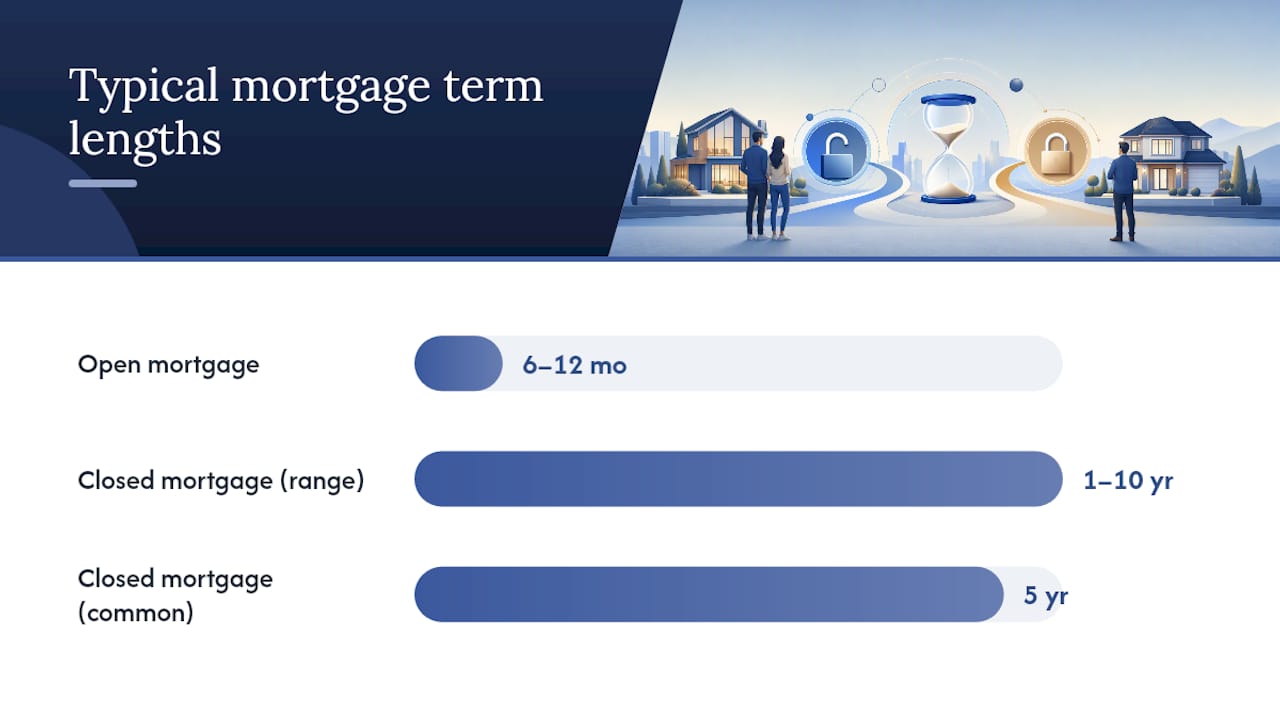
An open mortgage lets you repay part or all of the balance at any point in the term with no penalty, refinance whenever you want, and switch lenders mid term if a better deal shows up. Terms are usually short, often six months to one year, because lenders price in the churn. You get full portability, meaning you can move the mortgage to a new property without breaking anything.
A closed mortgage restricts how much you can prepay each year, typically through prepayment privileges: a set percentage of the original principal (commonly 10 to 20 percent annually) or an allowed increase to your regular payment. Go beyond that limit, or pay the whole thing off before the term ends, and you’re “breaking” the mortgage, which triggers a penalty. Closed terms run longer, usually one to ten years, with five years being the most common in Canada.
The rate gap is the real story here. Open mortgage rates run consistently higher than closed rates because lenders are pricing in the flexibility they’re giving up control over. On a $400,000 mortgage, even a one-point rate difference adds real dollars to your monthly payment.
Qualification doesn’t change much between the two. Lenders check the same things either way:
- Income and employment stability
- Credit history and score
- Debt-to-income ratios
- The mortgage stress test, which affects your approved amount regardless of mortgage type
Weighing the Pros and Cons of Each Mortgage Type
Neither option is objectively better. It depends entirely on your timeline and risk tolerance.
Open mortgage advantages:
- Pay off the entire balance whenever you want, with zero penalty
- Refinance or restructure without friction
- Ideal if you’re selling within a year or expecting a windfall
Open mortgage drawback: the rate premium adds up fast if you hold the loan longer than planned. What looked like a smart flexible choice in month one can quietly cost you thousands by month eighteen.
Closed mortgage advantages:
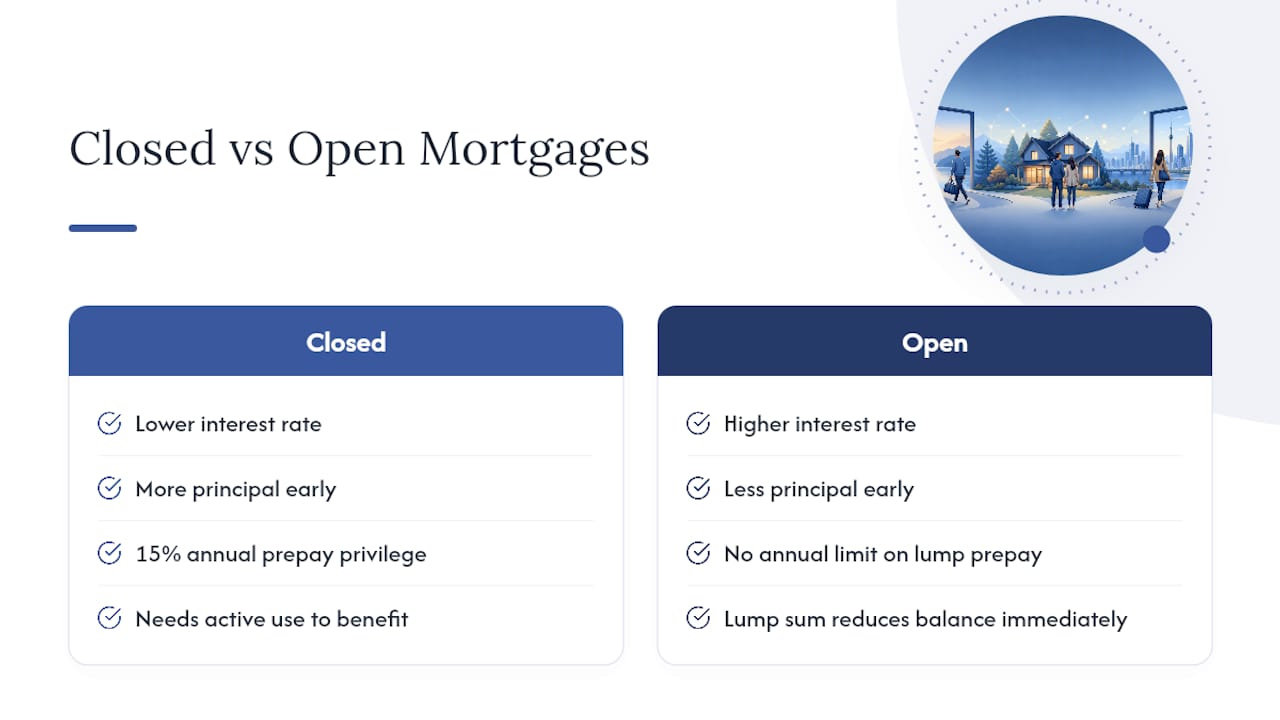
- Lower rate, which means lower monthly payments and less total interest over the amortization
- Predictable, stable payments for budgeting
- Built-in prepayment privileges still let you chip away at the principal faster, penalty-free, within the annual limit
Closed mortgage drawback: breaking the term early can trigger a penalty large enough to erase years of rate savings in one lump sum.
Pro Tip: If you’re disciplined about making extra payments, a closed mortgage with strong prepayment privileges usually beats an open mortgage on cost, even if you value flexibility. The catch: many borrowers plan to use those privileges and never actually do it, which quietly wastes the advantage they paid for.
How Is a Mortgage Break Penalty Calculated?
This is where the open vs closed mortgage decision gets mathematical, and where most borrowers get blindsided.
If you have a variable-rate closed mortgage, breaking it typically costs three months’ interest, a relatively simple and predictable number to calculate.
If you have a fixed-rate closed mortgage, the penalty is usually the greater of three months’ interest or the interest rate differential (IRD). The IRD compares your contract rate to the current rate the lender could charge for the remaining term. The bigger that gap, and the more time left on your term, the larger the penalty.
Here’s what that looks like on a $400,000 mortgage with three years remaining on a fixed term, comparing a modest rate drop scenario against three months’ interest:
| Penalty Method | How It’s Calculated | Approximate Cost on $400,000 |
|---|---|---|
| Three months’ interest | Balance × rate ÷ 12 × 3 | Roughly $4,000–$5,000 depending on rate |
| IRD (fixed, rates dropped) | Rate differential × balance × remaining term | Can run $8,000–$15,000+ |
The exact number depends entirely on your lender’s formula, and formulas genuinely differ. Monoline lenders often calculate IRD differently than major banks, sometimes landing on a lower figure. Never trust a rough online estimate for a decision this size. Ask your lender for a written penalty quote before you sign anything or before you decide to break an existing term.
When Should You Choose Open Over Closed?
Match the mortgage type to your actual timeline, not your gut feeling about flexibility.
- Selling or paying off within 6 to 24 months? Lean open. The rate premium over a short window usually costs less than a fixed or variable closed mortgage would.
- Expecting a lump sum soon (inheritance, bonus, business sale)? Open avoids paying a penalty to use that money on the mortgage the moment it lands.
- Planning to own for several years with no liquidity event on the horizon? Closed almost always wins on total cost, even accounting for prepayment privilege limits.
- Want a middle path? Convertible mortgages let you start closed at a lower rate and switch later if your plans change, without the full open-rate premium the whole time.
Short closed terms (one or two years) can also split the difference, giving you a lower rate than open with less long-term commitment than a five-year closed term.
How to Compare Lender Offers Before You Sign
Rate quotes alone tell you almost nothing. Ask every lender the same five questions and put the answers side by side:
- What is your rate for an open term versus a closed term of the same length?
- Exactly what prepayment privileges come with the closed option, as a percentage or payment increase?
- How do you calculate a break penalty: IRD, three months’ interest, or the greater of both?
- Are there administrative or discharge fees on top of the penalty?
- Can you provide that penalty formula in writing?
Once you have real numbers, run the math yourself: multiply the extra monthly cost of the open premium by how many months you actually expect to hold the loan, then compare that total against the penalty estimate for breaking a closed term early. Whichever number is smaller tells you which mortgage type actually saves money in your situation, not in the average case lenders like to quote.
How Mortgage Type Affects Your Total Interest Paid
The amortization schedule itself, meaning how many years it takes to pay off the loan, doesn’t change based on open versus closed. What changes is how much interest accumulates along the way.
A lower rate on a closed mortgage means more of each payment chips away at principal from day one, compounding in your favor over a 25 or 30 year amortization. Run two identical $400,000 mortgages side by side, one open and one closed, and the closed mortgage’s lower rate alone can save tens of thousands over a full amortization if you hold it that long.
Prepayment privileges matter more than most borrowers realize here. A closed mortgage that lets you pay an extra 15 percent of principal annually, and you actually use it, shortens your amortization and slashes total interest paid, sometimes rivaling or beating what an open mortgage would have offered anyway. The privilege only works if you use it, though, which is the gap between the mortgage’s theoretical benefit and what most borrowers actually capture.
Open mortgages don’t offer this compounding advantage through rate. Their advantage is timing: if you make one enormous unplanned prepayment (selling a property, cashing out an investment), that lump sum reduces your remaining balance immediately with no penalty, which can shorten your amortization dramatically in a single move. For most borrowers who make steady, moderate extra payments rather than one giant lump sum, closed almost always produces less total interest paid over the life of the loan.
Are There Tax Implications for Open vs Closed Mortgages?
For a primary residence, the choice between open and closed carries no direct tax consequence in Canada. Mortgage interest on your own home isn’t tax deductible either way, so switching mortgage types doesn’t change your personal tax return.
The calculation shifts if the property is a rental or investment property. Interest paid on a mortgage for income-producing real estate is generally deductible as a business expense, regardless of whether the mortgage is open or closed. In that case, a higher open-rate interest cost technically generates a bigger deduction, but that’s a wash rather than a benefit. You’re still paying more in real dollars; you’re just recovering a portion of it at tax time. A break penalty on a rental property mortgage may also be treated as a deductible expense in the year you pay it, though the rules depend on your specific situation and how the property is used.
None of this should drive your decision. The rate spread and penalty math dwarf any tax effect for almost every borrower. If you’re financing an investment property and want the deduction details confirmed for your exact circumstances, that’s a conversation for an accountant, not a mortgage comparison article.
Fiatmap’s Take: Model the Trade-Off, Don’t Guess It
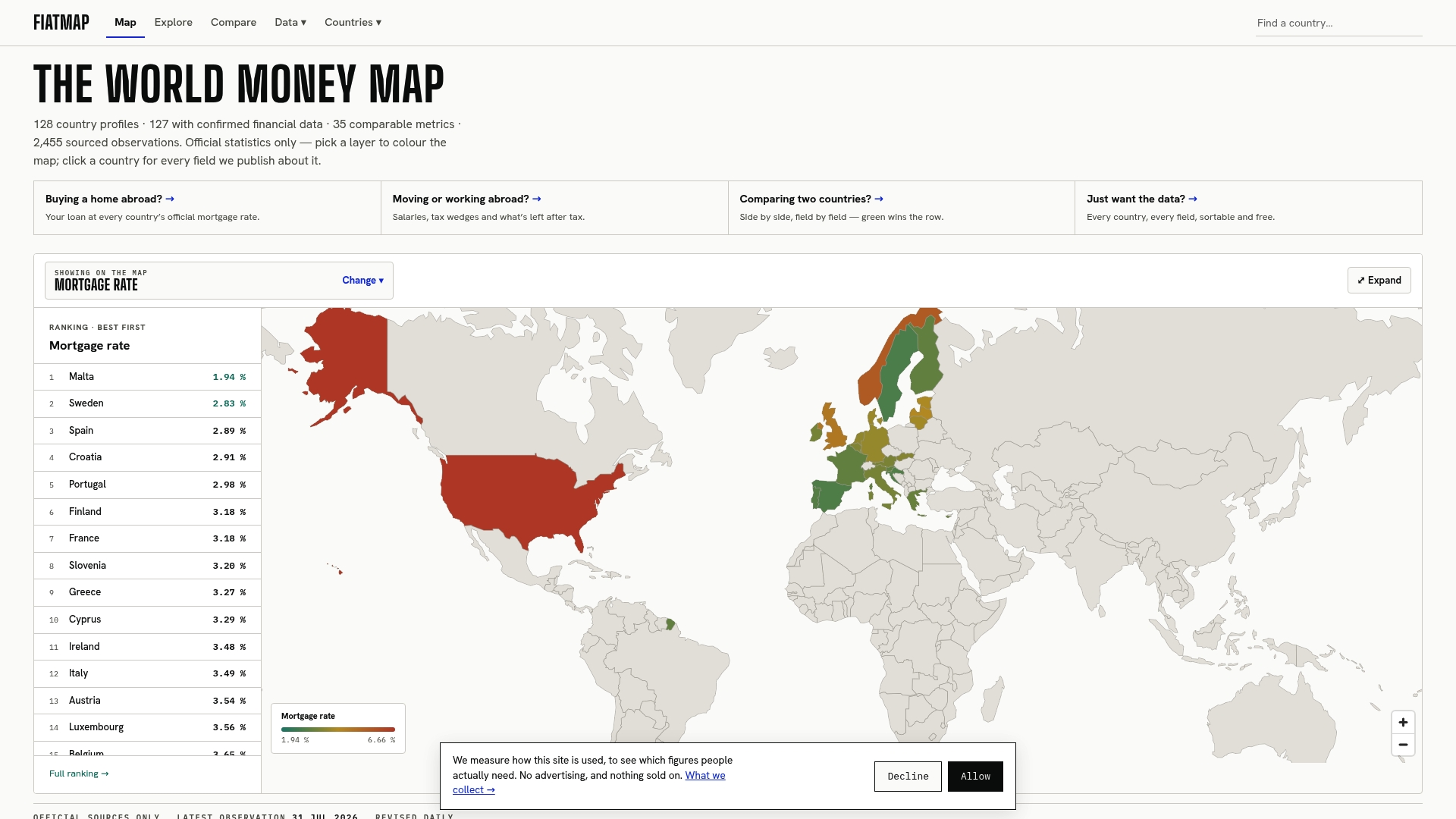
The open versus closed decision isn’t really a preference question, it’s a spread calculation. Fiatmap’s mortgage rate rankings let you see current open and closed spreads by market instead of relying on one lender’s quote. Pull the current spread, multiply it by your expected holding period, and compare that number against a realistic penalty estimate. The math usually settles the argument faster than any pros-and-cons list.
— Torstein
Model Your Mortgage Numbers Before You Choose
Every calculation in this article, the rate premium, the IRD estimate, the total interest gap, depends on knowing your actual numbers, not a rough national average. That’s the gap Fiatmap fills. Fiatmap’s mortgage rate glossary breaks down exactly how lenders price open versus closed terms, and the mortgage rankings let you compare current spreads across markets sourced directly from official statistics rather than marketing pages.
If you’re weighing a move, a refinance, or just want to see what your mortgage would cost under different rate environments, run the numbers through Fiatmap’s mortgage calculator. It’s built to turn “what if” into an actual dollar figure, so your open versus closed decision rests on your own math instead of a lender’s sales pitch.
Where to Verify Penalty Formulas and Lender Details
Every lender calculates penalties slightly differently, so treat the figures here as estimates. Confirm exact terms directly with Canada Life’s mortgage overview, RBC’s mortgage type breakdown, and always request a written penalty quote from your own lender before making a final call.
This article is general information, not a substitute for advice from a qualified financial advisor. Consult a qualified financial professional about your own circumstances before acting on anything here.
Sources
- Open vs. closed mortgages - Canada Life
- Closed, Open and Convertible Mortgages - RBC Royal Bank
- The Pros and Cons of Open and Closed Mortgages - Invis
FAQ
What’s the difference between an open and closed mortgage?
An open mortgage allows unlimited prepayment or full payoff anytime with no penalty, at a higher interest rate. A closed mortgage limits prepayments to set privileges and charges a penalty for breaking the term, but offers a lower rate.
What is the disadvantage of an open mortgage?
The main drawback is cost: open mortgages carry a rate premium over closed mortgages, so holding one longer than a year or two often ends up more expensive than the flexibility is worth.
What is the difference between a closed and open-end mortgage?
A closed mortgage restricts how much extra principal you can pay each year without penalty. An open mortgage, sometimes called open-end, has no such prepayment cap and can be paid off in full at any time.
Can you pay off an open mortgage?
Yes. You can pay off an entire open mortgage at any point during the term with no prepayment penalty, which is the defining feature that separates it from a closed mortgage.
How do I know if the open-rate premium is worth paying?
Compare the extra monthly cost of the open rate, multiplied by how many months you’ll realistically hold the mortgage, against a written penalty estimate from your lender for breaking a closed term. A tool like Fiatmap’s mortgage calculator makes that comparison concrete instead of theoretical.
Recommended
The figures on this site are collected from official statistics and each carries its own source and date — see /sources and the dataset. Where this article states a number, the country and ranking pages are what it should agree with.