Spot vs Forward Rate: Test Funding vs Forecast With 128 Countries
2026-10-05

A spot rate is the price you pay to exchange currency for settlement in a day or two, while a forward rate is the price you lock in today for a currency exchange that settles weeks or months from now. The gap between them, called forward points, comes mostly from the interest-rate difference between the two currencies, though in practice funding costs and market liquidity also leave their mark. The rest of this piece walks through the formulas, a couple of worked examples, and where the textbook math breaks down.
TL;DR:
- Forward points primarily reflect the interest rate differential between currencies, with higher-yielding currencies trading at a forward discount.
- Deviations from covered interest parity have persisted since 2007, incorporating funding and liquidity premiums beyond pure interest rates.
- Forward rates are tools for hedging or locking in future exchange rates, not reliable predictors of future spot movements.
- Comparing policy and deposit rates between countries helps estimate whether a currency should trade at a forward premium or discount.
- Always verify the settlement date and day-count conventions when comparing forward quotes to avoid significant discrepancies.
Table of Contents
- Defining Spot, Forward, and Forward Points
- How the Market Prices a Forward: Carry, CIP, and Where It Breaks Down
- Working Through the Numbers: Two Simple Calculations
- Why Forward Rates Aren’t Reliable Forecasts
- Choosing Between Spot and Forward: A Practical Checklist
- What Fiatmap’s Country Data Adds to the Picture
- Keep the Forward in Its Lane
- Compare the Rates That Drive Forward Pricing
- FAQ
- Sources
Defining Spot, Forward, and Forward Points
A spot rate is the exchange rate quoted for near-immediate delivery. In most currency pairs, that means settlement two business days after the trade, known as T+2, though some pairs settle next-day or same-day. A forward rate is the rate two parties agree on today for an exchange that will happen on a specified future date, whether that’s 30 days, 90 days, or a year out. Nothing changes hands at the moment the forward contract is signed. It’s a binding promise to trade at a fixed rate later, regardless of where the spot market ends up.

The difference between the spot rate and the forward rate is expressed in forward points, sometimes called the forward margin. When the forward rate sits above spot, traders call that a forward premium; when it sits below spot, that’s a forward discount, a convention Bank of England guidance spells out directly.
A few conventions worth knowing before you read a quote:
- Currency pairs are quoted as base/quote, so EUR/USD tells you how many dollars one euro buys.
- Forward points are typically quoted in small increments (pips) added to or subtracted from the spot rate to get the outright forward.
- Common forward maturities are 1 month, 3 months, 6 months, and 1 year, though banks will often price custom dates.
How the Market Prices a Forward: Carry, CIP, and Where It Breaks Down
The textbook logic behind forward pricing is covered interest parity (CIP): the forward rate should equal the spot rate adjusted for the interest-rate differential between the two currencies, because otherwise an arbitrageur could borrow in the cheap currency, convert at spot, invest at the higher rate, and lock in a risk-free profit with a forward contract. That arbitrage pressure is what ties the forward price to the interest differential rather than to anyone’s guess about where the exchange rate is headed.
In practice, forward points reflect the interest-rate differential between the two currencies: the higher-yielding currency trades at a forward discount, and the lower-yielding currency trades at a forward premium, so the carry is priced out of the deal rather than left as free money.
- If currency A’s interest rate is higher than currency B’s, A trades at a forward discount against B.
- The size of the discount or premium scales with the interest gap and the length of the forward contract.
- Day-count conventions (actual/360 versus actual/365) and settlement-date mismatches change the exact number, especially on short-dated forwards.
That’s the clean version. The messier, and more important, reality is that since the 2007 global financial crisis, persistent cross-currency basis spreads have meant CIP frequently fails to hold exactly, according to BIS research on the cross-currency basis, which treats CIP as close to a textbook law of forward pricing yet documents durable deviations tied to funding and liquidity constraints after the crisis. In other words, forward rates increasingly price in a funding and credit premium on top of the pure interest differential, not just the differential itself.
Working Through the Numbers: Two Simple Calculations
Here’s how the arithmetic plays out in two common scenarios.
- FX forward from spot plus points. Say EUR/USD spot is quoted at 1.0800, and the 3-month forward points are quoted as a negative small amount (negative typically happens because dollar rates exceed euro rates over that period). The outright forward rate is 1.0800 minus 0.0040, or 1.0760. That’s the rate a bank will commit to today for a trade settling in three months.
- Implied forward interest rate from two spot zero rates. If the 1-year zero rate is 3% and the 2-year zero rate is 4%, the implied 1-year forward rate (the rate for year two, locked in today) solves from (1.04)^2 = (1.03) x (1 + f), giving f of roughly 5.01%. That figure tells you what the market expects to charge for one-year money starting a year from now, not what will actually happen.
A few gotchas sit underneath both calculations. Dealer bid-offer spread sits on top of the theoretical forward price and is a separate cost from the interest differential itself, a distinction CF Insights draws out clearly. Day-count mismatches between the two legs of a trade can shift a short-dated forward by a few pips even when the stated rates look identical. Quoting conventions can also flip: always check which currency is the base before reading a forward points sheet.
Pro Tip: Before you compare a forward quote across two dealers, confirm they’re using the same settlement date and day-count basis. A one-day mismatch can explain most of the apparent price gap.
Why Forward Rates Aren’t Reliable Forecasts
A forward rate looks like a prediction of where spot will land, but it generally isn’t one. Uncovered interest parity (UIP) is the theory that the forward rate should equal the market’s unbiased expectation of the future spot rate, yet decades of currency research describe a persistent “forward premium puzzle”: the high-yielding currency in a pair tends to appreciate rather than depreciate as UIP would predict, meaning the forward rate is a biased, not unbiased, predictor of future spot.
- Forward rates are priced off interest differentials and funding costs, not off a consensus forecast of the future.
- The forward premium puzzle shows currencies with higher rates have often drifted stronger, not weaker, over the subsequent period, the opposite of naive UIP.
- Treat a forward quote as a hedging and funding price, never as a promise about where the market will trade later.
The funding dimension matters just as much as the forecasting failure. BIS research finds that cross-currency basis deviations from CIP have persisted since 2007, driven by balance-sheet constraints and liquidity stress rather than pure interest-rate arbitrage. That means the forward price you’re quoted embeds a funding premium that has nothing to do with anyone’s view on the currency’s direction. For anyone hedging a known future cash flow, the practical takeaway is the same either way: a forward locks in a price, it doesn’t predict one.
Choosing Between Spot and Forward: A Practical Checklist
The right instrument depends on your goal, not on which rate “looks better.” Converting cash you need today calls for spot. Locking in a known future cash flow, like a supplier payment due in 90 days, calls for a forward, which removes exchange-rate risk at the cost of giving up any upside if the rate moves in your favor. Pure funding or carry trades usually combine both legs.
Before committing to a forward, it helps to ask your counterparty a short list of questions:
- What day-count convention and settlement date are you using for this quote?
- How wide is your bid-offer spread on this maturity, and is it published anywhere?
- Is there a margin or collateral requirement if the rate moves against me before settlement?
- Can I unwind or extend this forward early, and what does that cost?
What Fiatmap’s Country Data Adds to the Picture
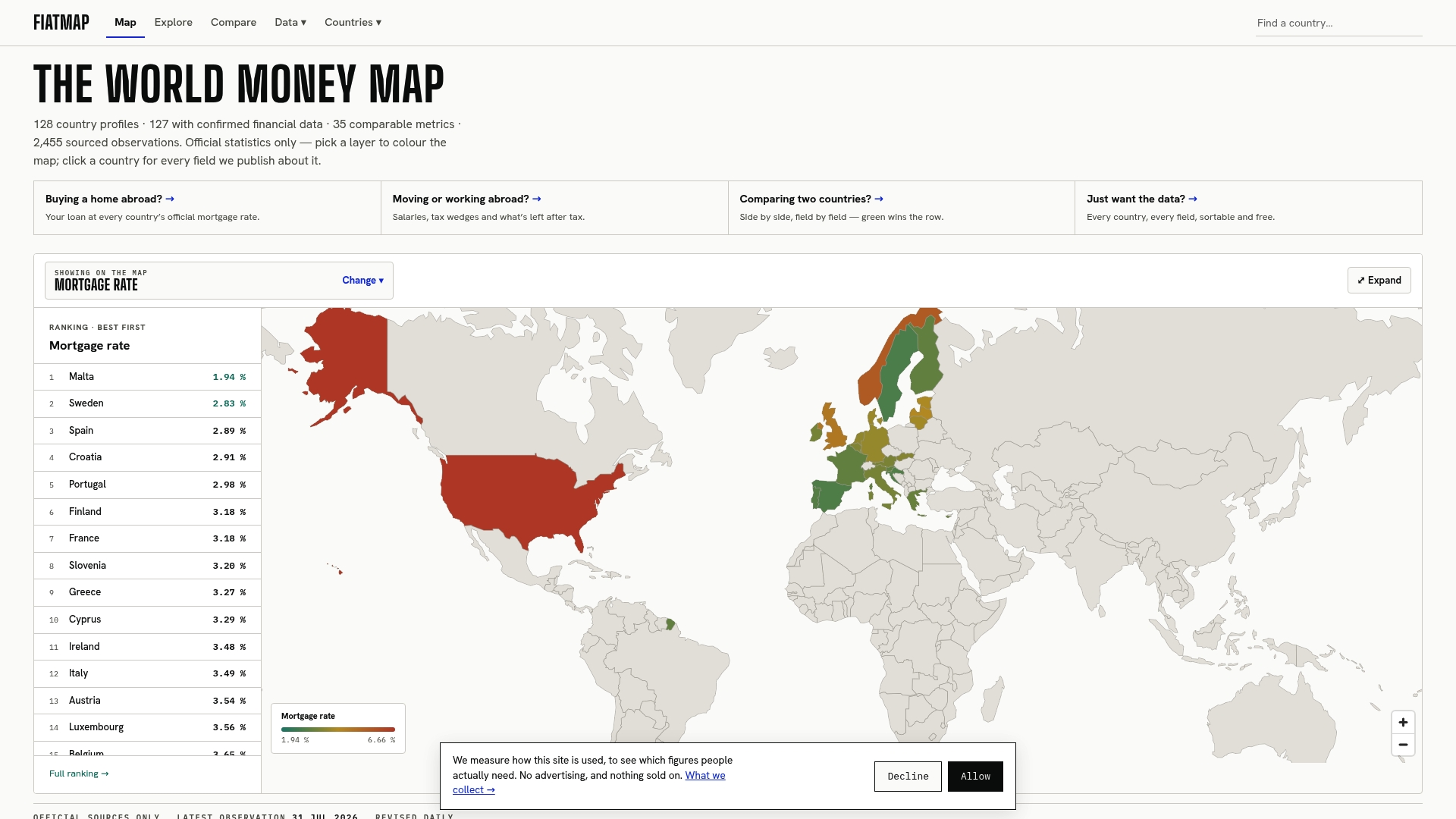
Because forward pricing starts with the interest-rate gap between two countries, comparing policy and deposit rates side by side is a useful sanity check before reading a forward quote. We built our real policy rate map and deposit rate map from official statistics so you can pick a country pair, compare their rates, and get a rough sense of which currency should trade at a forward premium or discount before you ever see a dealer’s quote.
Keep the Forward in Its Lane
In practice, a forward rate is a price, not a prophecy. Three things matter most: treat the forward as a hedge or funding tool rather than a forecast, confirm your counterparty’s day-count and settlement terms before comparing quotes, and remember that dealer spread sits on top of the theoretical price, not inside it. The two mistakes I see most often are reading forward points as a market call on currency direction, and ignoring liquidity costs that widen in stressed conditions. Get those two right and the rest of the math is straightforward.
— Torstein
Compare the Rates That Drive Forward Pricing
Reading a forward quote is easier once you know what the underlying interest-rate gap actually looks like, country by country. Our Global Money Dataset pulls policy rates, deposit rates, and inflation figures from official sources across 128 countries, free to browse or download in CSV or JSON.
- Compare policy and deposit rates for any two countries before estimating carry direction.
- Check the real interest rate behind a nominal quote so you’re comparing like with like.
- Pull the raw series yourself if you want to build your own forward-points estimate.
Start with the Global Money Dataset and see what the rate gap between your two currencies actually looks like.
This article is general information, not a substitute for advice from a qualified financial advisor. Consult a qualified financial professional about your own circumstances before acting on anything here.
FAQ
What is a spot rate?
A spot rate is the exchange rate for a currency trade that settles almost immediately, typically within two business days (T+2). It reflects current supply and demand in the currency market rather than any future expectation.
What is the difference between the spot and forward markets?
The spot market handles trades settling in one or two business days, while the forward market handles contracts for exchange at a fixed rate on a specified future date. The forward price is derived from the spot rate adjusted by forward points tied to the interest-rate differential between the two currencies.
What is a forward rate?
A forward rate is the exchange rate two parties agree on today for a currency trade that will settle on a future date, commonly 30, 90, or 365 days out. It’s calculated from the spot rate plus or minus forward points, which track the interest-rate gap between the two currencies rather than a forecast of future spot.
What does a 30-day forward rate mean?
A 30-day forward rate is the rate locked in today for a currency exchange that will settle 30 days from the trade date. It’s priced using the spot rate adjusted for the one-month interest differential between the two currencies, following the same covered interest parity logic used for longer maturities.
Sources
- Spot and forward rates — Mesirow Currency Viewpoints
- Covered interest parity lost: understanding the cross-currency basis — BIS Quarterly Review
- What is an FX forward curve? — CF Insights
Recommended
The figures on this site are collected from official statistics and each carries its own source and date — see /sources and the dataset. Where this article states a number, the country and ranking pages are what it should agree with.