Urbanization Rate by Country: Who Is Most Urban, Who Is Youngest
2026-11-01

The urbanization rate is the share of a country’s people who live in urban areas, and it varies from roughly a quarter of the population in some African countries to nearly 100% in city-states. Worldwide, 58 per cent of people lived in urban areas in 2025, and that share keeps climbing. This guide shows how to read the numbers by country, why two lists can disagree about the same place, and how urbanization connects to a country’s age profile and its housing market.
TL;DR
- The urbanization rate is the percentage of a country’s population living in urban areas. The rate of urban growth is a different number: how fast that urban population changes each year.
- Globally, 58 per cent of people lived in urban areas in 2025, according to the UN’s World Urbanization Prospects 2025.
- Every country defines “urban” its own way, so cross-country rankings are approximate. City-states top the lists, and large countries like India sit far lower.
- The youngest populations are concentrated in Africa, and many of those countries are also among the least urbanized, which is changing quickly.
- For housing and investment decisions, pair urbanization with house price, rent and mortgage data instead of reading it alone.
Table of Contents
- What the urbanization rate actually measures
- Urbanization worldwide: the big picture
- Most urbanized countries
- Least urbanized countries, and the fastest growing
- Urbanization and young populations
- How to compare countries without being misled
- From urbanization to housing costs
- Perspective
- Put the data to work
- FAQ
- Sources
What the urbanization rate actually measures
Two numbers get confused all the time.
The urbanization rate (or urban share) is a snapshot: of everyone living in a country in a given year, what percentage lives in places classified as urban. If a country has 100 million people and 70 million live in urban areas, its urbanization rate is 70%.
The rate of urban growth is movement. The United Nations defines it as the average annual rate of change of the population living in defined urban areas over a period, usually shown as a percentage. A country can be only 25% urban and still have one of the fastest-growing urban populations in the world, because it is starting from a low base and adding people to cities quickly.

This is why a ranking called “urbanization rate” sometimes lists Burundi first and a ranking of urban share lists Monaco first. They answer different questions. Before you use a table, check which of the two it shows.
Why “urban” means different things in different places
There is no single global definition. The UN Statistical Division notes that there is no internationally agreed definition of urban areas, and national definitions vary, often relying on locality size, administrative status or population density.
In practice that means:
- A settlement of a few thousand people may count as urban in one country and rural in another.
- Some countries classify by administrative label, so a town can be “urban” because of its legal status, not its density.
- Definitions change over time. The UN’s methodology notes that holding the urban and rural split of territory constant would be misleading, because urban areas expand as urbanization progresses and the true share of people in urban areas would be underestimated.
The UN’s 2025 revision also introduced a more harmonized lens. It reports that cities are now home to 45 per cent of the global population of 8.2 billion, a figure that uses a consistent settlement definition and is narrower than the 58 per cent “urban areas” figure based on national definitions. Both are valid. They simply measure different things, so never mix them in one chart.
Urbanization worldwide: the big picture
The UN reports that the share of people living in more urbanized settlements has risen since 1950 and is projected to keep increasing through 2050. The 2025 revision covers 237 countries or areas from 1950 to 2025, with projections to 2050, so it is the standard reference for country comparisons.
Regional gaps are wide. Earlier UN analysis put Northern America at 82 per cent urban while Asia was around 50 per cent at the time of that report, which is a reminder of how much of the world’s recent urban growth has happened in Asia and Africa. Since the last revision, the picture has kept shifting, so always note the year attached to a figure.
Most urbanized countries
The top of any urbanization ranking is dominated by city-states and small territories where almost the entire population lives in one built-up area: Monaco, the Holy See, Gibraltar, Macao SAR, Singapore, Hong Kong SAR and Bermuda are typically listed among the leaders. These are not very informative for comparing national economies. When you want a meaningful comparison, set them aside and look at sovereign states with rural land.
Among those, the UN reports several countries that had reached high urbanization levels by 2025, including the United Arab Emirates (75 per cent), Jordan (73 per cent), and Israel and Egypt (70 per cent).
Other patterns worth knowing:
- Gulf states and Latin America are heavily urban, often with a large share of the population in one or two metropolitan areas.
- Western Europe, Japan, South Korea and Australia are highly urban with older, slower-growing populations.
- Africa’s most urban countries can be very high. Statista reports that in 2024 Gabon had the highest urbanization rate in Africa, at over 90 percent, followed by Libya and Djibouti.
Least urbanized countries, and the fastest growing
At the other end are mostly low-income countries in sub-Saharan Africa and parts of South and Southeast Asia, where most people still live in villages and farms. Burundi is a clear example: Statista reports that its urban share was 24.83 percent in 2024.

Yet Burundi also shows why the rate of urban growth matters. CEIC’s series, built on World Bank estimates and UN urban ratios, records urban population growth of 7.863% in 2024. That is very fast: at that pace an urban population roughly doubles in a decade. One low share and one high growth rate describe the same country at once.
How to read the two together:
| Pattern | What it usually means | What to watch |
|---|---|---|
| High share, low growth | Mature urban system, often an aging population | Housing supply constraints, rent levels |
| Low share, high growth | Early-stage urbanization, young population | Infrastructure gaps, informal housing |
| High share, high growth | Rapid expansion of already large cities | Land prices, price growth, credit conditions |
| Low share, low growth | Rural economy or slow structural change | Data quality, definition changes |
The big absolute numbers sit elsewhere. Large countries with moderate shares hold the most urban residents: one widely cited table of urban population counts lists China at about 924 million and India at about 504 million, with Mexico above 103 million. A country can be middling on percentage and still be the biggest city market on earth.
Urbanization and young populations
Readers who look up urbanization also search for the youngest countries, and the two are linked.
How “young” is defined
There are two common definitions, and rankings mix them up:
- Median age. Half the population is younger than this age. Lower means younger.
- Youth share. The percentage of people in a set age band. The UN’s standard youth band is ages 15 to 24, and the UN World Population Prospects 2024 reports that the global average share of people aged 15 to 24 was 15.6 per cent in 2024.
Some media lists instead count everyone under 18 or under 15. Always check the band before comparing two lists.
Where the youngest populations are
Africa dominates. Statista notes that among the 35 countries with the lowest median age worldwide, only three fall outside Africa, and that Niger was the youngest in 2024 with a median age of 15.2 years. Other countries typically named near the bottom of the median-age table include Chad, Somalia, Mali, the Democratic Republic of the Congo and the Central African Republic.
The UN Population Division adds the growth angle: in 88 out of 126 countries with populations likely to grow through 2054, relative youthfulness is expected to be a primary driver of growth over the next 30 years. Young, fast-growing countries are where much of the next wave of urbanization will happen, because the young move to towns and cities for work and school.
Why the overlap matters
The youngest countries are often the least urbanized today and among the fastest urbanizing. Older countries in Europe and East Asia are already highly urban, with urban growth slowing or even flat. When you compare countries for long-term demand, a young, 30% urban country and an old, 85% urban country are on completely different trajectories, even though only one of them looks “more urban.”
How to compare countries without being misled
A few rules keep the comparison honest.
- Match the year. A 2015 table and a 2025 table are different datasets. Urban shares rise every year, and many pages on this topic are several years old.
- Match the source. Compare UN figures with UN figures, or national statistics office figures with the same. Mixing sources mixes definitions.
- Match the definition. Share of population in urban areas, share in cities, and urban land area are three different measures. A Reddit-style question about “percent urban area” is a land question, not a population question.
- Separate states from city-states. Singapore and Monaco will always be near 100%, and they say little about how a large country is organized.
- Look at growth, not just level. The direction of change is often more useful than the snapshot.
- Pair with economics. Urban share alone does not tell you about incomes, prices or credit. Compare it with GDP per capita and with housing costs.
From urbanization to housing costs
Urbanization is one of the forces behind demand for homes and rentals, since more people in cities means more households competing for limited housing. It does not set prices by itself, though. Supply, incomes, interest rates and regulation all matter.
If you are weighing countries as a homebuyer, an expat or an investor, these pages on our site let you test the urbanization story against prices:
- House price growth by country, ranked, and the world map of house price growth
- Countries with the highest house price growth since 2015 and the lowest
- Median rent by country, which explains why a national average can mislead when most of the demand is in the largest city
- Mortgage rates by country, ranked, because the cost of borrowing decides how much urban demand turns into purchases
A useful exercise: pick a fast-urbanizing country, then check whether its house prices have actually grown faster than elsewhere and what a mortgage costs there. Sometimes the demand story shows up in prices. Sometimes high rates, weak credit or abundant land cancel it out.
Perspective
We built Fiatmap because the same question keeps coming up: how do you compare countries when every statistics office measures things its own way? Urbanization is a perfect case. One list ranks by share, another by growth, a third by city population, and each uses a different year.
Our approach is to draw only on official statistics and to put them side by side, so the definition and the year travel with the number. We think that matters more than having one more ranking. A figure you cannot trace is a figure you cannot rely on.
For anyone moving abroad, investing or studying the global economy, urbanization is a starting point. It becomes useful once you place it next to house prices, rent, mortgage rates, inflation and income, which is what a single map of many indicators lets you do.
Torstein
Put the data to work
Fiatmap is a free financial atlas covering mortgage rates, inflation and more than 35 macroeconomic indicators across 128 countries, all drawn from official statistics. You can compare countries on one screen, download the data as CSV or JSON, and embed live maps and tables in your own work.
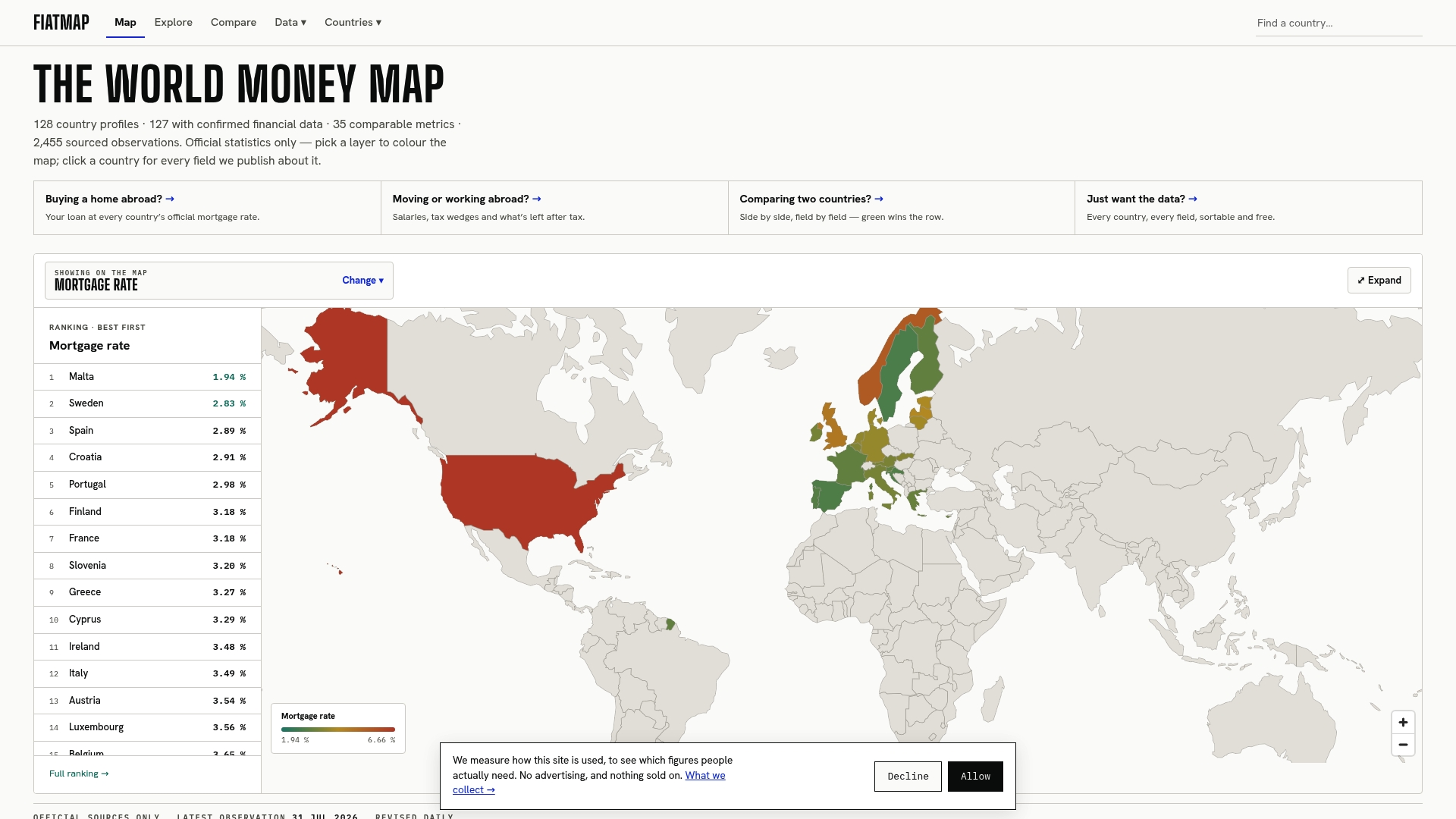
If you want the numbers behind this article in a form you can reuse, start with the FiatMap Global Money Dataset, or put live macro maps on your own page with our free embeddable widgets. To see how borrowing costs differ, open the mortgage rates ranking.
FAQ
Which country has the highest urbanization rate?
City-states and small territories such as Monaco, Singapore, Hong Kong SAR and Macao SAR sit at or near 100% urban. Among larger countries with real rural land, the highest shares are in places like Gabon, which Statista reports at over 90 percent in 2024. Rankings differ by year and by definition, so check both.
Is urbanization rate the same as urban growth rate?
No. The urbanization rate is the share of the population living in urban areas at one point in time. Urban growth is the average annual change in the urban population, usually in percent. A country can be low on one and high on the other.
Which countries have the youngest populations?
By median age, mostly African countries: Niger had the lowest at 15.2 years in 2024 according to Statista, with Chad, Somalia, Mali, the DR Congo and the Central African Republic also very young. By the UN’s 15 to 24 youth band, the global average share was 15.6 per cent in 2024.
Why do urbanization figures differ between websites?
Countries define urban areas differently, and sources use different years, revisions and definitions. The UN notes there is no internationally agreed definition. Compare figures only when the source, year and definition match.
How much of the world is urban?
The UN reports that 58 per cent of the world’s population lived in urban areas in 2025. Under its harmonized settlement approach, 45 per cent lived in cities. The share is projected to keep rising through 2050.
Sources
- World Urbanization Prospects 2025: Summary of Results (UN DESA)
- World Urbanization Prospects 2025 (UN DESA)
- Urban population growth indicator (United Nations)
- World Urbanization Prospects 2018 methodology (UN DESA)
- World Population Prospects 2024: Summary of Results (UN)
- World Population Day 2025 announcement (TÜİK, citing UN WPP 2024)
- Urbanization rate in Africa by country (Statista)
- Share of urban population in Burundi (Statista)
- Burundi urban population growth (CEIC)
- African countries with the lowest median age (Statista)
Recommended
The figures on this site are collected from official statistics and each carries its own source and date — see /sources and the dataset. Where this article states a number, the country and ranking pages are what it should agree with.