Euro Area Wage Indexation: Verify Rules With IMF and ECB Data
2026-09-15
Automatic wage indexation is rare. Most governments do not tie public salaries to inflation at all, and the IMF’s global dataset finds pensions get indexed far more often than paychecks. Inside the euro area, only a handful of countries run true automatic systems, led by Belgium and Luxembourg, with partial or negotiated versions in Spain, Malta, Cyprus, Italy, and parts of France.
TL;DR:
- Automatic wage indexation is rare globally, with most countries, especially outside Europe, mostly indexing pensions rather than active wages.
- Euro-area countries have varied systems, with Belgium and Luxembourg maintaining broad, automatic price-based indexation, while most others use partial or negotiated arrangements.
- The main formulas include price-based, wage-based, and hybrid models, each reacting to inflation or wage trends with different timing mechanisms like backward, forward, or trigger-based systems.
- Recent inflation shocks have tested these systems, sometimes prompting temporary government interventions to limit disruptions and prevent wage-price spirals.
- Outside the euro area, countries like the US rely on specific formulas for social benefits, but private wages are generally settled through negotiations, making formal indexation less common.
Table of Contents
- What Are the Main Types of Wage Indexation?
- How Many Countries Actually Index Wages?
- How Does the Euro Area Handle Public Wage and Pension Indexation?
- How Do Individual Euro-Area Countries Run Their Systems?
- What Are the Trade-Offs of Automatic Wage Indexation?
- Check the Numbers Behind Any Indexation Claim
- How Did Wage Indexation Systems Develop Over Time?
- Does Wage Indexation Affect Employment and Labor Market Flexibility?
- What Legal Rules and Bargaining Agreements Govern Indexation?
- Have Recent Inflation Shocks Tested Euro-Area Indexation Systems?
- How Does Wage Indexation Outside the Euro Area Compare?
- Who Actually Decides: Government or Private Sector?
- What Should You Watch Next in Wage Indexation?
- Try Fiatmap’s Global Money Dataset
- Sources
- FAQ
What Are the Main Types of Wage Indexation?
Wage indexation formulas differ in what they track and when they react. Getting these distinctions right matters, because the label “indexed” gets applied loosely to systems that behave very differently in practice.
Price-based indexation ties pay to a consumer price measure, usually a national CPI or the harmonized version economists use for cross-country comparisons, the HICP. This is the most common design where indexation exists at all, since it directly targets purchasing power. Wage-based indexation, by contrast, links adjustments to average wage growth or productivity, which tends to produce smoother, but less inflation-responsive increases. Some countries blend the two into mixed formulas that split the difference, adjusting partly for prices and partly for broader wage trends.
The second major split is timing:
- Backward-looking indexation uses a lagged average of past inflation, often measured over a rolling window of several months, so wages catch up to inflation that already happened.
- Forward-looking indexation tries to anticipate inflation using forecasts, which can prevent lag but risks overshooting or undershooting if the forecast misses.
- Trigger-based systems sit somewhere in between: rather than adjusting on a fixed calendar, they wait for a price index to cross a set threshold, then apply an automatic bump.
Belgium and Luxembourg run trigger systems built around a “pivot index.” When the relevant price measure crosses a preset threshold, an automatic readjustment fires, independent of the calendar. Minimum-wage indexation frequently runs on its own separate track from general wage indexation, since minimum-wage floors carry more political weight and often get reviewed through legislation rather than formula alone. Academic and policy research generally agrees that backward-looking rules are more common but create catch-up gaps, while forward-looking rules are rarer because they demand a forecast most negotiators do not trust.
How Many Countries Actually Index Wages?
The honest answer is: not many, and it depends heavily on what you’re indexing. The IMF’s global dataset, built from a country-desk survey covering advanced economies, emerging markets, and low-income developing countries, gives the clearest picture available.
Most economies in the IMF’s sample do not index public sector wages to inflation at all. Pensions and social assistance programs get indexed far more consistently.
That gap is not an accident. Pensioners have less ability to renegotiate their income than active workers, who can bargain, strike, or change jobs. Governments face more direct political pressure to protect retirees from inflation than to protect civil servants, whose pay often gets folded into broader budget negotiations instead.
A few things shape how this data should be read:
- Regional variation is sharp. Advanced economies index more budget items on average than emerging markets, and low-income developing countries index the fewest, reflecting weaker administrative capacity and less institutionalized wage bargaining.
- The survey has a cutoff. The IMF’s country-desk responses were collected through November 2023, so reforms enacted after that date won’t show up in the headline figures.
- “Automatic” and “de facto” are not the same thing. A country where wages happen to rise with inflation every year through repeated negotiation is not the same as a country with a legal indexation formula. The ECB’s own research draws this line explicitly, and it’s the single most important distinction for anyone comparing countries.
How Does the Euro Area Handle Public Wage and Pension Indexation?
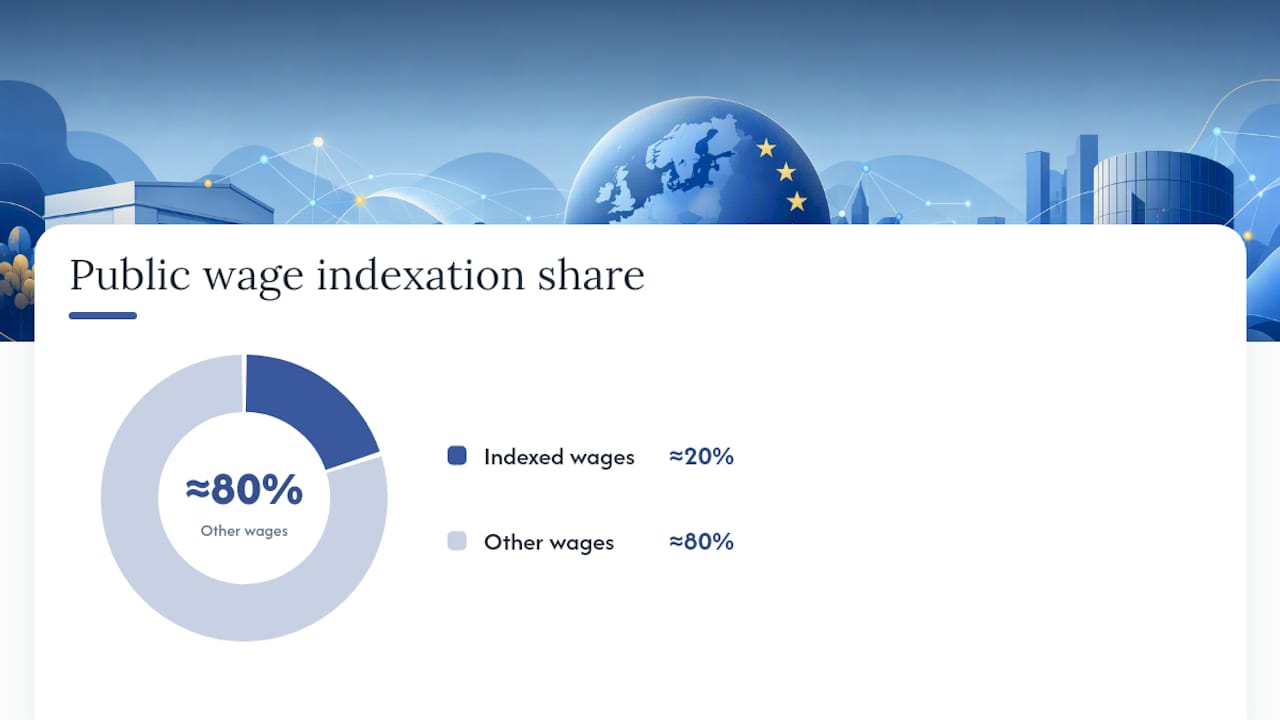
Inside the euro area, the picture sharpens. The ECB’s occasional paper on the topic, based on a questionnaire sent to the Working Group on Public Finance (WGPF), found that full or partial automatic price indexation of public wages covered roughly one fifth of the euro-area public wage bill, based on 2021 figures from five member states. That’s a narrow slice of the currency union running on autopilot; the rest adjusts through budget cycles, negotiated settlements, or ad hoc political decisions.
Pension indexation tells a different story. It’s considerably more widespread across the euro area, and more countries use backward-looking price formulas for pensions than for wages. That asymmetry echoes the global pattern the IMF dataset shows, just concentrated in a currency union where inflation differentials between member states already generate friction.
A rough grouping of how euro-area countries approach this:
- Full automatic price indexation of public wages: Belgium and Luxembourg apply this most consistently and broadly across the workforce.
- Partial or conditional arrangements: Spain, Malta, Cyprus, and Italy each run mechanisms that adjust wages or pensions to prices under specific conditions, caps, or negotiated triggers rather than a blanket formula.
- Negotiated, non-automatic adjustment: France falls largely into this category for wages, with indexation limited mostly to certain pension components and the minimum wage, while broader pay settlements go through annual negotiation.
The practical differences show up in the fine print: which price index is referenced (national CPI versus a harmonized measure), how long the reference window runs, and whether multi-year wage contracts include catch-up clauses if inflation outpaces earlier assumptions. Two countries can both claim “indexation” and mean very different things by it, which is exactly why the ECB’s country-by-country breakdown is worth reading directly rather than trusting a summary headline.
How Do Individual Euro-Area Countries Run Their Systems?
Formulas only make sense once you see them applied. Here’s how five representative countries actually operationalize wage indexation.
-
Belgium runs the euro area’s best-known pivot-index system. When the health index (a CPI variant that excludes items like alcohol, tobacco, and fuel) crosses a set threshold, wages, pensions, and social benefits adjust automatically. Timing varies by sector, since collective bargaining agreements determine exactly which month the increase lands, but the trigger itself applies economy-wide.
-
Luxembourg uses a similar mechanism with a defined trigger: when the national CPI rises by 2.5 index points over the reference window, a readjustment fires automatically for wages, pensions, and family benefits alike. This threshold design means adjustments can arrive several times in a high-inflation year or go quiet for a long stretch when prices are calm, which is exactly the volatility practitioner analysis of pivot-index systems flags as the tradeoff for administrative simplicity.
-
Spain overhauled its pension indexation rules in recent years, moving to a system that links pension increases more directly to average annual CPI, a change with real fiscal weight given the size of the country’s retiree population. Public sector wage adjustments remain a separate, largely negotiated process, decided through annual budget law rather than a standing formula.
-
France applies partial indexation mainly to basic state pensions and to the minimum wage (the SMIC), both tied to price measures with specific legal triggers. Broader public and private wage settlements go through negotiation rounds where the government’s own compensation decisions for civil servants often set a reference point the private sector watches closely.
-
Italy relies on multi-year collective bargaining contracts that build in catch-up clauses: if realized inflation outpaces the assumptions used when a contract was signed, later rounds true up the gap. That structure blends forward-looking planning with a backward-looking correction, which is a working compromise between the two indexation philosophies described earlier.
What Are the Trade-Offs of Automatic Wage Indexation?
Indexation exists to protect purchasing power, and it does that job reasonably well when inflation is moderate and formulas are transparent. The trouble starts when inflation runs hot.
Automatic wage increases during a high-inflation period can feed back into prices: businesses facing higher labor costs raise prices to cover them, which pushes the index that triggers the next round of wage increases, and the cycle repeats. Economists call this a wage-price spiral, and it’s the central argument critics raise against broad-based automatic systems. Belgium and Luxembourg have both built in safeguard clauses over the years, including temporary caps, delayed application windows, and, in some sectors, negotiated exceptions when triggers would otherwise fire too frequently.
There’s a fiscal dimension too. A government running automatic pension and wage indexation commits future budgets to rise with inflation regardless of what else is happening in the economy, which is exactly the link the IMF’s fiscal research draws between indexation design and long-run budget sustainability. That’s manageable when inflation is low and predictable. It becomes a real constraint when a shock pushes prices up sharply, since the automatic formula doesn’t pause to ask whether the government can afford it.
What tends to separate resilient systems from fragile ones:
- Whether the formula includes a cap or ceiling on the annual adjustment.
- Whether indexation applies to the full wage or only a base portion.
- Whether there’s a review clause allowing the government to suspend or modify the mechanism during a crisis.
- Whether the reference index itself (headline CPI versus a stripped-down variant) already filters out volatile components like energy.
Pro Tip: When you see a headline like “wages are indexed to inflation” in a country, check four things before drawing conclusions: the exact index named, the lag or averaging window, any trigger threshold or cap, and whether the adjustment is full or partial. Those four details determine almost everything about how the system actually behaves in a real inflation shock.
Real interest rates and savings returns sit downstream of this same inflation dynamic. Workers whose wages lag inflation often see it show up first in eroded purchasing power, not just in their paycheck but in how far their savings stretch.
Check the Numbers Behind Any Indexation Claim
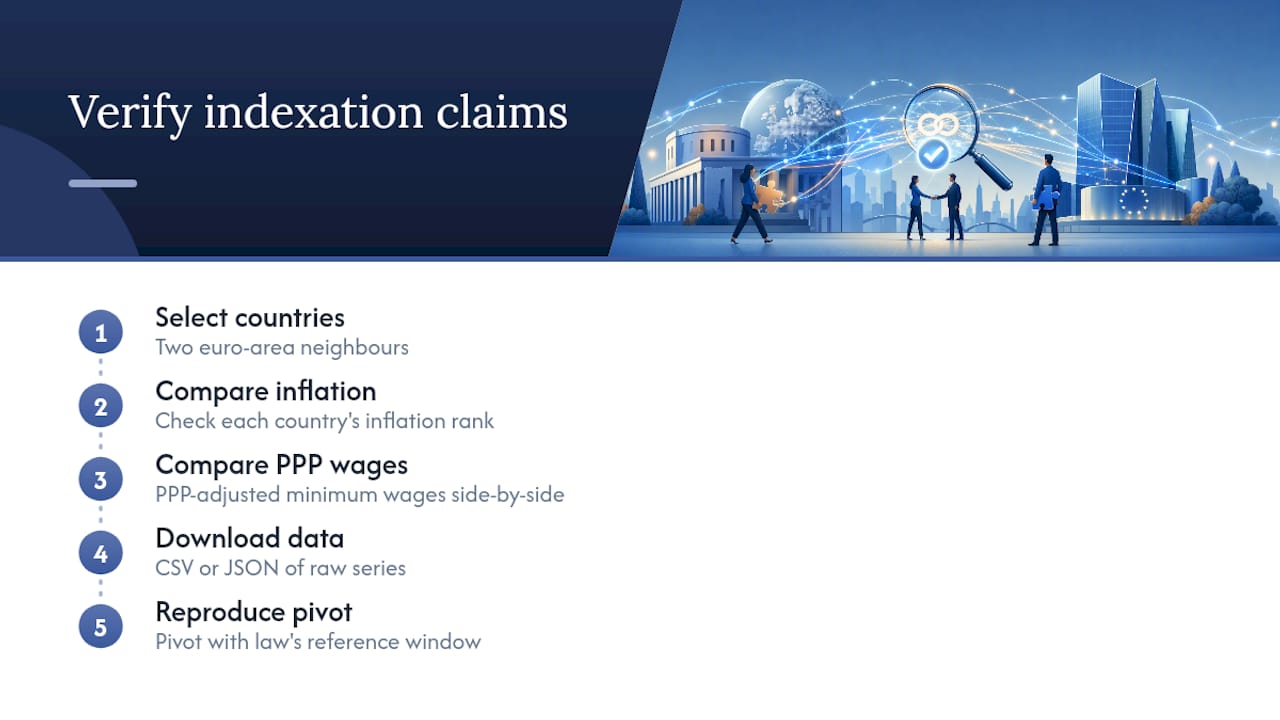
You don’t have to take a country’s headline claim about indexation at face value. Fiatmap’s Global Money Dataset pulls official-statistics series across 128 countries, including inflation histories and minimum-wage figures adjusted for purchasing power (PPP), so you can compare the raw inputs a formula would actually use.
A useful exercise: pull the inflation rate rankings for two euro-area countries side by side, then check where their minimum wages land once adjusted for PPP. If a country claims automatic indexation but its minimum wage has quietly lost ground against a neighbor with no formal formula, that’s worth a second look. You can download the underlying CSV or JSON data directly and reproduce a basic pivot-index calculation yourself, using the same reference window a country’s own law specifies.
How Did Wage Indexation Systems Develop Over Time?
Most of today’s automatic systems trace back to the high-inflation decades of the mid-20th century, when unions in several European economies pushed for formal protection against eroding real wages. Belgium’s pivot-index system dates to that era and survived largely intact, while several other countries that once ran similarly broad mechanisms scaled them back sharply during the 1980s and 1990s.
France offers the clearest example of retreat. Broad wage indexation was suspended there in 1982 as part of an anti-inflation policy package, a decision widely credited with helping break the wage-price spiral dynamics of that period, though it left later wage growth entirely to negotiation. Italy’s old scala mobile wage-indexation system, once one of Europe’s most aggressive, was phased out in the early 1990s under similar pressure, replaced eventually by the multi-year contract model with catch-up clauses used today.
Spain’s reforms moved in the opposite direction more recently, tightening the link between pensions and CPI after a period during which pension increases had been decoupled from inflation to manage budget pressure. That reversal shows indexation isn’t a one-way historical trend toward either more automation or less. It responds to whichever economic problem is most politically urgent at the time, whether that’s runaway inflation, budget strain, or an aging population’s retirement security.
Does Wage Indexation Affect Employment and Labor Market Flexibility?
Economists have long debated whether automatic indexation makes labor markets more rigid. The theoretical concern is straightforward: if wages rise automatically regardless of a firm’s or a sector’s underlying productivity or demand conditions, employers facing a downturn have fewer options besides layoffs, since they can’t let real wages adjust downward the way a purely negotiated system might allow.
In practice, the countries with the most robust automatic systems, Belgium and Luxembourg, have not shown dramatically worse employment outcomes than their less-indexed neighbors, partly because both economies pair indexation with other labor market institutions, like strong collective bargaining coverage and active labor market programs, that absorb some of the friction. That doesn’t mean the tradeoff disappears. It shows up more subtly, in how quickly employers adjust hiring plans when a pivot-index trigger fires unexpectedly, since a wage increase they didn’t budget for arrives with little warning.
Countries with no formal indexation, by contrast, tend to see wage adjustments move more gradually and predictably through annual negotiation cycles, which gives employers more lead time but leaves workers more exposed if negotiations stall during a high-inflation stretch. Neither model is free of trade-offs. The real difference is which side of the bargain absorbs the uncertainty: employers under automatic systems, or workers under negotiated ones.
What Legal Rules and Bargaining Agreements Govern Indexation?
Automatic indexation almost always rests on a specific legal instrument, not a general policy preference. Belgium’s system is anchored in national legislation defining the health index and the conditions under which it triggers adjustments, layered underneath thousands of sector-specific collective bargaining agreements that determine the exact timing and scope within each industry. Luxembourg’s mechanism is similarly codified in law, with the 2.5-point CPI threshold written into the statute itself rather than left to negotiation.
Where indexation is partial or negotiated, the legal basis looks different. Spain’s pension indexation reform was passed as national legislation with a defined formula and effective date, giving it the same legal weight as Belgium’s system but applied to a narrower slice of income. France’s minimum wage indexation is likewise set in law, while broader wage-setting for both public and private sectors runs through periodic collective bargaining rounds that carry contractual, not statutory, force.
Italy’s catch-up model depends entirely on the terms negotiated into each multi-year labor contract, meaning the specific inflation-correction clause can vary from one sector’s contract to the next. This is the practical distinction the ECB’s research draws between legal automatic indexation and de facto adjustment through repeated bargaining: one is enforceable regardless of negotiation outcomes, and the other depends on unions and employers reaching a new agreement every time.
Have Recent Inflation Shocks Tested Euro-Area Indexation Systems?
The inflation surge of the early 2020s put automatic indexation systems under real strain for the first time in decades. Belgium’s pivot-index triggered multiple times in rapid succession as prices climbed, delivering wage increases faster than many employers had budgeted for, which reignited the long-running debate in Belgian policy circles about whether the mechanism amplifies inflation rather than just tracking it.
Luxembourg faced a similar dynamic, and the government intervened directly, temporarily adjusting the timing of a scheduled readjustment to spread out the fiscal and business impact rather than letting the formula apply with no discretion. That intervention is itself informative: even the euro area’s most rules-based indexation systems retain a political off-ramp when the automatic outcome becomes too disruptive.
Countries without automatic systems experienced the same inflation shock through a different channel entirely: renegotiated contracts, one-off government bonuses, and emergency minimum-wage increases, all decided case by case rather than triggered by formula. The net effect across the euro area was a period where the gap between “automatic” and “negotiated” countries became unusually visible, since one group adjusted on a fixed schedule and the other scrambled to catch up through separate political decisions.
How Does Wage Indexation Outside the Euro Area Compare?
Beyond the euro area, formal automatic wage indexation is even rarer, though pension indexation follows a similar pattern of being more common than wage indexation almost everywhere. The United States offers the clearest large-economy example of a transparent, government-run indexation formula, just applied to Social Security rather than wages. The Social Security Administration calculates its annual Cost-of-Living Adjustment by comparing the CPI-W (a wage-earner-focused CPI variant) averaged over the third quarter of the current year against the third quarter of the prior COLA year. It’s a clean, published, backward-looking formula, and it’s one of the most cited real-world examples of how a CPI-linked adjustment actually works in practice.
U.S. private-sector wages, however, carry no equivalent automatic mechanism. Pay adjustments there run entirely through employer decisions, individual negotiation, or union contracts, which is closer to the French or Italian model than to Belgium’s.
Emerging markets and low-income developing countries index even less often than advanced economies, reflecting the IMF dataset’s finding that administrative capacity and institutionalized bargaining strongly predict whether a formal formula exists at all. Where indexation does appear outside Europe, it tends to concentrate on pensions and social transfers, mirroring the global pattern rather than breaking from it.
Who Actually Decides: Government or Private Sector?
The split between government and private-sector control over indexation depends heavily on which category of pay is involved. Public sector wages are, definitionally, a government decision, whether that means a standing legal formula like Belgium’s or an annual budget negotiation like France’s. Governments also set minimum wages almost everywhere, which is why minimum-wage indexation tends to be legislated directly rather than left to bargaining.
Private-sector wage indexation, where it exists, usually runs through collective bargaining agreements between unions and employer associations rather than direct government mandate. Belgium’s pivot-index applies economy-wide by law, but the specific sectoral agreements that implement it, covering things like exact payment timing and any sector-specific exceptions, are negotiated separately by industry.
Governments do exert indirect influence even over private-sector settlements. Public sector pay decisions often become a reference point that private employers and unions cite in their own negotiations, and government-set minimum wages establish a floor that shapes bargaining leverage further up the pay scale. Spain’s and France’s minimum-wage indexation rules function this way: legally mandated at the bottom of the labor market, informally influential well above it.
What Should You Watch Next in Wage Indexation?
If inflation stays elevated anywhere in the euro area for an extended stretch, expect renewed political pressure to expand automatic indexation, particularly for pensions, where the political cost of inaction is highest. Watch for updated IMF and ECB survey rounds, since both datasets get revised as countries reform their rules, and a headline “no indexation” classification can flip within a single budget cycle.
Treat any claim that a country “has wage indexation” with healthy skepticism until you’ve seen the formula itself. A negotiated annual raise that happens to track inflation is not the same legal animal as a statutory trigger, even though both produce a similar paycheck outcome in a good year.
— Torstein
Try Fiatmap’s Global Money Dataset
Every country note in this article rests on a specific number somewhere, a CPI variant, a minimum wage, an inflation rate, and those numbers are exactly what Fiatmap’s Global Money Dataset puts in your hands directly, sourced from official statistics across 128 countries rather than secondhand summaries.
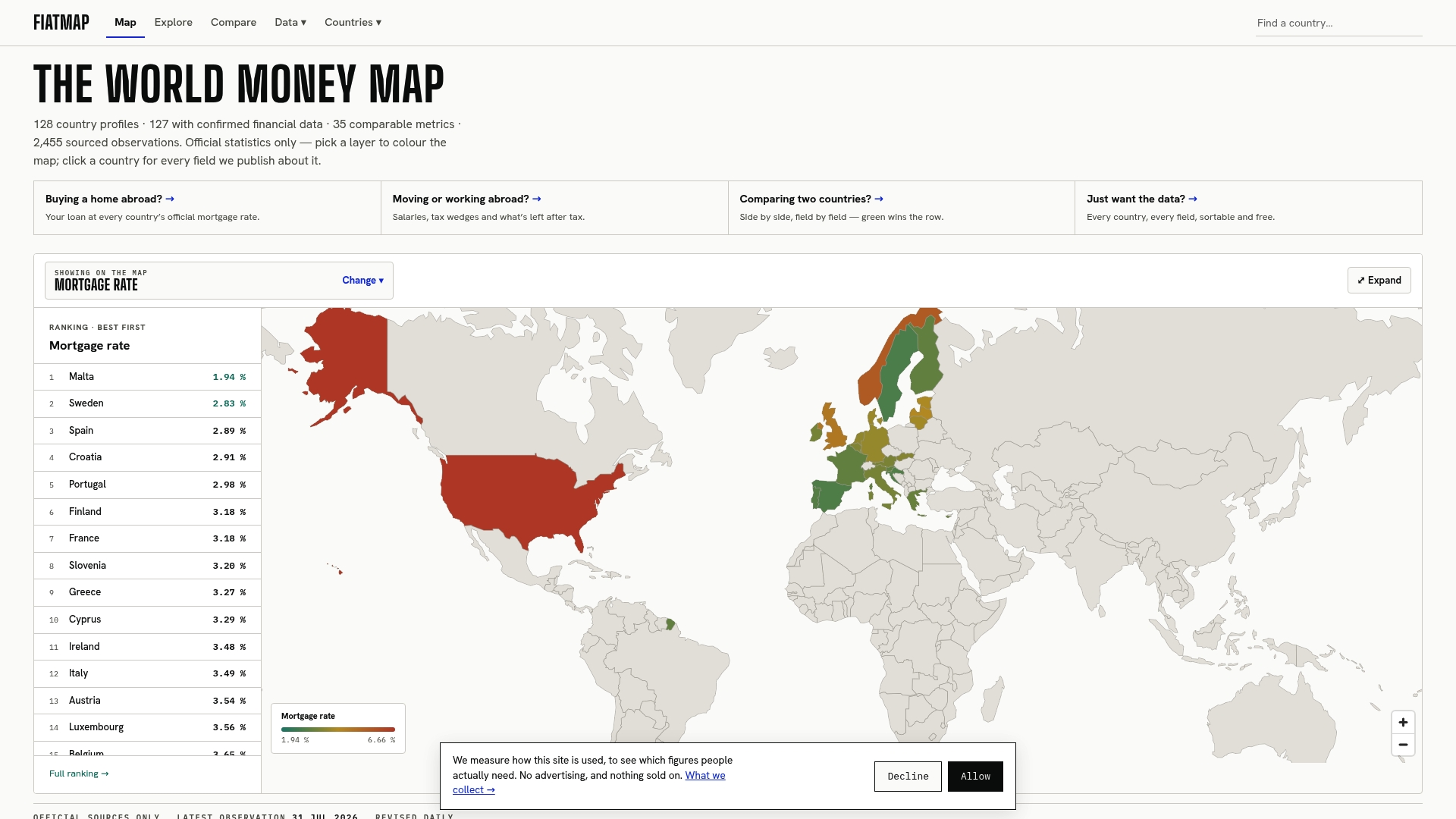
Fiatmap is the alternative to digging through national statistical office websites one country at a time: instead of hunting down a CPI series here and a minimum-wage figure there, you get standardized, downloadable data in CSV or JSON, plus interactive inflation rankings and PPP-adjusted minimum-wage comparisons already built. To check whether a country’s indexation formula is keeping pace with reality or to compare cost-of-living pressure across countries, users can start by accessing comprehensive datasets and running their own side-by-side comparisons.
Sources
- Inflation indexation in public finances: a global dataset on current practices (WP/23/264)
- Public wage and pension indexation in the euro area: an overview (ECB occasional paper No. 299)
- Cost-of-Living Adjustment (COLA) information — Social Security Administration
FAQ
Which Country Has the Highest Minimum Wage in the World?
Rankings shift with exchange rates and PPP adjustments, so the honest answer depends on whether you’re comparing raw currency values or purchasing-power-adjusted figures; Fiatmap’s minimum wage PPP comparisons let you check current standings directly rather than relying on a single snapshot number.
Are American Wages Rising Faster Than Inflation?
That depends on the period and the wage measure used; the U.S. has no automatic wage indexation, so pay growth versus inflation depends entirely on labor market conditions and negotiated raises rather than a formula, unlike Social Security’s CPI-W-linked COLA.
How Does the U.S. Minimum Wage Compare to Other Countries?
The U.S. federal minimum wage is not automatically indexed to inflation, which sets it apart from countries like France that legally tie their minimum wage to price movements; comparing exact standings across countries requires adjusting for purchasing power, which you can check using inflation-adjusted country rankings.
How Is Wage Indexation Actually Calculated?
Most formulas compare a price index, commonly a CPI variant, over two time points, such as the third quarter of consecutive years for the SSA’s COLA or a fixed point-threshold trigger for Belgium’s and Luxembourg’s pivot-index systems, then apply the resulting percentage change to wages or pensions.
Do Any Euro-Area Countries Fully Index Public Wages Automatically?
Belgium and Luxembourg are the clearest examples of broad, automatic, legally mandated wage indexation in the euro area; most other member states, including Spain, France, and Italy, use partial, conditional, or negotiated systems instead of a full automatic formula.
Recommended
The figures on this site are collected from official statistics and each carries its own source and date — see /sources and the dataset. Where this article states a number, the country and ranking pages are what it should agree with.