WPI vs CPI: How Wholesale and Consumer Inflation Differ
2026-10-31

The Wholesale Price Index (WPI) tracks price changes for goods at the bulk-sale stage, before they reach a shop. The Consumer Price Index (CPI) tracks what households pay for a basket of goods and services. WPI is a view from the factory gate, CPI is a view from the checkout. If you live in the US, you will almost never see a WPI: the American equivalent is the Producer Price Index (PPI), and the two have a family relationship worth understanding.
TL;DR
- WPI measures bulk, early-transaction prices of goods. CPI measures prices households pay for goods and services.
- WPI baskets are mostly manufacturing inputs and commodities. CPI baskets add housing, education, medical care and other services.
- Over time, many countries have replaced the WPI with the PPI, which has broader coverage. The US publishes a PPI and a CPI, not a WPI.
- Use CPI to judge living costs and to index wages and pensions. Use WPI or PPI to spot cost pressure early and to adjust long-term business contracts.
- Never compare a WPI figure from one country with a CPI figure from another without checking base years and methods.
Table of Contents
- What each index actually measures
- WPI vs CPI side by side
- Why the two numbers diverge
- Where the US PPI fits in
- What a rise in each index signals
- Which index should you use?
- Pitfalls when comparing countries
- Our perspective
- See inflation for 128 countries in one place
- FAQ
- Sources
What each index actually measures
WPI: prices at the bulk-sale stage
In India, the country where the WPI is most often discussed, the index tracks the average price change of commodities at the bulk-sale, early-transaction stage, such as ex-factory, ex-mine or mandi (wholesale market) prices. Nobody in the index pays a retail markup, a shop’s rent or a delivery fee to your door. It is about goods changing hands between businesses.
An international definition adds the detail that matters for comparisons. According to the IMF’s producer price index manual, a WPI measures prices at the wholesale stage, before final demand, and includes imported products and purchaser-price charges such as delivery charges and product taxes.
CPI: what households pay
The CPI measures changes over time in the general price levels of goods and services acquired by households for consumption, and it is the most widely used macroeconomic indicator of inflation. When a central bank, a government or a news headline says “inflation,” it almost always means CPI. We cover the basics on our page about what the consumer price index is.
WPI vs CPI side by side
| Feature | WPI | CPI |
|---|---|---|
| Stage of the supply chain | Wholesale, bulk, early transaction | Retail, what the household pays |
| What is covered | Goods, mostly manufacturing inputs and commodities | Goods and a wide range of services |
| Services | Generally absent | Housing, education, medical care and more |
| Weights based on | Value of production adjusted for net imports (India) | Household spending |
| Typical users | Businesses, analysts forecasting cost pressure | Central banks, governments, wage and pension setters |
| Also called | Wholesale inflation | Retail inflation, headline inflation |
The weights row deserves a closer look, because it explains most of the gap between the two numbers.
Why the two numbers diverge
Different baskets and weights
In India, WPI weights are based on the value of production adjusted for net imports. CPI weights come from what households spend. A commodity that matters a great deal to factories, such as metals or fuel, can carry heavy WPI weight and little CPI weight. Rent, by contrast, is a big part of a household budget and does not appear in a wholesale index at all.
That last point is the biggest structural difference. Services are generally absent from WPI baskets, which are dominated by manufacturing inputs, while CPI baskets include housing, education and medical care. In a service-heavy economy like the US, where much of a household’s budget goes to housing and healthcare, a goods-only index can say very little about the cost of living.

Different calculation methods
Both indices are usually built with a Laspeyres-type formula, meaning they compare the cost of a fixed basket over time. Below the headline, though, methods vary. The Reserve Bank of India notes that elementary aggregation methods differ by index series, including Dutot, Carli and Jevons. India’s CPI-combined index for 2012 uses the geometric mean (Jevons) at the elementary level, which is often considered to have the best properties there.
You do not need to master these formulas. You need to know they exist, because two indices that look alike can behave differently for purely technical reasons.
Taxes, imports and margins
A wholesale price is not a retail price. Between the two sit retailer margins, transport and taxes. The Irish Central Statistics Office points out that CPI includes services, imports and sales and excise taxes, while producer-price finished-goods indices exclude imports and those taxes. So a change in a sales tax can move CPI without touching wholesale prices at all.
Where the US PPI fits in
Many readers searching for “wholesale price index” in the US are really looking for the PPI. The IMF explains that PPI measures price changes for domestic producers’ output. It developed from the WPI and has broader coverage and better alignment with national accounts. The IMF’s 2019 survey adds that over time the WPI has been replaced by the PPI.
The practical differences between a WPI and a PPI:
- Coverage of origin. A WPI includes imported products. A PPI covers domestically produced products.
- Pricing basis. PPI output prices are basic prices received by producers and exclude separately invoiced transport charges. A WPI includes delivery charges and product taxes.
- Breadth. PPIs cover more products and industries, and tie more neatly into GDP statistics.
How common is each? In the IMF’s sample, all 196 economies compile CPIs, while 126 economies (64 percent) produce PPIs. CPI is universal. Producer-side indices are not.
PPI vs CPI in the US
It is tempting to treat the PPI as a crystal ball for the CPI: if producer prices jump, consumer prices must follow. The Bureau of Labor Statistics warns against exactly that assumption. It says that when the two diverge, conceptual and definitional differences in scope and coverage, categorization and technical details contribute to the gap. The BLS also notes that the PPI component closest to the CPI is the Personal Consumption PPI, which tracks manufacturer selling prices for consumer goods.
For a deeper walk-through aimed at analysts, see our guide to spotting inflation signals with PPI vs CPI.
What a rise in each index signals
A rising WPI or PPI means input and producer costs are climbing. A rising CPI means households are paying more. They are linked, but not one-to-one.
The UK’s Office for National Statistics finds that energy prices tend to be a main driver of producer price inflation, while food and energy prices have been main drivers of recent consumer price inflation. The same ONS analysis observes that when margins are tight, firms are more likely to pass additional costs on to consumers. In other words, producer inflation can feed into consumer inflation, but only if businesses cannot absorb it.
That answers the common question, “Is high WPI good or bad?” It depends on who you are:
- For a manufacturer or builder buying inputs, rising wholesale prices are bad news: costs go up.
- For a commodity producer selling those goods, the same rise can mean better revenue.
- For a household, a high WPI is a warning that retail prices may follow, with a lag and not always in full.
- For a central bank, a persistent WPI or PPI surge raises the odds of broader inflation, so it is watched but rarely acted on alone.
When only the volatile parts are moving, strip them out. Our explainer on core inflation shows how that works, and the pages on disinflation and deflation cover what happens when price growth slows or turns negative.
Which index should you use?
The IMF’s 2019 paper gives a clean rule: use CPI to gauge inflation and to index wages, pensions and social benefits; use PPI to forecast, deflate GDP estimates and adjust prices in long-term contracts. Statistics Canada says the same in practical terms: PPIs are frequently used in contract escalation clauses for construction or industrial goods, while CPIs are primarily used to index payments for consumers.
Here is how that plays out by reader:
| If you are… | Start with | Why |
|---|---|---|
| An expat comparing living costs | CPI | It reflects what households actually pay, including rent and services |
| A homebuyer abroad | CPI plus a house price index | Housing is a service-heavy cost the wholesale index ignores |
| An analyst watching cost pressure | WPI or PPI, then CPI | Producer prices often move first, and the CPI shows what reaches consumers |
| A contractor writing an escalation clause | PPI (or WPI where that is what the country publishes) | It tracks input costs in your industry |
| A student comparing countries | CPI, with a note on methodology | It is the one index every economy publishes |
If you are weighing wages against prices, our piece on testing U.S. wage purchasing power against inflation shows the CPI approach in practice. If you want a measure tailored to your own budget, see how to build a household price index.
Pitfalls when comparing countries
The IMF stresses that reliable price indexes are vital for monetary and fiscal policy, and that international comparability has become an increased focus for national statistical offices as trade globalizes. It is still a work in progress. Before you line up numbers from two countries, check:
- Which index it is. A country’s “wholesale” figure may be a WPI, a PPI or something in between.
- The base year and the basket. Indian WPI series, for example, are rebased from time to time, and weights change with them. Compare year-on-year rates, not raw index levels.
- Whether services are in. A goods-only index and an all-items CPI answer different questions.
- Taxes and imports. Some indices include them, some do not.
- Euro-area conventions. European comparisons often use a harmonized index; our page on the HICP explains it.
Also keep CPI apart from GDP, a question people often ask. CPI measures price changes. GDP measures the total value of output. Our GDP glossary entry covers the second.
Our perspective
We built Fiatmap around official statistics because index definitions are where most comparison errors begin. The WPI vs CPI debate looks like a quarrel about two acronyms, but it is really a question about where in the supply chain you are standing.

Our view is simple. For almost every personal decision, whether that is moving abroad, buying a home or negotiating a salary, CPI is the number to read, because it is the one built around household spending and the one every economy publishes. Wholesale and producer indices are a leading hint, not a verdict: useful for businesses and analysts, misleading when treated as a forecast of your grocery bill. And when a country reports only one of them, say so openly rather than filling the gap with a look-alike.
We would rather show you a clean, sourced CPI with its methodology than a tidy chart that mixes definitions.
— Torstein
See inflation for 128 countries in one place
Fiatmap puts official inflation and mortgage data for 128 countries on a single map, so you can compare consumer price inflation without cross-checking dozens of statistical office websites. Start with the inflation rate by country, ranked, or download the numbers from the free Fiatmap global money dataset for your own analysis.
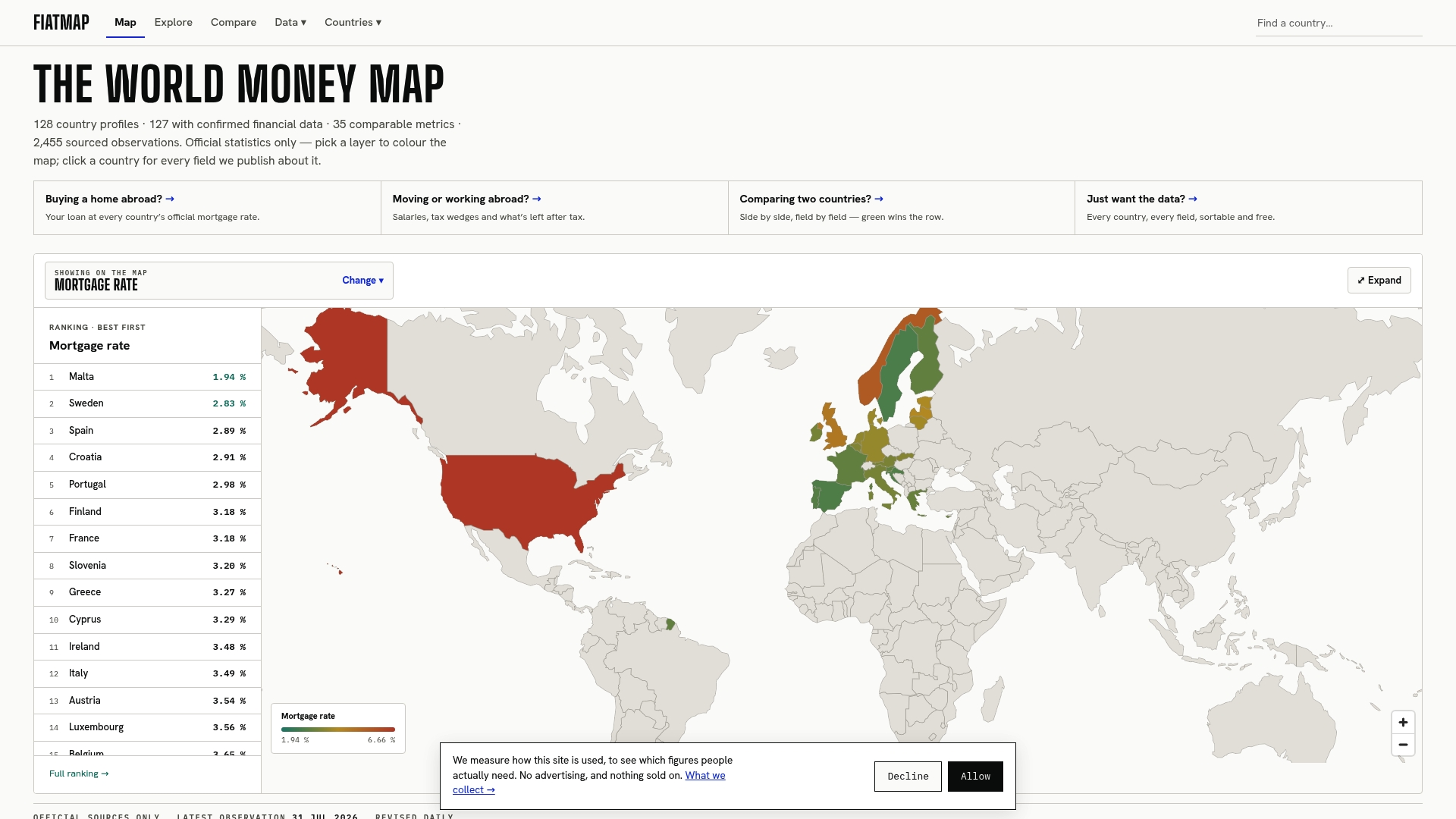
If you are comparing homes abroad, pair inflation with borrowing costs using the mortgage rates by country ranking.
FAQ
What is the main difference between WPI and CPI?
WPI measures price changes at the wholesale, bulk-sale stage, mostly for goods. CPI measures the prices households pay for a basket of goods and services. CPI includes services such as housing and medical care, which WPI generally leaves out.
Does the US have a WPI?
The US publishes a Producer Price Index and a Consumer Price Index through the Bureau of Labor Statistics. The PPI developed from the WPI and has broader coverage and a closer fit with national accounts. When US sources discuss wholesale-stage prices, they usually mean the PPI.
Is PPI the same as WPI?
No. A WPI includes imported products and charges such as delivery and product taxes. A PPI covers domestically produced output and measures prices received by producers. The PPI has largely replaced the WPI in many countries, though some, India among them, still publish a WPI.
Does a high WPI always lead to high CPI?
Not automatically. Producer cost increases can reach consumers when firms pass them on, which is more likely when margins are tight. Services, taxes and imports also shape consumer prices, so CPI can move differently from wholesale prices.
Which is a better measure of inflation?
For household living costs, wages and pensions, CPI is the standard measure. For input costs, forecasting and long-term business contracts, a wholesale or producer index fits better. Many analysts read both.
Sources
- Wholesale Price Index (WPI), Indian Economic Service
- Price Statistics Compilation in 196 Economies, IMF
- Background, Purpose, and Uses of Producer Price Indices, IMF
- WPI FAQs, Office of the Economic Adviser, India
- Reserve Bank of India publication on price indices
- How does the PPI differ from the CPI, Central Statistics Office Ireland
- Comparing the Personal Consumption PPI with the CPI, U.S. Bureau of Labor Statistics
- Global inflation, Office for National Statistics
- Price Adjustment Guide for Contract Escalation, Statistics Canada
Recommended
The figures on this site are collected from official statistics and each carries its own source and date — see /sources and the dataset. Where this article states a number, the country and ranking pages are what it should agree with.