Cost of Borrowing Abroad: How to Compare Loan Rates by Country
2026-10-29

The cost of borrowing abroad is the total price you pay for a loan in another country: the interest rate, the lender’s fees and, if the loan is in a foreign currency, the exchange-rate risk that comes with it. A headline rate by country is a good place to start, but it is rarely the number you will actually pay. This guide shows what sits inside that number, why countries differ, and how to compare them without fooling yourself.
TL;DR
- The interest rate is only part of the cost. APR adds lender fees, so compare APR to APR, or rate to rate, never one against the other.
- Country lending rates are averages over different loans, maturities and borrowers. They show the direction of a market, not your personal quote.
- Inflation, public debt, policy rates, bank overhead, bad loans and legal systems all push rates up or down.
- Borrowing in a currency you do not earn in adds exchange-rate risk that no rate table captures.
- Use official statistics, check the definition behind each series, and test any shortlist with a calculator.
Table of Contents
- What the cost of borrowing actually includes
- What the country-level numbers measure
- Why borrowing costs differ so much between countries
- Loan type changes the answer
- How to compare borrowing costs across countries
- Can you borrow money in another country?
- See what your mortgage would cost abroad
- Our perspective
- FAQ
- Sources
What the cost of borrowing actually includes
Most people use “cost of borrowing” and “interest rate” as if they meant the same thing. They do not.
The U.S. Consumer Financial Protection Bureau puts it simply: the interest rate is the cost of borrowing on top of the principal, while APR is the rate plus additional lender fees, including origination charges and other fees charged when the loan is made. Two loans with the same rate can therefore cost very different amounts.
U.S. rules go further. Regulation Z defines a finance charge as the dollar cost of consumer credit, and its list of included charges covers interest, service and transaction charges, points, loan and appraisal fees, credit-report fees and certain insurance premiums. That is a U.S. definition. Other countries draw the line in different places, which is one reason foreign quotes are hard to line up.
Fees are the second layer. The CFPB notes that personal installment loans often carry origination, documentation and late fees on top of interest, and that some insurance charges are generally optional. When you ask for a quote abroad, ask for every one of these in writing, and ask which are optional.
If you want a worked method for setting a rate against an APR, our guide on five steps to compare APR and interest rate walks through it. For a deeper look at how lenders layer fees onto a base rate, a debt consolidation loan comparison shows the same logic applied to everyday credit.
A quick example of why the label matters
Imagine two lenders in two countries both advertise 5%. Lender A charges no upfront fee. Lender B charges an origination fee and a documentation fee. On day one you owe the same principal, but the second loan costs more over its life, and only the APR will show it. The same trap exists between countries: one national statistic might describe an average rate on new loans, another an average on all outstanding loans. Both are called “lending rate”, and they are not the same number.
What the country-level numbers measure
When you look up loan interest rates by country, you are usually looking at one of a handful of official series. Knowing which one saves you from bad comparisons.
Bank lending rates. The World Bank’s study of emerging and developing economies defines lending rates as volume-weighted average rates on specified bank loans. It defines the spread as the lending rate minus the deposit rate, and a real lending rate as the lending rate minus contemporaneous annual inflation. Each of those three views answers a different question: what a borrower pays, what the bank earns on the margin, and what the loan costs after inflation.

Policy and money-market rates. These are not what households pay. The OECD, for instance, defines short-term interest rates as rates on short-term borrowing between financial institutions or on short-term government paper. They move the whole system, but your mortgage or personal loan sits several layers above them.
Composite indicators. The European Central Bank builds composite cost-of-borrowing indicators from monetary-financial-institution interest-rate statistics, designed to improve comparability across euro-area countries. They separate short- and long-term rates for companies and for households buying homes. The ECB also explains that short-term corporate measures may mix overdraft rates with loans fixed for under a year, and that floating-rate long-term loans may be reclassified as short-term. Even careful official indicators make definitional choices.
National datasets. The IMF’s Monetary and Financial Statistics interest-rate dataset presents country-specific rates by sector and instrument using nationally defined methodologies. That is the key phrase: national methods. The IMF also says that national statistical agencies are the ultimate providers of historical data and definitions, while international bodies help harmonize concepts and classifications.
Why borrowing costs differ so much between countries
Two borrowers with identical incomes can face very different prices simply because of where the lender sits. The research points to several groups of causes.
Macro conditions
The World Bank’s analysis of 140 emerging-market and developing economies finds that lending rates and spreads are associated with macro-fiscal conditions, banking-sector characteristics and the business environment. In practice that means inflation, public debt and the central bank’s policy rate set the floor. When inflation runs high, lenders demand more to protect the real value of what they get back. You can see the inflation side in our inflation rate ranking and the policy side in the real policy rate map.
Banking-system costs
The same study ties spreads to overhead costs, nonperforming loans and non-interest income, and breaks them into operating-cost, risk-premium, quasi-tax and return components. A bank that spends more to run branches, or loses more on bad loans, passes some of that to borrowers. Our bank spread ranking shows how wide that gap between lending and deposit rates is in each country, and the deposit rate map shows the other side of it.
Legal and information systems
Credit-bureau coverage and the time it takes to resolve insolvency also show up in the World Bank’s findings. If a lender cannot easily check your history or recover collateral, the price of the loan rises. This is why a country with a stable inflation rate can still have expensive credit.
Market structure and risk
Ben Bernanke’s housing-finance speech explains that mortgage borrowing costs reflect illiquidity, interest-rate risk and default risk, and that market integration and institutional structure shape regional differences. A BIS working paper adds a concrete case from the United States: higher spreads on manufactured-home loans were linked to greater local market concentration. Less competition, higher price.
Loan type changes the answer
A country’s “lending rate” is an average. Your loan is not average.
The World Bank warns that comparability is limited because borrower risk, purpose, maturity and collateral differ across countries, and that unsecured consumer, small-business and microfinance loans generally carry higher rates than loans to large enterprises.
The same country can show very different prices by product. In a 2023 speech, François Villeroy de Galhau reported that average euro-area household house-purchase borrowing costs had risen from about 1.3% to almost 3.5% by March 2023, while France stood at about 2.6%. One currency area, one loan type, and already a visible spread between members.
The BIS working paper gives a second illustration. In its U.S. sample, manufactured-home loans carried a 5% interest rate against 3.6% for site-built mortgages, and spreads of 1.9 percentage points against 0.5. The paper measures the spread using APR, which incorporates upfront costs. Same country, same decade, very different prices, because collateral and lender competition differ.
For home loans in particular, the structure of the rate matters too. A fixed versus tracker mortgage decision, for example, changes how exposed you are to future rate moves, and not every country offers both in the same form.

How to compare borrowing costs across countries
Here is a practical process that holds up against the definitional traps above.
- Pick one product. Compare mortgages with mortgages, or bank lending with bank lending. Do not mix a policy rate in one country with a mortgage rate in another.
- Check the definition. Is the series new loans or the stock of outstanding loans? Is it weighted by volume? What maturity and which borrowers does it cover? Our guide to five checks for fair country comparisons covers exactly this.
- Match the period. Rates move. Compare the same month or quarter, and note the date of each figure. The IMF cautions that datasets are not universally comparable when sector or instrument coverage differs, and that revisions can follow changes in sources.
- Adjust for inflation. A 9% rate with 8% inflation is cheaper in real terms than a 5% rate with 1% inflation would suggest at a glance. Real lending rates, as the World Bank defines them, subtract inflation. Our savings vs inflation ranking applies the same logic to deposits.
- Add the fees. Ask any lender for the APR or the local equivalent, plus a list of every charge. Official country series rarely include them.
- Convert to your own situation. Run a sample loan through a calculator using your amount and term.
Context beyond the rate
A cheap loan in a country where your income is not earned is not necessarily cheap for you. Put the payment next to local wages and prices. The monthly earnings map and the price level map show what local incomes and costs look like, and the tax on pay map shows how much of earnings reaches the bank account that services the loan.
Can you borrow money in another country?
Often yes, but the practical answer depends on the lender, the loan type and your residency, and rules differ by country. Lenders generally want to assess your income, your credit history and the collateral. A credit history built in one country does not always travel with you, which can raise the price or limit the choice. Ask each lender directly what documents it accepts from foreign residents, and whether it considers income earned abroad.
Three costs are specific to borrowing across borders.
- Currency risk. If you borrow in a currency you do not earn, your payment in your own money rises whenever that currency strengthens against yours. A low foreign rate can turn out expensive after exchange moves. A loan in the currency of your income removes that risk, even when its headline rate looks higher.
- Conversion and transfer costs. Moving money between countries and currencies usually carries charges on each payment. Ask the lender and your bank what they charge.
- Tax and legal differences. Interest deductibility, stamp duties and property rules vary by country. Before signing, speak with a tax adviser who knows both countries and, for property, a local lawyer.
For mortgages, our mortgage rate glossary entry explains the term, and the ranking of mortgage rates by country shows where the price of home credit is highest and lowest. See also the lists of countries with the highest lending rates, the highest mortgage rates and the lowest mortgage rates.
Some borrowers are not looking at household credit at all. Property investors compare asset-based loans, where pricing logic differs again; an index of hard money and DSCR rates shows how far investor loan pricing sits from standard bank rates.
See what your mortgage would cost abroad
The quickest way to turn all this into a number is to test it. Our mortgage calculator for abroad lets you enter a loan and see how the same mortgage is priced across countries, using official statistics only. The comparison is easy to read and stays honest about what a national average can and cannot tell you.
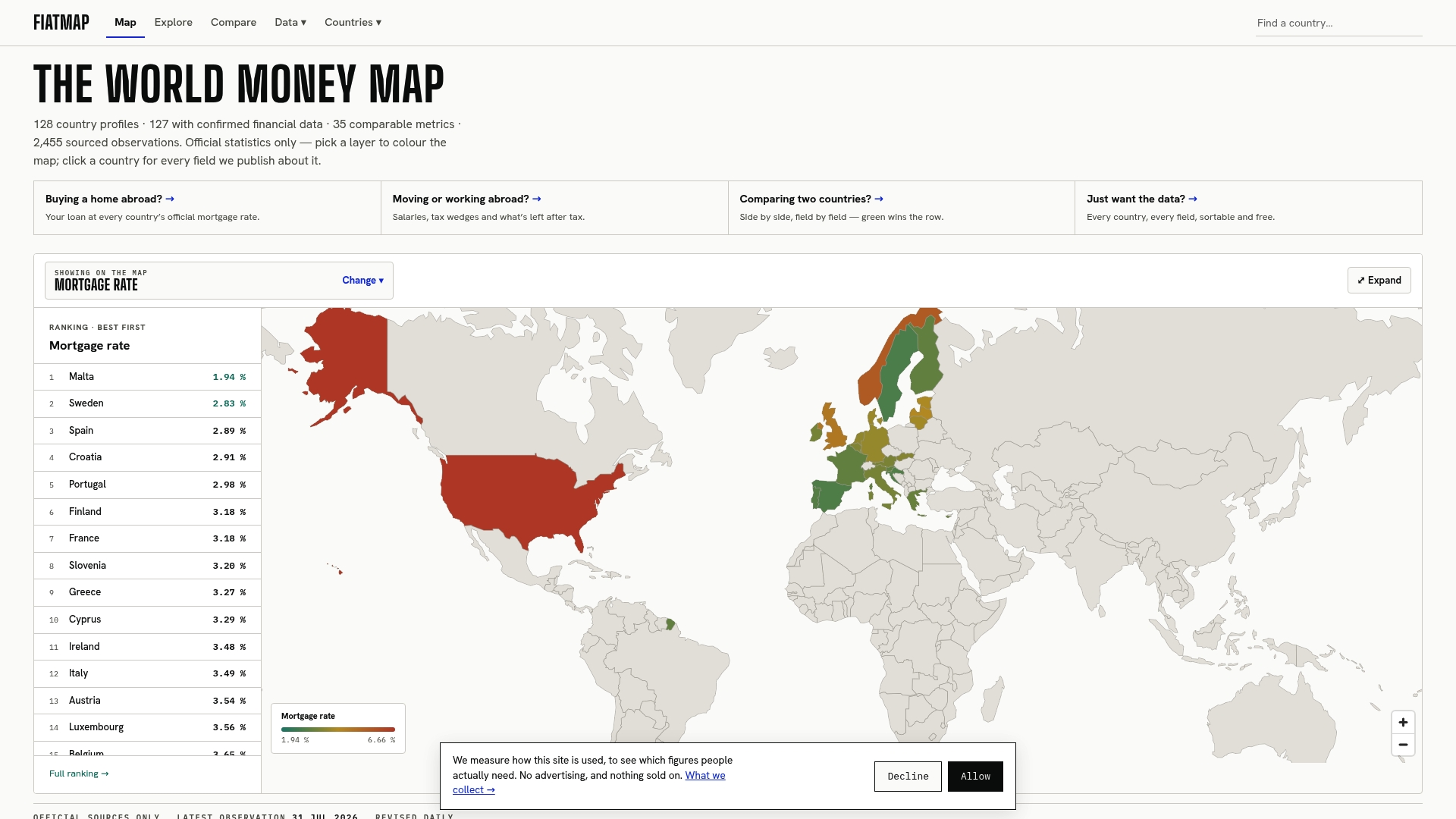
If you want the raw figures, the Fiatmap global money dataset is free, sourced and licensed CC BY 4.0, so you can pull it into your own spreadsheet. And for a story-style look at the problem, read the same mortgage at wildly different prices.
Our perspective
We built Fiatmap because country comparisons of money are scattered across dozens of official sites, each with its own definitions. After working with that data, our view is simple: the biggest error people make is comparing numbers that carry the same label but measure different things.
A lending rate in one country may be an average of new loans and in another an average of the whole loan stock. Without checking, a ranking can send you to the wrong conclusion. That is why we use official statistics only, and why we insist on showing the definition next to the number. You can browse the full picture on the lending rate map, and the plain-language macro glossary explains each term.
Our advice has three parts. Use country rates to narrow where to look, never to price a specific loan. Always ask for the APR or its local equivalent. And treat currency risk as a cost of its own, because no rate table includes it.
— Torstein
FAQ
Is a fee charged for borrowing money?
Often, yes. The CFPB says personal installment loans commonly carry fees such as origination, documentation and late charges in addition to interest, and some insurance products are generally optional. Ask for the APR and a written list of fees before you accept an offer.
How do you calculate the average cost of borrowing?
For a single loan, take the total interest and fees you will pay over the term and compare it to the amount borrowed, or use the APR, which folds in lender fees. For a country, official statistics usually give a volume-weighted average lending rate. Subtract inflation to see the real cost.
Can I borrow money abroad?
Usually it is possible, but eligibility depends on the lender, the loan type and your residency and income documents. Foreign residents may face fewer options or higher prices because lenders cannot always see their credit history. Currency risk is the extra cost to check first.
Why do loan interest rates differ so much by country?
Inflation, public debt and policy rates set the baseline. Bank operating costs, bad loans, competition and the strength of legal and credit-information systems then adjust it. Loan type, maturity and collateral change the figure again.
Sources
- CFPB: difference between a loan interest rate and the APR
- CFPB: do personal installment loans have fees
- Federal Reserve: Regulation Z, section 1026.4, finance charge
- World Bank: Bank Lending Rates and Spreads in EMDEs
- OECD: short-term interest rates
- ECB: composite cost of borrowing indicators
- IMF: Monetary and Financial Statistics interest rates dataset
- IMF: World Economic Outlook, October 2018, statistical appendix
- BIS: Villeroy de Galhau on monetary policy transmission
- BIS: Bernanke on housing, housing finance and monetary policy
- BIS working paper 1255
Recommended
The figures on this site are collected from official statistics and each carries its own source and date — see /sources and the dataset. Where this article states a number, the country and ranking pages are what it should agree with.